Showing posts with label darlington. Show all posts

Tuesday, May 11, 2021

May 9, 1970 - Darlington's Rebel 400

NASCAR began the second quarter of its 1970 Grand National division season with the Rebel 400 at Darlington on Saturday, May 9th. Because of state blue laws, Darlington's races were held for years on Saturday in the spring and Labor Day Monday in September for the Southern 500. 

The 1970 Rebel edition was the final one held on Saturday. A change in law or some sort of lobbying resulted in the 1971 race being scheduled for a Sunday. Darlington didn't host another Saturday Cup race until 2005 when their relocated Southern 500 was booked the day before Mother's Day for the better part of eight years.

Chargin' Charlie Glotzbach set a track record in winning the pole in his purple, winged Dodge Daytona. Bobby Allison timed second in another winged Daytona prepared by Mario Rossi. 

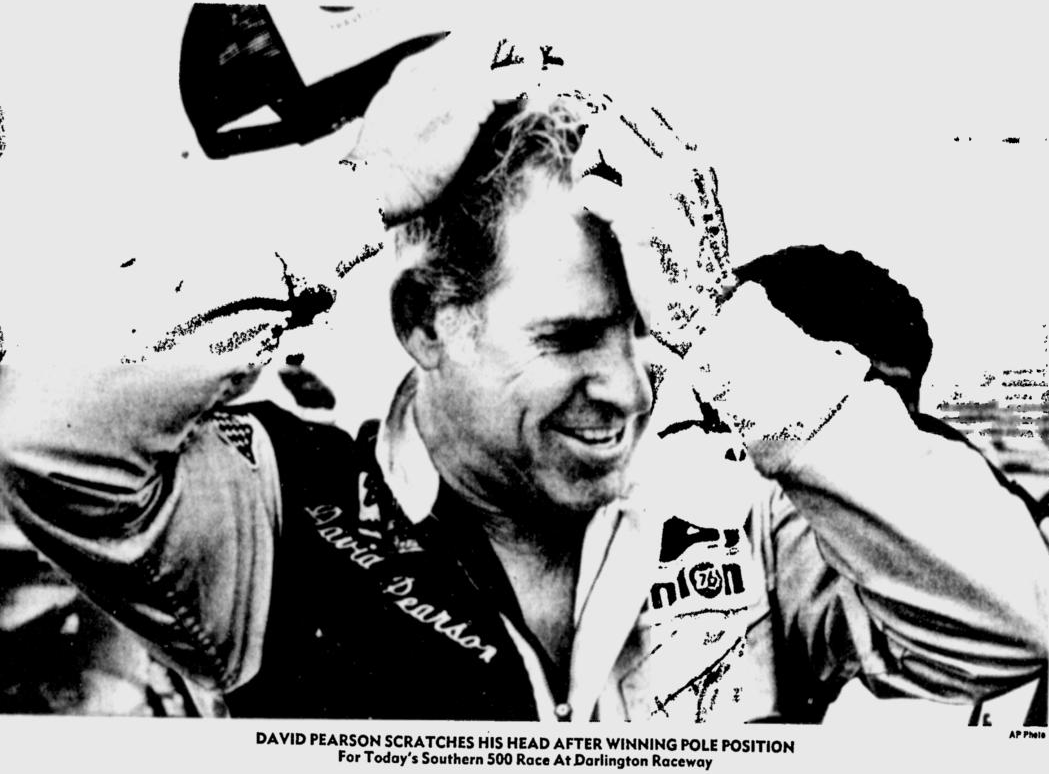
Defending and three-time NASCAR Grand National champion, David Pearson, qualified third. During practice prior to qualifying, Pearson clipped the wall four times. Crew chief Dick Hutcherson made several spring adjustments, and the changes helped as Pearson logged the third quickest lap without any additional misadventures with the fence. Nonetheless, the track's PA announcer had a bit of fun at Pearson's expense by introducing him to the crowd as David "Wall" Pearson.

Pearson was flanked by Pete Hamilton who was driving a second Plymouth entry for Petty Enterprises. After Hamilton's qualifying run, he commented candidly to reporter Bob Myers:
I honestly believe we are running too fast for this race track. In the fourth turn, we are headed straight for the wall coming out. There it is near impossible to avoid hitting the wall. - Charlotte News
Though Hamilton was in a second Petty team car, he had the only Petty Superbird in the race. His teammate, the King, qualified his Superbird seventh on the first day of time trials. After logging his lap, Petty returned to the track during a follow-up practice session. Just as Hamilton had observed, Petty lost the handle coming off turn four, popped the wall, sailed back across the track, and pounded the pit wall.

Source: Greenville News
Source: Charlotte News
The crew loaded the trashed Superbird, forfeited their starting spot, returned home to Level Cross, and readied the team's Plymouth Roadrunner short track car to qualify again the next day. After a quick night's work - likely with limited, if any, sleep - the team returned with its backup. The Roadrunner was plenty quick, and the King timed 12th - only five spots lower than his forfeited day one slot. Yet his weekend problems were far from over.

Glotzbach grabbed the lead at the drop of the green. After a few laps, Allison roared back by him to lead for over 50 laps. 


After the two Dodges led the first 60 laps, its factory cousin let it be known it wanted some prime time exposure. Hamilton's Superbird seized the lead for a couple of laps before teammate Petty put the Roadrunner out front. 

Allison, however, wasn't done. His red and gold Daytona returned to the point to lead a couple of stretches for another 30 laps or so. Near halfway though, the Dodge's Hemi could handle no more. Allison was done for the day, and he headed to the garage to join Glotzbach who'd also retired with engine issues about 10 laps earlier. After starting on the front row, Glotzbach and Allison ended their days by finishing 22nd and 20th, respectively.

Four laps after Allison's exit, Pete Hamilton spun and destroyed the Petty team's second Superbird in only a matter of days.

With Glotzbach's and Allison's winged Daytonas out of the race and Hamilton's wounded Bird loaded for the ride home, Petty's short-track Roadrunner suddenly became the stalwart Mopar on the track. The car was fairly sporty after having led a few laps. The 43 bunch just needed to wrap up the day and hope for better ones down the road.


About 25 laps after Hamilton's wreck, however, the Petty team's weekend devolved from bad to worse. Much worse. Similar to the wreck he experienced in the Superbird, the King destroyed a third team car with far more force and in the most spectacular fashion. As he did following qualifying, Petty pounded the wall coming off the fourth turn and drilled the pit wall. The force broke the cement wall and sent Petty's Roadrunner into a series of terrifying flips - right in front of the packed grandstands. 

The 43 crew, driver LeeRoy Yarbrough, Francis Allen (a Yarbrough crewman), and Glotzbach crewman Buck Brigance immediately broke into an all-out sprint to the car. Many fans and crew members feared the worst - especially when it seemed his body had come apart and ruptured blood onto the track. Though bad optically, it was several red shop rags that had flown out of the car. For much of his career, the King kept a wet rag in his mouth in an effort to help with hydration.

Though he was alive, the battered driver suffered a dislocated shoulder. The injury forced him to miss the next five races. The team skipped four short track races and fielded former team driver Jim Paschal in the World 600 at Charlotte.

After Petty's wreck, the race concluded with 100 caution-free laps. The final third featured great racing between factory rivals on the track but between drivers who were good friends off the track. Pearson in his Holman Moody Ford battled Bobby Isaac in the Harry Hyde-prepared Dodge Daytona. Each took turns leading sizable chunks of laps before the other went back out front.

With about 30 laps to go, however, Isaac drifted high with a cut tire. Pearson decided it was go-time and seized the moment. He eased by Isaac and led the remaining laps to capture his 58th career win. The victory was his second Rebel 400 win in three years after also capturing the 1968 Rebel 400

Though Petty spent the night in a hospital bed as his rival celebrated in victory lane, the King exhibited class as he always has. He called Pearson on Sunday morning to congratulate him on his win. 

Source: Charlotte Observer
TMC

Monday, May 10, 2021

May 11, 1968 - Darlington's Rebel 400

As NASCAR's Grand National division neared its one-third mark of the 1968 season, the teams arrived for the Rebel 400 at Darlington Raceway on a Saturday afternoon. Because of South Carolina's blue laws, races weren't held on Sundays for many years. The spring races were instead held on Saturday afternoons with the Southern 500 run on Monday, Labor Day each year.

Source: Motor Racing Programme Covers
To that point of the season, the wins had been pretty evenly distributed among a handful of drivers. David Pearson had won four races, Cale Yarborough and Richard Petty banked three trophies each, and Bobby Isaac had pocketed a couple of skins in his Dodge. 

In qualifying at Darlington, only Pearson was quick enough to start up front. Four Fords dominated the top five starting spots. LeeRoy Yarbrough won the pole in Junior Johnson's Ford followed by Pearson and his Holman Moody entry. Darel Dieringer in Mario Rossi's Plymouth split the two pair of top Ford starters. The Allison brothers, Bobby and Donnie, started fourth and fifth, respectively.

Curtis Turner started his first race in about eight months. He qualified eighth in Tom Friedken's Plymouth - generally a solid car that multiple drivers had raced. 

Despite the rust of being out of a race, Turner's natural talent never left him. He ran a decent pace and was in the top 10 much of the day. Engine failure about 40 laps from the end of the race, however, doomed him to P15 - a finish that could have been lower had it not been for the race's high attrition rate.

Pearson seized the lead at the drop of the green and retained it for 18 laps. Yarbrough then put Junior's Ford in the wind and led the next nine laps. Following Cale's stint, Buddy Baker reminded folks the Mopars had race strength even if it wasn't necessarily on display during qualifying. 

Baker eased by Pearson and Yarbrough and paced the field for 116 of the next 130 laps. His last long venture at the front came at the expense of Charlie Glotzbach, who recently passed away in April 2021. Glotzbach led eight laps in Cotton Owens' Dodge. As Baker closed on Glotzbach, however, Baker carried him high and into the guardrail. 

Baker rolled on to lead another stretch of 42 laps, but Glotzbach faded. He struggled to keep up in the laps to follow and finally fell out of the race with oil pressure problems about 30 laps later. 

As good a first half of the race as Baker had, the second half presented more of a challenge. Battling continual tire issues, he mustered only a fourth place finish despite leading a ton of laps early. 

The King hung tough with the leaders on a track that really challenged him throughout his career. His Hemi-powered Plymouth led 21 laps, but tire issues and pit miscues dropped him to a P3 finish. With about 40 laps to go, Petty hit pit road for his final stop. After returning to the track, his crew realized they had left off the gas cap. Petty hit pit road a second time to replace the cap - and then pitted a third time to change one of the new tires because of an inner liner problem. Though he finished on the lead lap, his opportunity to challenge for the lead went kaput.

With Glotzbach's Dodge out of the race, the tire issues with Baker's Dodge, engine woes for Turner's Plymouth, an underwhelming performance for Bobby Isaac's Harry Hyde-prepared Dodge, and a three-stop fail for Petty's Plymouth, the Mopar faithful were running low on remaining opportunities to capture a win. 

Third place starter Dieringer remained Plymouth's final hope. His owner and crew chief, Mario Rossi, nervously burned through a gaggle of cigarettes as he watched his driver stalk the leader. In the end, however, Dieringer led zero laps en route to a second place finish. Though disappointed with P2, Dieringer was pleased as he seemed to have recovered from his health woes resulting from exhaust inhalation (and likely carbon monoxide poisoning) at Bristol several weeks earlier.

Pearson - the only driver to lead more laps than Baker - calmly waited as other drivers seemed to self destruct one by one. He and crew chief Dick Hutcherson made a pre-race decision to run a smaller engine with less car weight rather than a larger engine and heavier car favored by others in the field. The decision resulted in a solid balance between horsepower and handling.

After Petty had his ill-fated stop, Pearson led the rest of the way and won his 35th career race by a comfortable margin over Dieringer. The victory was his first of what ultimately became ten career GN/Cup wins at Darlington.

And though he'd won the previous week at Asheville-Weaverville and three others earlier in the season, his Darlington victory was his first superspeedway win since the 1961 Dixie 400 at Atlanta. To celebrate the win, he fired up a lung dart before the car even came to a stop for his interview with ABC's Wide World of Sports.

Pearson never lacked for confidence during his driving career; however, he also believed in his fair share of superstitions. Racers always embrace luck in whatever form they can get it. In Pearson's case, his 1968 win total to-date of five races may have been aided by the presence of his middle son Ricky. At Darlington, Asheville-Weaverville, and North Wilkesboro - Pearson's three most recent wins - Ricky was in attendance. 

Pearson's oldest son and future two-time NASCAR Busch Series champion, Larry, became a bit envious of his younger brother getting to see all of the wins. So Daddy Pearson made sure Larry was there with Ricky at Darlington to double the luck, and sure enough the trio got to enjoy victory lane together.

As a side note, Lennie Waldo finished 18th in his first of four career GN starts. The late model racer drove for owner Elmer Buxton who fielded cars in nine races - the last four with Waldo. It's possible NASCAR has not seen a better pairing of two perfect racing names. I now have a sudden urge to go watch Shawshank Redemption for the gazillionth time.

Source: Charlotte Observer
TMC

Thursday, April 15, 2021

April 15, 1973 - Darlington's Rebel 500

The eighth race of the 1973 NASCAR Winston Cup season was the Rebel 500 at South Carolina's Darlington Raceway. What better way than to race on tax day! (Cue the tax accountants: Technically, the filing day would likely have been extended to Monday, April 16th because of the weekend. ENOUGH!)

Source: Motor Racing Programme Covers
After a dozen years or so of being known first as the Rebel 300 and then the Rebel 400, the race distance was extended for the first time to 500 miles to match the length of the traditional Labor Day weekend Southern 500.

Though the race distance was extended 100 miles, the track length remained the same. And David Pearson knew how to navigate it. He won the pole in the Wood Brothers' Purolator Mercury just as he'd done in his debut with the team a year earlier. 

Pearson's top speed extended the roll he was on in the early part of the 1973 season. The Wood Brothers team skipped the short tracks at Richmond, Bristol, and North Wilkesboro. But Pearson and the 21 bunch won the previous two races they'd entered at Rockingham and Atlanta.

Cale Yarborough - another Darlington master - qualified second. The Three B's - Bobby Allison, Bobby Isaac, and Buddy Baker - rounded out the top five starters. (Tax accountants return: Technically, we counted eight B's. SHUT UP, Green Shades!)

Forty cars took the green that Sunday afternoon. Four hours later, however, attrition thinned the finishers to about a third of that number. It wasn't the extra 74 laps that did 'em in as more than half the field DNF'd well before the 400-mile mark.

Engines failed on many cars, but others retired early from accidents - some from driver errors according to those caught up in the accidents or near them. 

It didn't take long for the action to begin. Pearson seized the lead at the start. On lap three, however, Dave Marcis collided with Rookie of the Year candidate Lennie Pond. Marcis got the worst end of the deal and finished dead last as Pond continued.

Pond had more issues later in the race. Though he started second, Yarborough never led a lap. He tangled with Pond near lap 40, and Pond's second incident put his Chevy on the trailer. Cale kept a'goin, but a blown engine about three-quarters of the way through the race sent him to his nearby home with a 19th place finish.

For the first half of the race, fans witnessed a number of different leaders. Pearson, Allison, Richard Petty, Benny Parsons, and rookie Darrell Waltrip all had opportunities at the front. 
  • As happened with Cale, however, the engine in Waltrip's brown Mercury laid down sending him back to Tennessee with a P24 in his Darlington debut. 
  • Petty settled from the lead back into a top five pace; however, the quick pace eventually put him down a couple of laps - with more problems yet to come.
  • Parsons ran a pace similar to Petty, contributed to Petty's problems, yet salvaged a good points day.
Allison's self-owned Coke Machine was the only one who could consistently keep pace with Pearson - at least through the first half. Once the second act began, however, it was all Pearson and in a big sort of way.

As was often the case at Darlington, Pearson and the Woods found a remarkable balance of speed, handling, and smoothness in banking lap after lap. For the 15 or so cars remaining on the track, seeing the 21 Mercury lap them time and again may have been equally as painful as loading early. Pearson's run was so dominant that many fans also DNF'd as they headed for the exits. (Tax accountants: What true fan leaves a race early? You never know what might happen. YOU AGA...? Oh OK, finally you make a fair point.)

Those already on the road missed the last couple rounds of drama. First, Allison's Chevy started smoking with about 25 laps to go - all but gift wrapping the presumed win for Pearson. And then The Big One unfolded a couple of laps later. 

Virginia's Buddy Arrington, though laps down, was in the racing groove. He prevented Parsons from getting by - as Petty quickly closed the gap to Parsons. Petty and Parsons remained in the hunt for a top five, and Arrington factored into which one would get the differential pay for the day.

Arrington finally took the hint and moved to the inside. He did so, however, about the same as Parsons had seen enough and dropped to the inside as well. As Parsons popped his brakes to avoid Arrington, Petty plowed into Benny who then pinballed into Arrington anyway. Arrington was turned headfirst into the wall as Petty t-boned him on the right side. Parsons squirted by the two of them and stumbled on the track apron the rest of the way, but Roy Mayne and Dick Brooks joined the fray to really make a mess of things.

As the race concluded, Pearson took the checkers to go back-to-back in the Rebel. Despite his slow crawl, Parsons survived the day for a P2. The effort paid dividends in November 1973 when he captured the Winston Cup title by a scant few points. Allison's car could go no more as the final green waved. Despite pulling off the track with a blown engine and DNF, Allison still managed to finish third. Two independents - Richard Childress and J.D. McDuffie - survived the wrecks, kept their cars in one piece, and had career days by finishing third and fourth, respectively. As crazy as it sounds, Petty had already showered and dressed before learning he still managed to finish seventh.

Pearson earned his 69th career Cup trophy with a 13 lap - THIRTEEN - win over second place Parsons. The margin of victory may be topped as the worst Cup beatdown only by Ned Jarrett's 14-lap win in the 1965 Southern 500.

 
Source: Charlotte News
TMC

Tuesday, April 13, 2021

April 13, 1980 - Darlington's Rebel 500

Following a pit stop during the 1979 CRC Chemicals Rebel 500, the wheels fell off David Pearson's car. Because of a miscommunication, Pearson thought the Wood Brothers planned to change two tires whereas the crew actually planned a four-tire stop and removed the left side lugnuts. 

Pearson parted ways with the Woods a few days after Darlington - a reality few could envision. As it turns out, the wheels had apparently begun to also fall off the driver-team relationship well before the embarrassing incident at Darlington.

A year later, Pearson found himself on the positive side of a driver change. Car owner Hoss Ellington began 1980 with Donnie Allison as his driver for a fifth part-time season. After only three races, however, Allison was released with Pearson hired as his replacement. 

Source: Raleigh News and Observer
 The first race for the new combo was at Darlington - a track on which Pearson flourished and one where Ellington's cars had never won.

Source: Motor Racing Programme Covers
Benny Parson captured the pole, and Pearson slotted second in his new ride. Three-time and reigning Cup champion Cale Yarborough, Ricky Rudd in D.K. Ulrich's independent effort, and 1979 NASCAR Winston Cup Rookie of the Year Dale Earnhardt rounded out the top five starters.

The race started as a bit of a cluster fudddggge. As the cars barreled into turn 1 of the first lap, seventh-place starting Richard Petty and Rudd made a move for the same real estate. And it didn't go well.

Source: Raleigh News and Observer
The tangle quickly ensnared second year driver Terry Labonte, Buddy Baker, James Hylton, and Neil Bonnett. All but Bonnett continued though Baker fell by the wayside seven laps later. Bonnett's DNF sent him home dead last. It was quite the coincidence since he was the driver to replace Pearson in the Wood Brothers Mercury a year earlier.

Source: Charlotte Observer
Following the clean-up on aisle four, Pearson got the jump on Parsons and led the first dozen laps. Earnhardt - a driver who eventually developed a mastery of Darlington nearly on par with Pearson - passed the Silver Fox to lead 14 laps of his own.

Drivers then and now will chirp - and rightfully so - that a race is won on the last lap and not the first one. During the 1980 Rebel 500, however, the drivers had a greater urgency to get to the front. Alll anticipated they'd likely be racing to halfway vs. the full distance for the win because of the threat of rain.

With dark skies and low clouds, Earnhardt, Parsons, Pearson, Waltrip, and Yarborough battled to get to the point. Once there, the next goal was to stay there as the rain loomed nearby. 

Sure enough, the moisture arrived near lap 90. After a few laps under caution, however, the race returned to green as the rain dissipated. Yet a few laps later, Mother Nature chuckled as she delayed the race once more. Again, NASCAR bowed up, waited it out, and restarted the race after only a few more laps under yellow. 

Then She reminded Bill France, Jr. that he only thought he was in charge on race day. Heavy rains began to pour, and the race went under the red flag. After more than two hours, however, the track caught a break. The showers moved out of the area, track drying began, and drivers returned to their steeds. 

As the green was unfurled, the new reality was darkness would determine the length of the race - particularly since DST was still two weeks away. 

Earnhardt lost the engine in his Rod Osterlund Chevy shortly after the race restarted. Yarborough made his way back to the front around lap 120 before fading and having his day doomed by the same fate as Earnhardt. 

With daylight fading, the race became a battle of the top two starters: Parsons and Pearson. Waltrip made it interesting by leading a few laps of his own, but he couldn't hang and eventually finished P4.

Pearson got back by Parsons on lap 158 and led an additional 30+ laps before NASCAR finally displayed the checkered flag. The rain and darkness resulted in the drivers completing only 189 of the scheduled 367 laps - just a few laps beyond halfway.

Few could have anticipated it at the time, but the win turned out to be the 105th and final career Cup win for the Silver Fox. Fittingly, his final win came at Darlington. AND he doubled-up after narrowily edging fellow Cup racer Dave Marcis the day before in the late model sportsman (pre-Xfinity Series) race. 

Audio of Universal Racing Network's radio broadcast of the race is available on Appalachian State's library website

Source: Raleigh News and Observer
TMC

Sunday, April 11, 2021

April 11, 1976: Darlington's Rebel 500

The eighth race of NASCAR's 1976 Winston Cup Series schedule was the Rebel 500 at Darlington Raceway.

Though the season was seven races old, the story to that point was the Wood Brothers team with David Pearson. The team entered only four of the first seven races, yet Pearson won three of the four at Riverside, the Daytona 500, and Atlanta. Pearson arrived in Darlington having also won three of the past four Rebel 500 races.

Richard Petty, grew a beard in conjunction with the year-long celebration of the United States' bicentennial. After growing and showing in the legendary finish of the '76 Daytona 500 with Pearson and in victory lane two weeks later at Rockingham, The King caved and shaved during the week before Darlington.

To the surprise of ... well, no one actually, Pearson won the pole. He won it for the third consecutive Darlington race and the fourth of the five previous Rebel races. Bobby Allison, the winner of both of Darlington's races in 1975, timed alongside Pearson in Roger Penske's CAM2 Mercury.

Fans were treated to a great race from the jump. Pearson led the first lap but was soon passed by Allison. Pearson battled back a couple of laps later to regain the lead, but his time there was once again short lived. 

Others soon battled past Pearson and Allison to take their own turns at the point. Buddy Baker, Donnie Allison, Lennie Pond, Darrell Waltrip, Dave Marcis, Benny Parsons, Cale Yarborough and Petty all muscled their way to join Pearson and Bobby Allison at the front at some point during the first two-thirds of the race. Throughout the day, fans witnessed 32 lead changes - a stat generally expected at other tracks such as Daytona or Talladega.

The race featured a couple of brutal accidents - though fortunately none of the drivers involved were seriously injured. Shortly past the 80th lap, independent racer James Hylton spun and was clipped by Buddy Baker. As Hylton's car swapped ends, Waltrip had nowhere to go and drilled the nose of Hylton's 48 hard enough to launch his Gatorade Chevy a bit. Both were done for the day. 

Early leader Bobby Allison also nicked Hylton. He was able to continue but was no longer competitive. Baker damaged the nose and hood of his Bud Moore Ford, but the team made some battlefield repairs that allowed the car to remain competitive the rest of the way.

About a hundred laps later, Jerry Sisco lost it coming off turn four. He popped the outside wall along the front straightway, crossed the track near the flag stand, drilled the inside pit wall, and came to a stop as flames began to emerge from the car.

Credit: Gerald Medford
Sisco's car came to rest near the Petty pit stall. Crew chief Dale Inman and crewman (and future crew chief) Barry Dodson instinctively rushed to Sisco's aid. They leapt the pit wall and pulled Sisco to safety before rescue crews arrived.

Credit: Don Hunter / Smyle Media
Sisco, the brother of Cup racer and 1969 Nashville late model sportsman champion Dave Sisco, had only three Cup starts on his resume prior to Darlington. With the hit and near miss, his Cup days ended after his fourth one. 

Though Sisco did not return to NASCAR, his racing days continued. He returned in the early 1980s to race in the Grand American Division at Nashville's Fairgrounds Speedway. Sterling Marlin's streak of consecutive track championships ended at three when Sisco won the title himself in 1983. He was later inducted into Nashville's Hall of Fame in 2012.

Car owner Wayne Day, Nashville PR Director Tom Roberts, and
1983 Grand American track champion Jerry Sisco
Source: Tom Roberts
By the time the race reached it's final 100 laps, the Track Too Tough To Tame had taken its toll on many. Ol' DW was nursing some bruises from his tough hit on James Hylton. Bobby Allison hung in as best he could after also tangling with Hylton. Cale Yarborough's engine failed around lap 170, and Richard Petty's Dodge suffered the same fate about 30 laps later.

Buddy Baker, however, was still up on the wheel. Despite the damage suffered in the Hylton crash, he remained in the hunt. He and Pearson swapped the lead several times in the second half of the race - with Baker leading most of them. 

With about 20 laps, Parsons looped his car to bring out the final caution of the day. At the time of the yellow, Baker had once again gone to the front, led a sizable chunk of laps, and gapped second place running Pearson a bit. 

As the race returned to green, Pearson had a renewed opportunity. With about 10 to go, he eased the Purolator Mercury past Baker's Ford and continued to win yet another time at Darlington. Though Baker wasn't happy with P2, he had to be pleased at leading over 200 of the race's 367 laps - most of them with a damaged car.

Pearson's 91st career win was also his sixth at Darlington and fourth of the past five Rebel races.
 

Source: Charlotte Observer
TMC

Wednesday, April 7, 2021

April 7, 1974 - Darlington's Rebel 500

NASCAR's seventh race of its 1974 season was the Rebel 500 at Darlington Raceway - except it wasn't.

Source: Motor Racing Programme Covers
As was the case for about the first half of the 1974 season, NASCAR trimmed its race distances by 10 percent in response to the US energy crisis. Darlington's spring race, therefore, was only 450  miles - though it remained billed as the Rebel 500. 

Donnie Allison captured the pole in a DiGard Chevy recently purchased from Banjo Matthews. The pole was his second in three races after also starting first at Bristol. Donnie's top spot was a mild surprise as he bumped David Pearson to the second spot in the legendary Wood Brothers Mercury. Pearson had won the pole in three of the past four Darlington races - including both races in 1973.

Bobby Allison and Buddy Baker comprised the second row, and Dave Marcis completed the top five starters in Roger Penske's AMC Matador.

Richard Petty timed tenth - not the best starting spot but certainly not the worst. Hershel McGriff entered the race in a second Petty Enterprises-prepared Dodge Charger. McGriff raced in Darlington's first race in 1950. After a couple of days of practice that didn't yield the speed needed to be competitive, the team withdrew from the race without making a legit qualifying run. 

The Allison brothers tag-teamed to lead the first 25 laps. Pearson soon rose to the occasion to pocket 25 laps of his own out front. Baker banked about 15 laps for himself as the race neared its one-third mark.

The race featured three pretty frightening accidents. Around lap 60, 1973 Winston Cup Champion Benny Parsons spun and was drilled by Bobby Isaac. Fortunately, neither were injured.

The second major incident happened about 60 laps later when journeyman racer Johnny Barnes lost an engine. James Hylton hammered Barnes in the driver's side door. After being briefly knocked out, Barnes was treated and released from a nearby hospital without any serious injuries. Just rub some dirt on that noggin, son. It'll be a'ight. 

The third major accident occurred around lap 215 when Lennie Pond, the 1973 Rookie of the Year, blew an engine and wiped out about 20 feet of guardrail including six fence posts. Pond was OK, but NASCAR red-flagged the race for about 40 minutes as safety crews made repairs to the railing.

After the three major hits, Joe Frasson brought a good bit of levity to everyone as the red flag was lifted. The long-time independent racer made a beeline for Pearson's #21 Mercury rather than return to his own car. Pearson had to wrangle the sizable Frasson from his seat so everyone could return to racing action.

The second half of the race featured great racing action between the Allison brothers, Buddy Baker, and Pearson. Though they raced for different teams and manufacturers, the one thing they had in common - at least the Allisons and Pearson - was a smaller engine. 

As Detroit's engines changed in passenger cars, NASCAR began a similar transition. Dodge racers such as Petty and Baker continued to race the famed Hemi engine. NASCAR, however, mandated the engines be fitted with a restrictor plate. The Allisons and Pearson; however, raced with smaller cubic-inch engines - but without a plate. It became apparent the smaller, unrestricted engine - along with less nose weight - made a big difference.

Though Petty's Hemi had been a powerful beast for 10 years, it gave up the ghost just past the race's two-thirds mark.

With 50 laps to go, Donnie Allison and Baker faded a bit. The battle narrowed to just Bobby Allison and Pearson. Each took a turn leading a double-digit number of laps before the other returned - all as both managed their fuel mileage. Pearson re-assumed the lead for the final time with 11 laps to go when Bobby's engine sputtered a bit as he sought every last fuel drop. Allison barely held onto P2 as Baker charged hard in a failed effort to pass him for the position.

Pearson's 78th career win was also his third Rebel win in a row and fourth in five years.

Audio of Universal Racing Network's radio broadcast of the race is available on Appalachian State's library website

Source: Sumter Daily Item

TMC

Wednesday, September 6, 2017

September 6, 1971 - Southern 500

Winston cigarettes became the title sponsor of NASCAR's top series in 1971. Because of the timing of the contract, the 1971 schedule was left largely "as is" with 48 races. Many races - primarily short tracks - were cut from the schedule as the modern era, as most refer to it, began in 1972 with 31 races.

In the first year of the Winston Cup Series, the traditional, Labor Day Southern 500 was held on Monday, September 6. The race was the 40th of the 48-race season.

Source: Motor Racing Programme Covers
A legit but convenient way for many to quickly highlight Richard Petty's career is to recall 1967 when the King won 27 of 48 races. A seldom quoted stat is his 1971 season which statistically was his second best career year. Through 39 races leading into the Southern 500, Petty had banked 17 wins, 30 top five finishes, nine poles, and his third Daytona 500.

Despite those gaudy stats, Darlington was a track often too tough to tame for Petty. He generally raced well at Darlington, and he won three times in 1966-1967. But his overall winning percentage didn't apply at Darlington. Yet he was in as good a position as he'd been in some time to win the '71 edition of the Southern 500.

Petty as a favorite was a storyline of the race; however, another one centered on a popular driver suddenly involved in a bit of Silly Season. Fred Lorenzen was a winning driver from the early through mid 60s and was always a Ford man. He then walked away unexpectedly in 1967. Lorenzen returned for a a handful of races in 1970 before signing a deal with STP to race Ray Nichels' Plymouth in 1971.

The #99 Plymouth car was sharp looking, and Lorenzen earned a top 5 finish in about half of his 13 starts prior to Darlington. But Lorenzen also complained the car wasn't where it needed to be. He quit Nichels' team after the Talladega 500 in late August - though technically he remained under contract with STP.

Interestingly, STP allowed him to step away from their sponsorship for one race - the Southern 500 - to race the Wood Brothers' famed #21 Purolator Mercury. The Woods' regular driver in 1971, Donnie Allison, had to skip the Southern 500 because of a commitment to race in the California 500 Indy car race at Ontario Motor Speedway the day before Darlington.

Source: Spartanburg Herald via Google News Archive
Credit: Wood Brothers Racing
STP didn't want to leave Nichels without sponsorship after Lorenzen's departure. Dave Marcis was hired to pilot the #99 Plymouth for Darlington for what was supposed to be a one-time deal.

Lorenzen's second career race attempt with the Wood Brothers went horribly wrong in pre-qualifying practice. He pounded the outside wall of the frontstretch, rode the outside wall, sailed off the wall, and then made a beeline to drill the inside pit wall. In doing so, his #21 Mercury tore a chunk out of the pit wall reminiscent of Richard Petty's hit a year earlier in the Rebel 400.

Lorenzen was knocked cold and had to dragged out of his smoldering car by drivers Joe Frasson and Bill Seifert rather than track emergency personnel. He wasn't critically injured and returned three races later (coincidentally in a reunion with Nichels), but he and the Woods were done for the weekend.

Source: Spartanburg Herald
The Wood Brothers loaded up their destroyed car and headed home to Stuart, Virginia. As a result of Lorenzen's wreck, Glen, Leonard, and Delano missed their first Southern 500 since 1962. The possibility existed the Woods may not race again. Glen was frustrated with many of NASCAR's quickly shifting rules and was shaken by Lorenzen's wreck.

Racing can often be brutally cold when a bad wreck happens because the show always continues. Qualifying was held after practice, and Bobby Allison won the pole in his Coca-Cola, Holman Moody Mercury. Pete Hamilton lined up outside of Allison in Cotton Owens' Plymouth. Charlie Glotzbach timed third, and Buddy Baker qualified fourth in the #11 Petty Enterprises factory-supported Dodge. Marcis locked in the fifth starting spot in Nichels' Plymouth.

Actor James Brolin was the race's grand marshal and a judge at the annual Miss Southern 500 pageant.

At the time, Brolin was known for his role on the TV show Marcus Welby MD. He had a few other minor roles over his acting career. Brolin is perhaps best known, however, for his scintillating role as Pee Wee Herman in the movie Pee Wee's Big Adventure.

When the green dropped, the race developed into one of high attrition and few lap leaders. Bobby Allison led 65 of the first 90 laps with Bobby Isaac leading a stretch of 24 laps to break Allison's lead time out front into two segments. Petty took the lead for a few laps before Allison again went to the point for nearly 200 of the race's next 210 laps.

Pete Hamilton, who started second, fell out of the race after completing 157 laps after his Plymouth's engine developed an overheating issue. He immediately went to Petty's pit to see if his employer from 1970 might need a relief driver. Petty waved him off at the next stop and went the distance. Isaac, however, was gassed and did need the help.

Dick Brooks was truly the yeoman of the race by driving three different ride and three different brands of cars. His own Pontiac was done after only eight laps because of overheating. A bit later, he was asked to relieve Bill Dennis in Junie Donlavey's #90 Mercury. That ride made it to around lap 265 before it lost power because of a failed battery.

Brooks then took over for country singer and part-time racer Marty Robbins. He helped Robbins' Dodge finish 7th - a career best at the time for Robbins and topped later only by a 5th place finish in 1974. Marty was pleased as punch at the finish. He was also voted rookie of the race - which is interesting considering he only raced about three-quarters of the race before turning the car over to Brooks.

Petty hounded Allison as the Coke Machine led lap after lap. After turning down Hamilton's offer to spell him, Petty's exhaustion began to set in a bit. With 50+ laps to go, Petty simply had to have a drink of water to continue. He hit pit road with the expectation of having a cup quickly shoved to him. Instead, the Petty crew had a mix-up on what was to happen. A crewman spun off the fuel cap in anticipation of adding gas. Petty took off with his cup of water - but also with his fuel cap dangling from its tether.

The King had to make a second unscheduled stop to replace the cap, and the race was then effectively over. Petty admitted he likely would not have been able to catch Allison - even without the botched stop for water.

Embed from Getty Images

Baker - winner of the 1970 Southern 500 for Cotton Owens and the spring 1971 Rebel 400 for the Pettys - finished third. Isaac's #71 Dodge finished fourth with Hamilton at the wheel, and Marcis wheeled Nichels' STP Plymouth to fifth.

The race was the 25th of 51 times rivals Petty and Allison finished in the top two spots. Allison won his first of an eventual four career Southern 500 races. Petty also finished second in 1975 when Allison captured his third Southern 500.


Source: Spartanburg Herald
After going home, cooling off, and rethinking things following their awful Darlington trip, the Wood Brothers agreed to continue doing what the Wood Brothers do: race. When the teams arrived in Martinsville later in September, the famed 21 Mercury was there with Donnie Allison at the wheel.

Two races after Darlington in the National 500 at Charlotte, Marcis was back in Nichels' STP Pontiac. But after a heated argument with the crew over handling and tires, Marcis parked the car and quit the team.

Three races after Darlington at Dover, Lorenzen was back at the wheel of the STP Plymouth. Once again, however, Lorenzen's day ended early, and he again parted ways with the team.

TMC

September 6, 1982 - Southern 500

The 1982 Southern 500 was the 22nd race of a 30-race Winston Cup season, and was the next-to-last Southern 500 held on Monday - true Labor Day.

The season's points battle was shaping up as a repeat of 1981. Bobby Allison and Darrell Waltrip were again pushing one another week to week, race to race. Terry Labonte, three years removed from his rookie season, was thick in the mix as well. But on a pleasantly warm, late summer day at Darlington in September 1982, the three of them took a backseat to a few other legends of the era.

Source: Motor Racing Programme Covers
As shown above, the Wood Brothers were featured on the program cover along with their driver Neil Bonnett. Throughout the 1970s, the Woods' 21 Mercury frequently won the pole with David Pearson. The two parted ways in 1979, and Pearson raced only in selected Cup races afterwards.

But the Silver Fox never forgot his way around Darlington. Sure enough, in a Bobby Hawkins-owned, Chattanooga Chew-sponsored #03 Buick, Pearson again won the pole. The top spot was Pearson's last career pole and his twelfth at Darlington.

Source: Spartanburg Herald Journal
Waltrip and Allison kept each other in sight and were both quick in qualifying. Waltrip lined up alongside Pearson, and Allison started third. Joe Ruttman and Dale Earnhardt in Bud Moore's Ford rounded out the top 5 starters.

Miss Cathy Lee Knauss won the traditional Miss Southern 500 pageant held before each year's race. Though it's uncertain that she was related to Chad Knauss, rumor has it she asked for a rules interpretation for the talent and swimsuit components of the contest.

Source: Sumter Daily Item via Google News Archive
Kyle Petty qualified 24th in Hoss Ellington's STP/UNO Chevrolet. The Southern 500 was the only time Hoss fielded a Chevy in 1982 for Kyle or any of his other drivers that year (Benny Parsons, Donnie Allison, and Buddy Baker). One is led to wonder if Hoss leased the car from another team to see if it would race better than the other cars he'd used that year.

Kyle raced a Chevrolet for Petty Enterprises in 1979-80. After NASCAR reduced the Cup wheelbase to 110 inches in 1981, however, Kyle raced a Chevy only two times during the remainder of his career. The first time was the 1982 Darlington race, and the other was in a Monte Carlo borrowed from Hendrick Motorsports as a backup for the 1989 Coke 600 at Charlotte.

Kyle's day was about on par with his other starts with Ellington: average. After qualifying poorly, he got caught up in an early caution with independent driver Tommy Gale. The #1 Chevy returned to race to the credit of Kyle and the crew, and Kyle salvaged a 14th place finish - the best of his six starts for Ellington.

TMC Archives
When the green dropped, the field sailed off into turn 1 with Pearson taking the early lead. Down the backstretch (Darlington's frontstretch today), Allison dropped low with the plan of taking the lead. But Pearson held his line, and Allison lost a bit of ground as he fell back a few car lengths.

A couple of laps later, however, Allison made his pass on Pearson to take the lead. Waltrip followed suite and went with Allison. Richard Petty soon came from his eighth starting spot to take the lead. And on it went for the first 20 percent or so of the race: Allison, Petty, Pearson, and Tim Richmond.

During the first caution, an oil line broke on rookie Mark Martin's Buick. The oil ignited, and flames erupted immediately under the car and from under the hood.

Source: Chicago Tribune
Martin's first Southern 500 was certainly spectacular and memorable but perhaps more because of his perseverance than the fire. He stopped the car right away, he was pulled from the car, the flames were extinguished, and the car was towed to the garage. Martin's crew thrashed on it, and he re-entered the race to earn a 22nd place finish - the final car still running at the end.

Near lap 80, Pearson's plan of winning at Darlington yet again ended. His Buick broke an axle, and he was done for the day. Labonte, who entered the race second in points, followed Pearson to the trailer 40 laps later when his #44 Buick lost an engine and popped the wall. After Waltrip led several more laps at different stages, he too lost an engine and exited at lap 241.

With DNFs by Labonte and Waltrip, Allison had the opportunity to open a wider points gap. Instead, his 88 Gatorade Buick had issues of its own. He finished the race - but 40 laps down and only a few spots ahead of Waltrip in the final standings.

Over the final 30 laps, the race turned into a three-car battle between Earnhardt, Richard Petty, and Yarborough. Throughout his career, Petty had a reputation as a smooth driver. He could flat dominate a race or perhaps outlast the competition to seize a victory near the end of the race.

But having not won at Darlington in 15 years nor at all in about a year, the King displayed a new personality. Petty's Pontiac dogged Cale in the remaining laps. He leaned on him in the corners - wisps of tire smoke rising from between the two cars.

Source: Sumter Daily Item
With 12 to go, Petty stuck his car to the inside, fought his Grand Prix as the rear drift into Cale's Buick, stood on the gas, and took the lead. As he did so, Earnhardt watched from third and had a thought about taking the leaders three-wide. Instead, he cracked just a moment and watched as the two titans settled it between themselves.

From TMC Archives
Four laps later, Cale went back to the point. As Petty worked through his plan to set up Cale once again for the lead - and the win, the two came upon a couple of lapped cars. Both times, the King threaded the needle, nicked the inside slower car, bounced off Cale, and kept his foot in it.

But time ran out. Cale was able to maintain the lead and gapped Petty a bit as King managed his swerving car and worn out tires. Yarborough breezed across the finish time to claim his fifth Southern 500 win with Petty a close second. The race was the 31st and final time Petty and Yarborough finished in the top two spots.


The win was Cale's third of the year with owner M.C. Anderson and fifth over two limited seasons. Anderson had a desire to return to full-time Cup racing as he had in 1979 and 1980. Yarborough was committed, however, to sticking to his new career path of running only selected events.

As a result, Anderson stepped away from NASCAR altogether and sold his team to drag racer Raymond Beadle. Yarborough moved to Ranier Racing in 1983 and promptly won the Daytona 500. Beadle re-branded his newly acquired team Blue Max Racing and hired raw talent Tim Richmond.

TMC