Showing posts with label tim richmond. Show all posts

Tuesday, July 25, 2017

July 25, 1982 - Mountain Dew 500

NASCAR's 1981 season saw a ton of change.
  • A reduction in the wheelbase of Cup cars to 110 inches. 
  • A non-aero friendly notchback rear window on all but one model.
  • Several notable driver / team changes including Darrell Waltrip from DiGard to Junior Johnson, Cale Yarborough from Junior's team to M.C. Anderson, and Bobby Allison from Bud Moore to Ranier Racing.
It took several races before most teams adapted to their new teams and cars. One team that seemed to gel right away, however, was Waltrip and his new Mountain Dew Buick team. The team banked a dozen wins and Waltrip's first title in 1981. 

Another team that fared pretty well without a driver change was Richard Petty. The King banked three wins in 1981 - the Daytona 500 plus wins at North Wilkesboro and Michigan.

When 1982 arrived, Waltrip still had his mojo. With two-thirds of the season in the books, Waltrip and Junior's team had piled up another gaudy six wins. Allison left Ranier after one season and moved to DiGard - the team vacated by Waltrip when he joined Junior Johnson in 1981 - and notched four wins by mid-season. Petty's STP team, meanwhile, was scratching his head as he fought through a winless dry spell dating back to August 1981..

After Waltrip won the Busch Nashville 420 on his home track, the NASCAR circuit headed for Pocono. Next on the schedule was, perhaps fittingly for DW, the Mountain Dew 500.

Cale Yarborough scored the pole in his #27 Valvoline Buick. Harry Gant qualified alongside him in the Skoal Bandit Buick. Ricky Rudd lined up third in his #3 Richard Childress Racing Pontiac. (Yes, RUDD in the #3 folks.) Allison started fourth in the Gatorade Buick.

Kyle Petty started 17th in Hoss Ellington's #1 STP/UNO Buick. Today, Kyle is a retired driver and an NBC commentator. In his second season as a full-time Cup driver in 1982, however, he still struggled to keep a toehold in Cup. The finances in Level Cross were stretched then in an effort to field two full-time cars.

At mid-season, the team announced a novel alternative. Kyle would continue to race short-track races for the family team. For superspeedway races, however, he would race for Ellington. The experiment ended later in the season, but all parties thought it worth the risk to help both organizations.

Yarborough got the jump at the green and led the first half-dozen laps. Allison and Dave Marcis then led the next six. Then Marcis and Gant split the next six. And on it went for the rest of the race. In addition to the early leaders, many others grabbed their opportunity to be on the point - even for a few laps, which is all most leads lasted. Waltrip, Petty, Dale Earnhardt, Tim Richmond, and a couple of young, emerging drivers - Bill Elliott and Mark Martin - all saw their number posted in the top spot for one or more laps.

Mark Martin had issues with his exhaust or firewall. The heat inside the car became so intense that he had to pit the car for a relief driver. Long-time independent driver Ronnie Thomas took over to spell Martin a while.Yet Martin knew Thomas couldn't last long either and eventually re-entered the car. The tandem survived to notch a 10th place finish for Martin's #02 Apache Stove Pontiac.

Though the racing at the front was exciting, the race is perhaps best remembered for an incident with just under 70 laps to go. Earnhardt drafted Richmond as they barreled into turn 1. But they then touched. Richmond spun, but Earnhardt took a tough right turn into the wall. He pummeled the boilerplate, got up in the air, and rolled over as he slid a good distance before coming to rest upside down.

Long-time motorsports photographer Jack Kromer got a shot of the #15 Wrangler Ford after it was righted and hauled back to the garage.

Greg Moore, Bud's son and long-time team crewman, recalled the incident in the book Bud Moore’s Right Hand Man: A NASCAR Team Manager’s Career at Full Throttle by Moore and Perry Allen Wood:
Earnhardt and Richmond were battling, and you had to use a little bit of brakes back then, but Dale didn't use brakes much. They wrecked, and I can remember hearing the fans reacting and seeing Richmond go out of sight. There was a car upside down with a gray bottom. I knew that was us. Daddy's on the radio saying, "Caution! Caution! Come on in. We're going to change all four." I hadn't even had a chance to say anything to Daddy, and Earnhardt was on his damn roof. Earnhardt keyed the mic and said "Yeah Bud. If you come down here to turn one and two, it'll be real easy to change them because all four wheels are off the ground." That's how conscious he was. Earnhardt went to the infield care center, and we flew back to Spartanburg on a private plane together. We played cards on the airplane, laughing and talking about it.
Dave Fulton, director of Wrangler's NASCAR marketing program, has memories of the wreck as well:
I was standing next to car owner/crew chief, Bud Moore on pit road at Pocono. The blue & yellow T-bird climbed the old boiler plate steel wall and rode for a distance on its roof before coming back down on the track. The car almost cut down the "Winston Pack" MRN radio booth with Eli Gold inside - a very scary moment for Eli.

Those were the days of racing back to the flag and very slow emergency response times. Dale was being inundated with hot oil from the oil cooler as he struggled upside down to get free. A photographer ran across the track to assist, along with Richmond, who helped Dale to the ambulance that finally arrived at the crash scene. I always remember Tim helping Dale that day.

The late Don Naman called me in Greensboro at Wrangler headquarters on Monday morning after the crash to see if I could get Bud to donate the car to the International Motorsports Hall of Fame Museum in Talladega as a "safety" display. Bud, who had no use for wrecked cars and had lost drivers Joe Weatherly and Billy Wade in crashes, politely declined the request.
With Earnhardt and Richmond having survived the wreck with only minimal injuries, one was then allowed to wonder. Were either of them perhaps distracted by the Schaefer Beer logo on the wall? Maybe they lost focus momentarily when suddenly hit with a thirst for the one beer to have when having more than one.

With 43 laps to go, all of the lead lap cars made stops under another yellow. The timing of the stop challenged each crew chief and driver to carefully manage their fuel mileage over the remaining laps.

The King had led the most laps of the race and was having one of his most fortunate days of the season. He could seem to go back to the lead when he wanted. Waltrip ran second, and Allison was content to follow the other two cars in third.

With just 7 laps to go, however, Petty's Pontiac had to make a quick stop-and-go for gas. His time out front, though impressive, burned more fuel than Waltrip and Allison running behind him.

Darrell Waltrip took the lead as Petty hit pit road, and Junior's team planned to go the distance and finish on fumes. Allison drafted Waltrip, and Petty returned to the track and made his way back to third.

With three to go, Waltrip's car began to burp. He rolled out of the throttle in an effort to manage his remaining fuel. Allison blew by him and stretched a bit of lead. On the last lap, Waltrip's #11 Buick consumed its last drop of dew. Despite jostling his car, he fell away from Allison. Petty made up some of his lost ground and sailed by Waltrip to take second.

Waltrip faded to a sixth place finish. He did so by getting a push on the final lap from infrequent Cup driver Joe Booher. Interestingly, Waltrip accused Harry Gant nine years later at Talladega of getting a push from Rick Mast even though it was unclear if Gant got a winning assist.


With cable TV still in its infancy and NASCAR TV coverage fractured over a number of media outlets, the race wasn't broadcast live. A condensed package of it was aired later through syndication.
  • 30:00 mark: Martin's heat issue, driver change, and interview
  • 35:00 mark: Earnhardt / Richmond wreck and Tim Richmond interview
The race was the 50th of 51 times that Petty and Allison finished in the top two spots.

Source: The Free Lance Star via Google News Archive
Greg Moore recalls the following few days between Pocono and the next race at Talladega:
Two days later, Earnhardt came down to the shop hobbling on crutches with a buddy of his. They looked at the car and he said, "Look how the roll bars held up," and he laughed about it. A lot of the drivers wouldn't have wanted to look at it. Daddy had already checked Dale's leg, and Earnhardt pulled me off to the side and told me it was broken. We didn't want NASCAR to know that, so we never said a word to Daddy. Dale never said a word to anybody. Only he and I and some doctor knew about it...If NASCAR had known it was broken, they would not let him start the race. 
Earnhardt did indeed race the next week at Talladega. And once again, he wrecked and left the race early. Tom Higgins reported in the Charlotte Observer that Earnhardt had surgery two days after the Talladega race and nine days after Pocono:
...Dale Earnhardt underwent apparently successful surgery Tuesday in a Statesville hospital for the broken left knee he suffered in a race crash July 25.

Joe Whitlock, an associate of Earnhardt's, said there were no problems in the operation, during which two screws were inserted into Earnhardt's knee.

"The only hitch was that Dale is miffed that the doctor wouldn't follow his suggestion and make the incision in the form of a W like that sewn on the back pockets of Wrangler jeans," said Whitlock chuckling.
TMC

Friday, August 3, 2012

1980 Coca-Cola 500 at Pocono

As my personal odometer continues to roll over year-by-year, the less I remember - or really even care - about what life was like back in my youth. But in thinking about it a bit, 1980 was a fun, interesting and even challenging year for me:
  • I went to my first Daytona 500 in February 1980 and saw Buddy Baker win his only 500 in Harry Ranier's #28 "Grey Ghost" Oldsmobile 442.
  • My first trip to Disneyworld was in May 1980 - at the expense of missing King Richard win the Music City 420. 
  • In December 1980, a surgeon performed full-blown knee surgery on me. If only arthroscopic techniques had been more widely available back then, perhaps I wouldn't be hobbling around today like Festus from Gunsmoke.
  • Our high school annual featured a candid of me wearing of course....
On July 27, 1980, an eventful race took place at Pocono - the Coca-Cola 500. Full recognition of the race's relevance didn't fully resonate with me - or likely others - that day. The race's story lines included a King's crash, the rise of a promising prodigy, the farewell of a contemporary trailblazer, and the Cup debut of a non-traditional but incredibly talented and impactful racer.

Richard Petty had a forgettable 1978 season, but he returned to form in 1979 to snag his sixth Daytona 500 victory and seventh Winston Cup championship. He had fewer wins at the mid-point of the 1980 season than in 1979, but he was hanging tough in the points standings. He was giving three-time champion Cale Yarborough and reigning rookie of the year Dale Earnhardt a good run for their money as he tried for his eighth Cup.

And then Pocono..

On lap 57, a wheel broke on Petty's #43 Monte Carlo, the back end came around, and he backed it into the boiler plate wall - HARD. The hit was in the era long before SAFER barriers or H.A.N.S. devices were even visioned much less designed and installed.

Chuck Bown spun himself to avoid hitting Richard, but then Darrell Waltrip ended up nailing the 43 right in the door.


The safety crews extricated the King from the car. But they didn't backboard him or put any sort of neck brace on him. They simply walked him to the ambulance as he grimaced in pain.

Officially, Richard suffered a 'strained neck' and pulled back muscles. The Petty team said it, Joe Mattioli from Pocono repeated it, and the media reported it.

Article courtesy of Jerry Bushmire
Even though Richard's day ended with a painful thud, Petty Enterprises still had some success in the race. Richard's son Kyle made his Pocono debut. Having run only a handful of races from late in 1979 through the mid-point of 1980, Kyle was still very much a rookie. Yet he seemed to take to Pocono like a duck to water and finished a very respectable 7th.

Each year, Indianapolis 500 officials recognize a 'rookie of the race'. In 1980, a promising young driver from Ashland, OH named Tim Richmond won the award. Sponsored by UNO playing cards (one of the best games ever in my opinion), the personality-laden driver finished 9th in his Indy 500 debut. His performance in the 500 caught the eye of Pocono's owner Joe Mattioli. He negotiated a deal with driver and car owner D.K. Ulrich to put Tim in a stock car for the 1980 Cup race. (As a reminder once again, Ulrich was the car owner of the Schaefer beer sponsored Buick driven by Al Loquasto one year later in 1981 at Pocono.)

Tim finished a very respectable 12th in his first Cup race - five spots behind Kyle Petty. Richmond returned to Indy a second time in 1981 and finished 12th while driving for Super Tex, A.J. Foyt. But with urging from his mother, he then turned to NASCAR full-time and raced stock cars full-time until 1987 when his health situation worsened dramatically. Complications from the AIDS virus he contracted and protracted legal wranglings with NASCAR's brass sidelined Tim permanently, and he finally succumbed to AIDS in 1989.

Schaefer Hall of Famer Rev. Randy recently sent me some great photos from the 1980 race given to him and shot by co-worker Jim Jandrasits.

Jim was able to snap a photo of what would be another relevant story line to the race - the final Winston Cup start for Janet Guthrie.While not the first female race driver in NASCAR, she did break some barriers by racing with some amount of relative success - both in Indy cars and in NASCAR - as both racing series gained more popularity across the country. Guthrie started 33 Cup races from 1976 through 1980, and the 1980 Pocono event was her final one.

As a Petty fan, I'm fortunate today that Jim took some great shots of the two-car team 30+ years ago. Rookie Kyle is seen standing near pit wall near his father's 43 Monte Carlo as the cars were rolled to the starting grid.

Years before pit wagons became the norm in the pits, 'extravagance' in the pits was limited to an umbrella and an Igloo cooler of cold water. Here, King Richard can be seen talking to his crew as Kyle likely gets the punchline of a joke from NASCAR Hall of Fame crew chief Dale Inman (wearing the Ray-Ban sunglasses).

Taken from a great vantage point, Kyle is seen making a pit stop with his alternate day-glo red on Petty blue #42 scheme.


Before his vicious wreck, the King was challenging for the lead. Here here is sandwiched between the #88 Gatorade Monte Carlo of Darrell Waltrip and eventual race winner Neil Bonnett in the #21 Purolator / Wood Brothers Mercury.

Jim also had the presence of mind to snap a pic of the 1979 Rookie of the Year, Dale Earnhardt, as he pitted next to the 1979 Winston Cup champion, King Richard. Coincidentally, Earnhardt pounded the wall at Pocono a year earlier in his rookie season just as Richard did. He broke both collarbones and had to miss a couple of starts. But he returned to still claim the 1979 Rookie of the Year award.

And yes Earnhardt fans, that is Earnhardt driving a #2 car above. He didn't drive the famous #3 from the get-go because someone else was already driving with it - future car owner Richard Childress.

As Neil Bonnett headed for victory lane, second place Buddy Baker and third place Cale Yarborough call it a day and head for their haulers.

Bonnett and the Wood Brothers team took their Purolator Mercury in victory lane.

Source: Wood Brothers Racing
With apologies to the late Paul Harvey, here is ... the rest of the story.

Richard - The reality of Richard's injures weren't revealed until much, much later. Richard had indeed suffered a fracture in his neck. Incredibly and stubbornly, he soldiered on and did not miss a start. Had NASCAR known this - or had the information been leaked, its likely their hand would have been forced to sit Richard until doctors cleared him to race. Early in the next three races at Talladega, Michigan and Bristol, he turned the car over to former Petty crewman and driver, Joe Millikan.

Kyle - After a solid Pocono debut and a few other starts in 1980, Kyle began racing Cup full-time in 1981. He eventually notched a Pocono win in 1993. After the death of his son and Richard's grandson, Adam Petty, at New Hampshire in 2000, Pocono named the track's garage area as the Adam Petty Garage in his memory.

Credit: Action Sports Photography - Source: Motorsport.com
Earnhardt - With Richard's championship hopes all but gone, it was up to the veteran Yarborough and the Junior Johnson team to snag their fourth championship. The Rod Osterlund-owned team with Jake Elder as the crew chief and Earnhardt as the driver, however, may have bent but didn't break. The team withstood a strong challenge by the Yarborough team, but in the end Earnhardt earned the first of his seven Cup championships.

Richmond - After racing a part-time schedule by hopping rides with multiple car owners in 1981 and 1982, Tim finally landed with car owner Raymond Beadle and his Old Milwaukee Beer sponsored Pontiac team in 1983. After a moderately successful three year run with the Blue Max team, Tim moved to Hendrick Motorsports in 1986. He and crew chief Harry Hyde caught lightning in a bottle about a third of the way through the season. With seven wins to their credit but without the Cup, the 25 team was among the favorites heading into the 1987 season. But as Richmond's undisclosed illness began to take over, he all but faded away. Tim made an abbreviated but remarkable comeback midway through 1987 by winning back-to-back races at Riverside and Pocono. After that, however, he wasn't super-competitive and raced for the final time late in mid-August 1987.

TMC
Edited July 27, 2014

Monday, January 31, 2011

Old school decals: Entry 3 of a mini-series

This entry of my racing-related decals is focused on drivers.

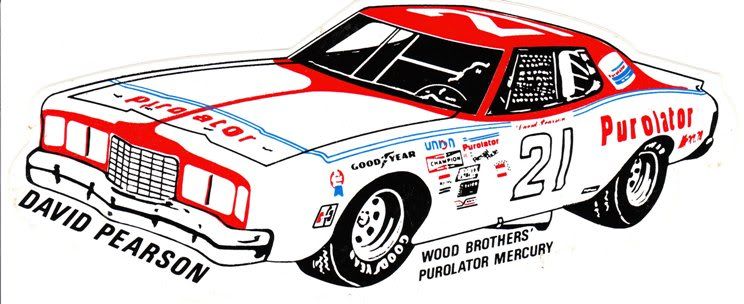
Here's one promoting David Pearson when he drove the Wood Brothers/Purolator Mercury. While I can't remember the exact year I got this one, it had to have been between 1976 and 1979 - the years the Silver Fox drove for them with this body style Merc.

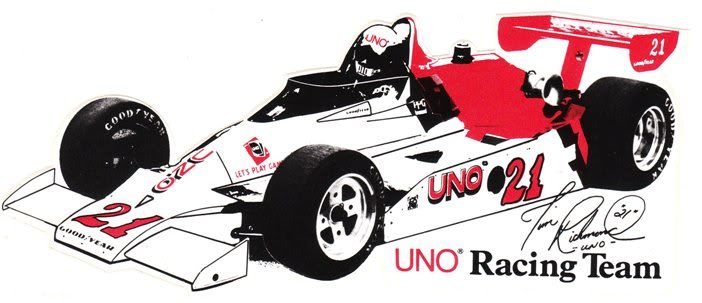
Before Tim Richmond came to NASCAR for a brief - yet successful - career, he spent a couple of years in Indy cars. He earned rookie-of-the- year honors in the 1981 Indianapolis 500. I got this decal by writing the manufacturer of the UNO card game.

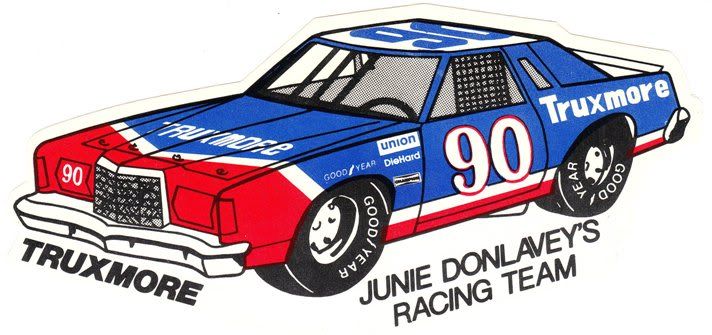
Junie Donlavey was a Virginia gentlemen and long-time car owner. Many drivers cycled through his car. Some of them were veteran drivers like Charlie Glotzbach, Dick Brooks, Jody Ridley, Benny Parsons, and Dick Trickle. And some were predicted to be up-and-comers at the time they hitched a ride with Donlavey such as Ken Schrader, Bobby Hillin Jr, Wally Dallenbach Jr, and Mike Wallace. (All predictions don't come true obviously.)

This decal is one for Ridley for the 1981 season. Coincidentally perhaps, Ridley gave Donlavey his only win as a car owner in 850+ starts in the 1981 Mason-Dixon 500 at Dover.

Many folks who became NASCAR fans in the late 1980s and into the 1990s think Dale Earnhardt was always the Man In Black. I've also heard many folks talk about his 7 championships with Richard Childress Racing and the #3 Monte Carlo. Turns out neither is true.

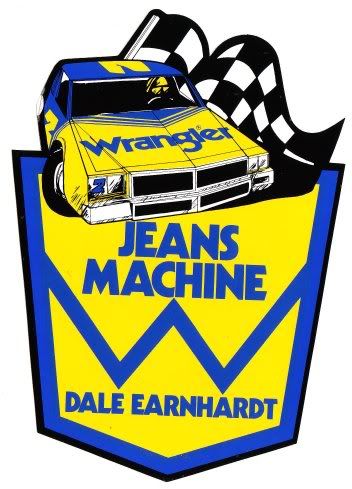
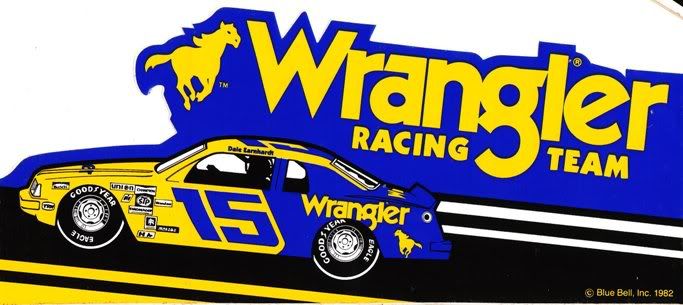
As Dale Jr. reminded folks in the 2010 Daytona Nationwide race, Dale Sr. raced much of the early 1980s in blue-and-yellow cars sponsored by Wrangler jeans. Also, his first Cup was won not with Childress but with car owner Rod Osterland in a #2 Chevy. In 1981, the year of this decal, Osterland Racing switched over to a Pontiac Grand Prix. Earnhardt left about 2/3 of the way through the season to join Childress.

The other thing Earnhardt fans often forget about is Dale Sr. actually drove a Ford in 1982-1983. After joining Childress in late 1981, they only stayed together the rest of that season. Childress encouraged Earnhardt to look elsewhere while he built up Richard Childress Racing. Dale Sr. went to Bud Moore's Ford team along with his Wrangler sponsorship for two years.

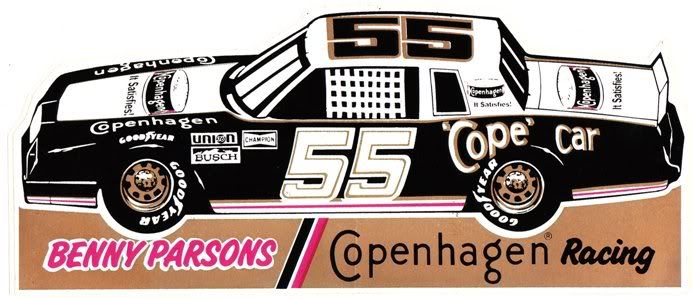
I'll wrap this entry up with a decal for the late Benny Parsons, the 1973 Winston Cup champion and 1975 Daytona 500 winner. Of the cars U.S. Tobacco sponsored, Harry Gant's Skoal Bandit was perhaps the most well-recognized. But I always thought BP's Cope car was a pretty cool looking car in its own right.

TMC

Sunday, April 19, 2009

Conflicted about Mark Martin's comment

Its amazing how quickly the TV folks can drop their fave and jump aboard the bandwagon of the "hot new thang". But its also doubly amazing when the fave is Junebug Jr. as he faded late in the Phoenix race and the "hot new thang" is 50 year old, thrice-retired Mark Martin.

I don't dislike Mark. But I'm not a big fan either. Just call me ambivalent. I do believe, however, his victory was generally popular with the fans, fellow competitors, sponsors, NASCAR, and the media.

What has me conflicted a bit, however, is a comment Mark made in victory lane Saturday night. He made the comparison of his victory (his first since 2005) to Tim Richmond's comeback victory at Pocono in 1987.


I'm glad 50 year-old Martin remembers Tim and mentioned his name in victory lane. With Kyle Petty and Ken Schrader sidelined and Bill Elliott only barely around anymore, only Mark is left to remember what it was like racing in Tim's era.

Mark also knows his place at Hendrick. Even though the car is #5, the team is from the lineage of Tim's #25 team. The FOX TV guys referenced how special the #5 is to Rick Hendrick because that's the number he used from the beginning with Geoff Bodine. They've already forgotten the true 5 team (Shrub's old ride) was re-numbered to 88 when the Double Joonyurs were hired, and the 25 team was re-numbered to 5 (piloted previously by Casey Mears and now Martin). I think Mark was honestly trying to give props to Tim for setting a high mark for the 25 (then) / 5 (now) team that hasn't been matched since.


Source: Ray Lamm

I also recognize Mark's win meant a lot to him. Even when he was winning regularly in Roush's #6 Ford, he often said the victories were special because you never knew if it was his last one.

But to compare winning a race - after a four-year drought...in top physical condition...as a fan-favorite...and embraced by NASCAR - to a comeback victory by a driver...with "pneumonia like symptoms"...having AIDS as a death sentence...not being trusted by your fellow competitors...and having your character attacked by NASCAR, well I think that's a stretch for me.

In the end, I'll likely give Mark a pass. He was excited about the win, he and the team have pulled themselves off the mat to go from 35th in points to 13th, and he didn't have a lot of time in victory lane to arrange his words perfectly about Tim. The bottom line is he at least he did mention Tim's relevance, and in the end that was a pretty classy thing to do.

TMC

Saturday, December 20, 2008

These are a few of my favorite schemes

With apologies to Julie Andrews' tune from The Sound of Music.

NASCAR silly season bores me anymore. Especially this year since my favorite 43 team is in the mix but for all the wrong reasons.

So I thought I'd instead focus on some of my favorite paint schemes from over the years. As we near the end of 2008, "best of" and "top ten" lists tend to dominate the landscape in the week between Christmas and New Year's Day. Letterman also has his nightly Top Ten list, and I'm a big fan of his. So I'll start with...seven. Not sure any of these qualify as "best of", but 7 doesn't have a magic ring to it when it comes to NASCAR. It represents the number of championships won each by Richard Petty and Dale Earnhardt. The number also signifies the number of Daytona 500 wins by Richard Petty. (Good thing I didn't use the # of D500 wins by Earnhardt as my basis because I'd only be able to share ONE picture.)

Disclaimer: I've tried to focus on paint schemes used on a regular basis vs. those used once or twice.

In order to draw out the suspense, here we go in reverse order. (drum roll please).

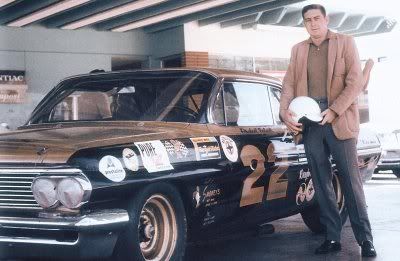
#7 - Smokey Yunick-prepared cars. Officially, he prepared Pontiacs, Chevelles and Ford Torinos. Maybe others too. But with the way he poured over the details and modified the bodies of his entries, no one can say for sure what he put on the track. Here's one of his #22 Pontiacs driven by Fireball Roberts. Later, he entered his patented black-and-gold colors on #13 cars - immortalized of course in that award-winning race movie, Talladega Nights: The Ballad of Ricky Bobby.


#6 - Cale Yarborough's Busch beer sponsored Olds 442 from 1979-1980. Other than his 3 consecutive championships, Cale is perhaps best known for wrecking this beautiful car on the last lap of the 1979 Daytona 500 along with Donnie Allison.


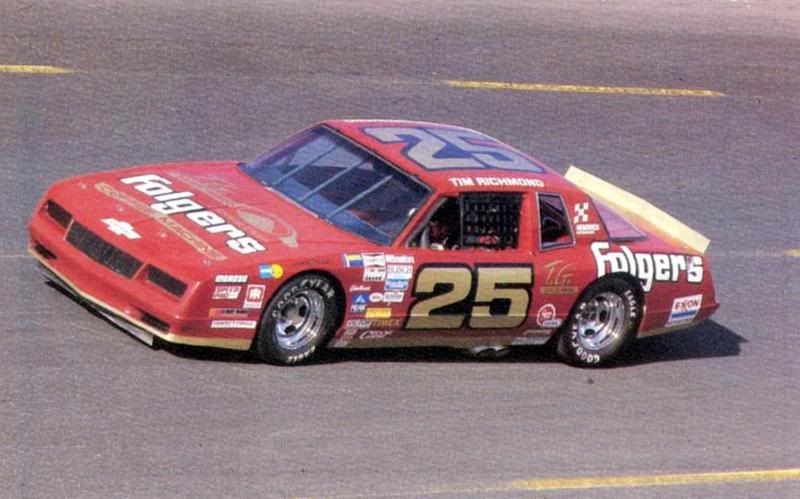
#5 - Tim Richmond's early season Folger's Coffee scheme from the early part of 1986. About a third of the way through the season, the team began using regular white letters vs. the black-backed gold numerals. It changed the whole look for the worse, but apparently it was a good change for him. After the change, he ripped off seven wins in the second half of the 86 season.


#4 - Darrell Waltrip's original Budweiser sponsored Chevy from 1984.


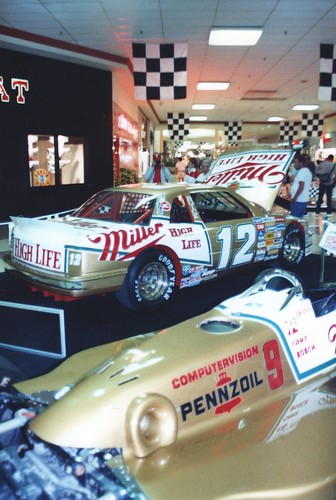
#3 - Bobby Allison's Miller High Life Buick from 1988. He won the Daytona 500 in 1988, and his son Davey finished 2nd. His career was violently ended at Pocono that same year when he spun and was t-boned in the driver's side.


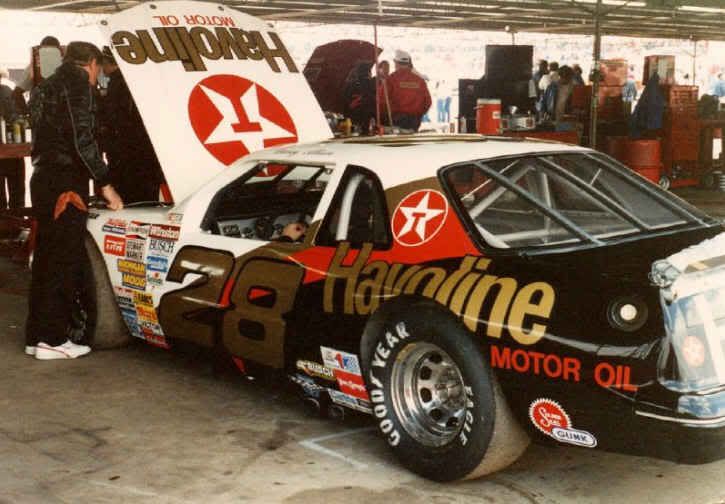
#2 - Davey Allison's original Havoline Ford from 1987. He ran the same scheme at the Daytona 500 but without the sponsor name or logo because the sponsorship deal wasn't finished. It was, however, completed by the time they got to Talladega in the spring for the Winston 500. First I watched as Bobby Allison tore the fence down. And then I watched as his son, Davey, won his first ever Cup race.


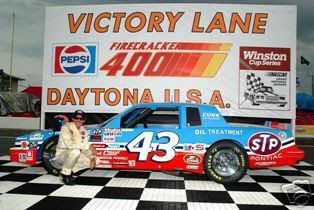
#1 - Richard Petty's STP Pontiac in which he won his 200th race at the 1984 Firecracker 400 in front of President Ronald Reagan.