Showing posts with label pete hamilton. Show all posts

Wednesday, February 10, 2021

Daytona's 1969 and 1971 Twins

David Pearson is the second winningest NASCAR Cup driver of all time. His 105 wins rank second only to the King, Richard Petty. Included in Petty's 200 wins are seven Daytona 500 victories. Seven! Pearson captured only a single trophy in the Great American Race. The one he nabbed, however, was certainly one for the ages: the 1976 Daytona 500.

Though the 1976 500 ranks as Pearson's best known Daytona victory, his win tally includes two additional February wins.

Pearson rolled into Daytona in February 1969 as the defending champion from 1968. Driving the blue and gold Holman Moody Ford, he piled up 16 wins and 36 top 5 finishes in 48 starts. Petty also won 16 races with his Plymouth in 1968 yet finished third in the points.

Things looked a bit different the following February though. Pearson returned in his #17 Ford...  
...but Petty was now in the Blue Oval camp as well after doing the unthinkable and leaving Plymouth.
 
Buddy Baker captured the pole for the Daytona 500 on February 9th with a speed of 188+ MPH. Bobby Issac laid down the second quickest lap locking him and Baker into the front row for the 500. Qualifying continued in the days to follow to set the line-up for the twin qualifying races. 

On Wednesday, February 19th, Pearson became the first driver to break 190 MPH. Though the fastest lap was now his record, Pearson had to start 15th in his qualifying twin because of when the lap was set. 

From 1959 through 1968, the qualifying races were 100 miles each. Beginning in 1969, the races were extended to 125 miles. The idea was the cars would have to pit at least once for fuel rather than stretching fuel mileage to run the full race distance without a stop.

Baker took the green from the top spot earned by his pole-day run in the first of the two twins on Thursday, February 20th. After a couple of laps out front, however, he pulled his Cotton Owens Dodge behind the wall to preserve the car for the 500. Pete Hamilton, the 1968 Rookie of the Year, took over the lead and held it for 14 laps in the #1 A.J. King 1969 Dodge Charger. A few years later, Hamilton's Charger became a late model sportsman car for Dave Marcis - and eventually a show car for Goody's Headache Powders and R.J. Reynolds.

As Hamilton pulled the field around the 2.5 mile superspeedway, Pearson made his way through the field from his 15th place starting spot. He went to the point on lap 18 and stayed there for six laps until surrendering the lead to pit. Cale Yarborough then set the pace for 19 laps in the Wood Brothers Ford. With six laps to go, however, Pearson's powerful Holman Moody Ford caught and passed Yarborough. The #17 led the remaining laps to capture the win.

The victory was Pearson's 47th career Grand National / Cup win and his first at Daytona since the 1961 Firecracker 250. Pearson could not extend his good fortune from the 125 to the 500. He finished sixth, two laps down to winner LeeRoy Yarbrough.

Source: Daytona Beach Morning Journal
Two years later, Pearson was back at the Beach with Holman Moody. The #17 had Purolator Filters on the side as a sponsor - a company that joined him in the years to follow with the Wood Brothers.
     
A.J. Foyt captured the pole for the 500 in the Wood Brothers' car. Isaac once again qualified second as he did two years earlier. Pearson's qualifying time placed him in the second twin rather than the first one that he won in 1969.

Isaac started from the pole in the twin as a result of his pole day second fastest time. Buddy Baker started alongside him in the Petty Enterprises #11 factory-backed Dodge.
 
Credit: Al Consoli
Though he started fourth, Pearson rocketed to the lead on the first lap and held it for the first three laps. The two powerful Hemi-powered Dodges of Isaac and Baker then diced for the next 20+ laps with neither leading more than a couple of laps at a time. 

With about 20 laps to go, Pearson went back to the front. Baker's Maurice Petty-built Hemi, however, refused to concede to Pearson's Ford and stormed back to the front to lead for nine laps. 

Pearson drafted Baker's Dodge and once again took the lead with 10 to go. Baker pursued Pearson's 17 doggedly and eked out the lead once again - but only for a single lap. Pearson found the extra oomph he needed and led the final fix laps to win his second twin in three years.
 
The win was Pearson's 59th victory of his GN/Cup career. As was the case in 1969, Pearson's success on Thursday did not transfer to the 500. He finished fourth to the King. Petty captured this third Daytona 500 trophy as Pearson continued to seek his first.

TMC

Friday, August 23, 2013

August 23, 1970 - Pete Doubles-Up At Dega

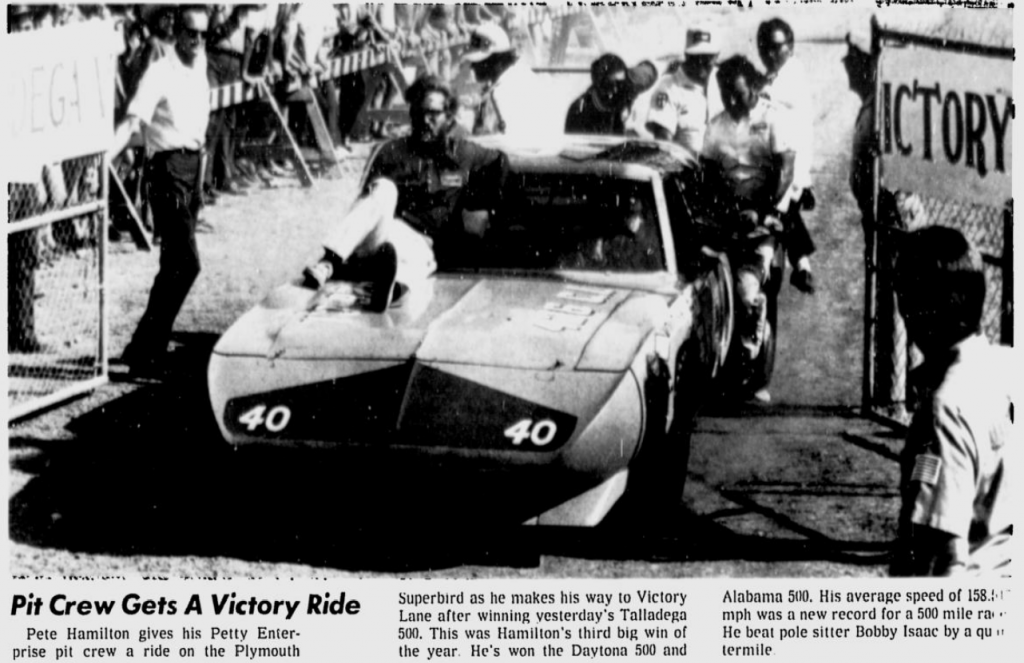
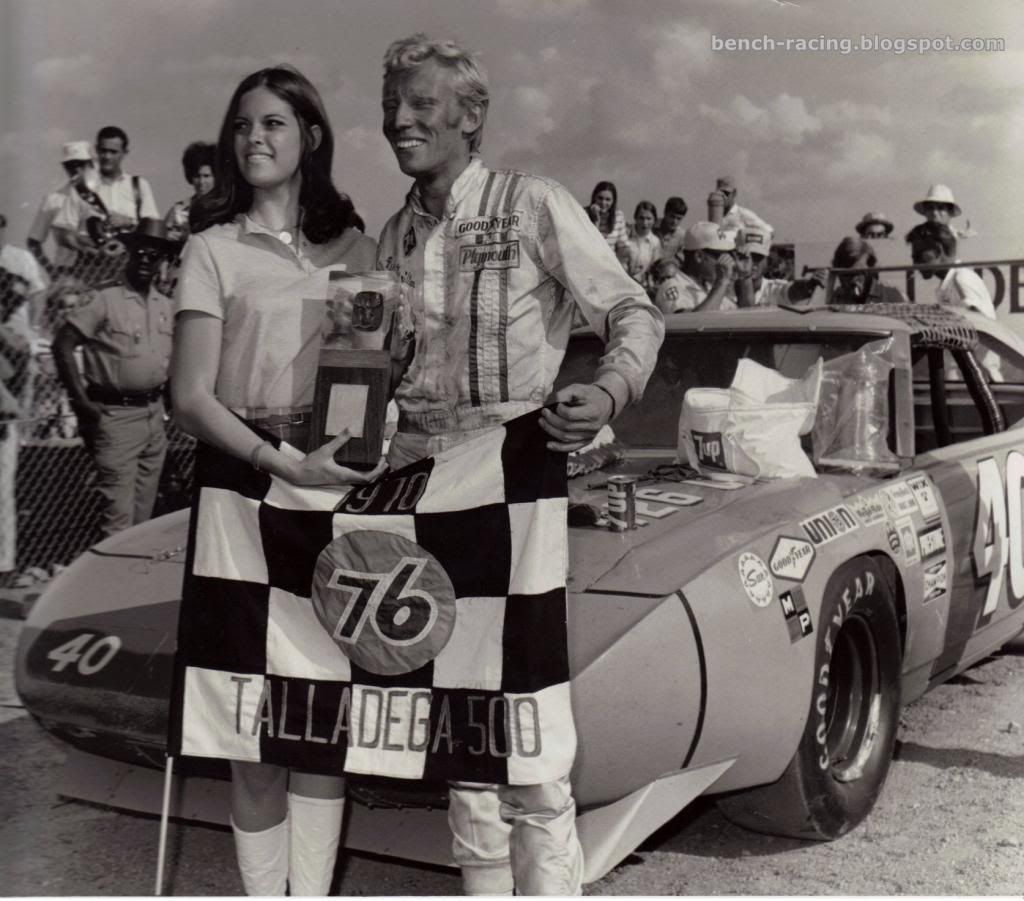
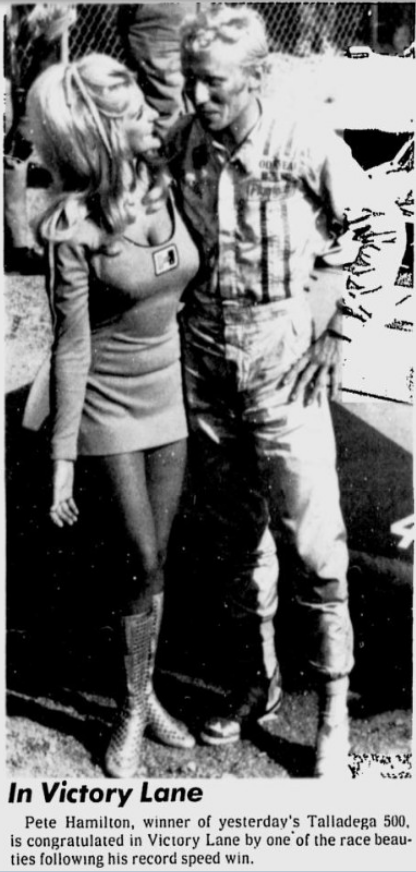
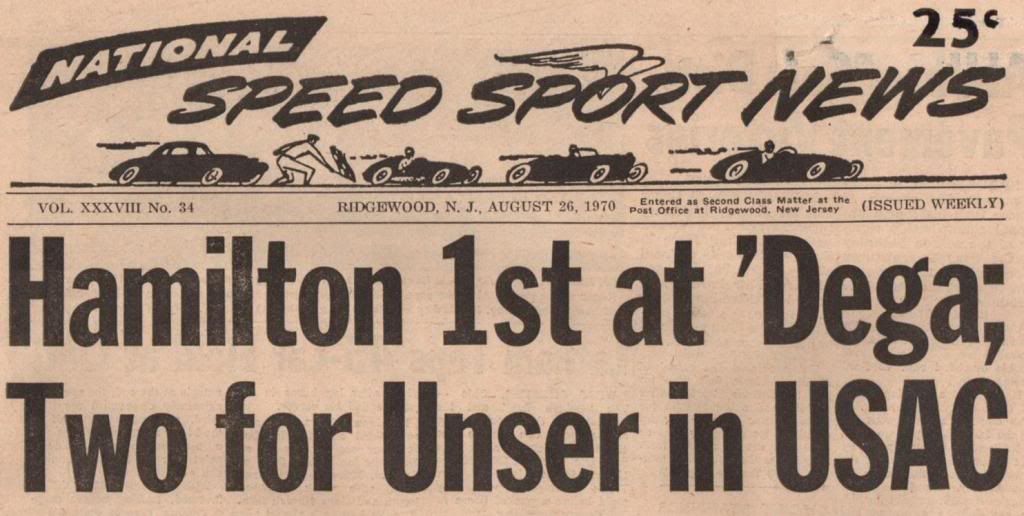
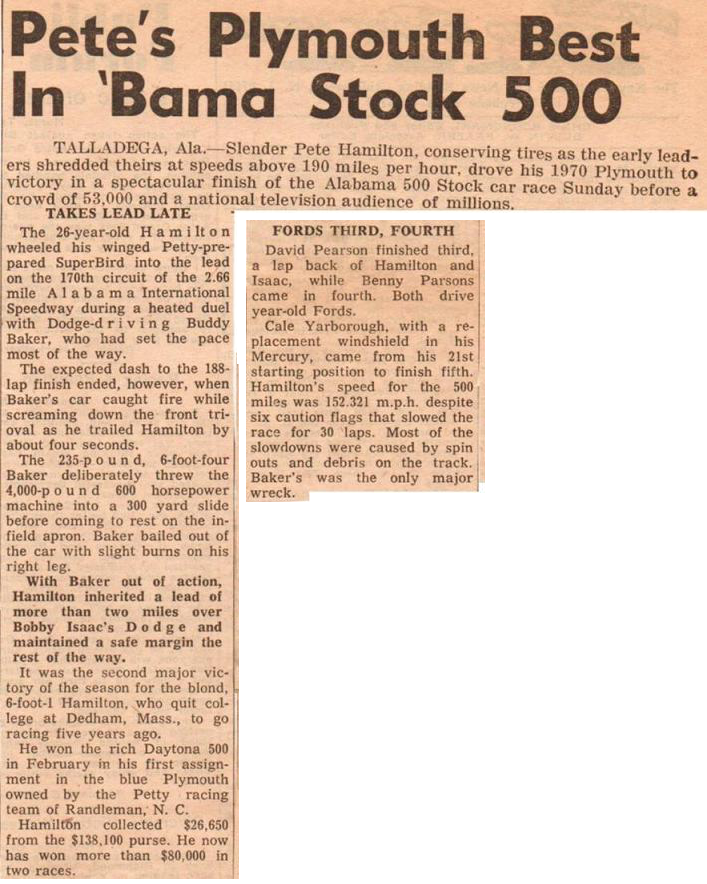
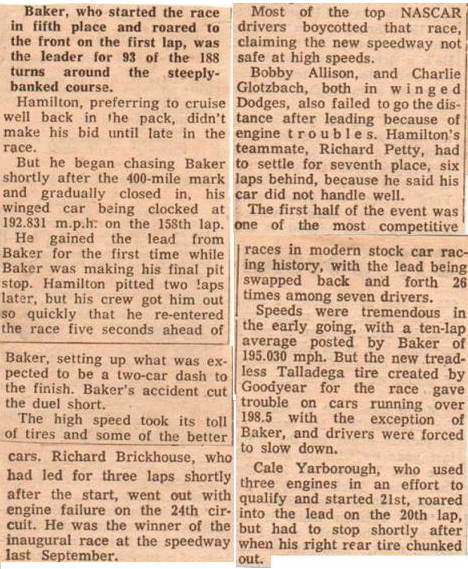
August 23, 1970: Starting fourth in the #40 Petty Plymouth Superbird, Pete Hamilton puts a whoopin' on the field in the Talladega 500. Hamilton led 153 of 188 laps. The remaining laps were sprinkled amongst Bobby Isaac (12), Charlie Glotzbach (6),and six others with five or less laps on point. Hamilton's Petty Enterprises teammate, King Richard, had a pedestrian day in his Bird. He started fifth and finished seventh but with but didn't lead a lap.
The King's 1970 Superbird is one of the two most iconic cars for him (the other being the mid-70s STP red / Petty blue Dodge Charger). In the five Grand National races held at Daytona and Talladega in 1970, however, the 43 ultra-smooth Superbird had zero wins, no top 5s, only three top 10s (1 of which was in a Daytona 500 qualifying race), and zero laps led. Pete, on the other hand, drove his #40 Petty Bird to three wins in his five races, racked up four top 5s, and led 25 percent of the laps in those five races.

Fifty cars started the race. The front row was comprised of Bobby Isaac in the #71 Harry Hyde-prepared winged Dodge Charger and David Pearson in his Holman-Moody Ford. The second row included Charlie Glotzbach and Hamilton. Chargin' Charlie finished second to Richard Brooks in the inaugural Talladega 500 a year earlier.

Fast Freddy Lorenzen, who won 26 Grand National races from 1961 to 1967 with more than 60 Top 5 finishes, still had to sport a yellow "rookie stripe" on his Ray Fox-prepared Dodge. The reason? He'd never raced Talladega before. This led me to wonder if every car ran the yellow stripe a year earlier in the first Dega GN race. Unfortunately for Lorenzen, his prep for his first Dega race and his visual warning to other drivers didn't help much. He finished 49th in the 50-car field after losing an engine only 9 laps into the race.

The race began with the various drivers mentioned earlier leading a lap here and there. Around 40 laps into the race, however, Hamilton began to show 'em who was boss. He went to the front for a 26 lap stint. After surrendering the lead for a lap (presumably for pit stops), the 40 Plymouth went back out front for a dominating 82 laps. With 35 to go, Hamilton passed pole-winner Isaac, waved good-bye, and set sail for the win.

The young driver swept the Talladega races and pocketed the Daytona 500 to boot. Yet that résumé wasn't enough to keep his job. Hamilton won three career Grand National races - all in 1970 - all for Petty Enterprises. Yet when Chrysler move its financial support of Ray Nichels' Dodge team to Petty Enterprises team for 1971, the decision was made to place Baker at PE for the Dodge program and let Hamilton go.


Hamilton raced another few years on a part-time basis, primarily for NASCAR Hall of Fame owner Cotton Owens. Pete's final race was in 1973 at the Atlanta 500. After getting his back nicked up pretty good in some accidents, Hamilton left NASCAR and focused on a successful trucking business he had grown near Atlanta, Georgia. Like many racing fans, I've never had the opportunity to meet Pete - yet I've always wanted to. Once he left NASCAR though, that was it. Except for a handful of appearances over the years for special occasions, he is not involved in the sport in any capacity.

Sports Illustrated latched on to Pete's magical 1970 season and wrote a feature article on him in the June 15, 1970 issue - several weeks before his second Talladega win and several months before he was told he wouldn't be returning to the Petty team in 1971.


The folks at RealRacinUSA.com did a half-hour phone interview with Hamilton back in 2007. For me, it is one of the few extended sessions I've ever heard with him. Your time will be well-spent taking the opportunity to listen to his racing memories and what he does in more contemporary times.

NSSN headline and article courtesy of Jerry Bushmire

TMC

Friday, April 12, 2013

April 12, 1970 - Pete Inherits Talladega

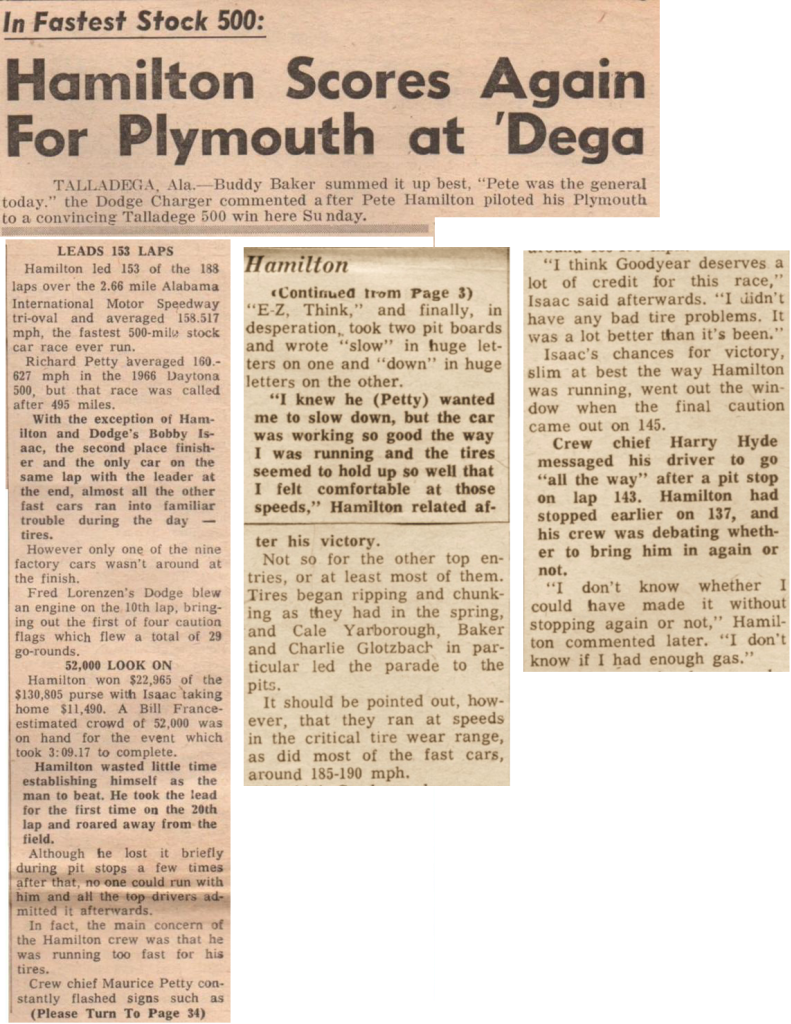
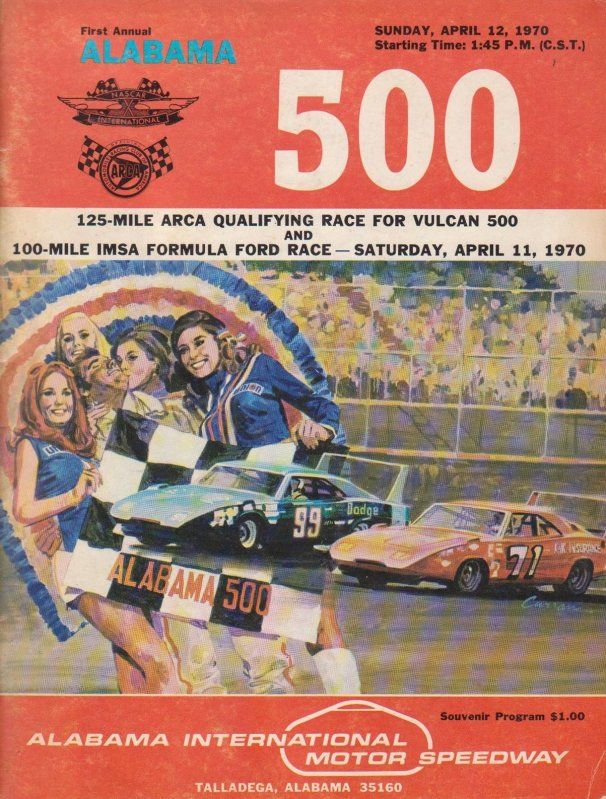
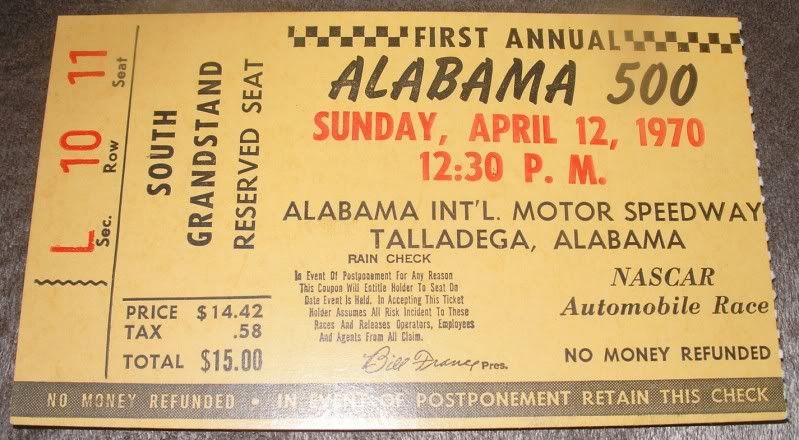
April 12, 1970: Going back-to-back on Bill France Sr.'s superspeedways, Pete Hamilton follows his win in February's Daytona 500 with a victory in the first Alabama 500 at Talladega.

As a part-time racer for Petty Enterprises in 1970, Hamilton again raced a #40 Plymouth Superbird to the win in the second NASCAR Grand National race at Talladega - but the first spring / Alabama 500 race (renamed a couple of years later as the Winston 500).

Hamilton started sixth and comfortably won over pole-winner Bobby Isaac. Richard Petty qualified eighth - 2 spots worse than Pete - and finished seventh as the checkers fell.

As the laps wound down and Pete cruised along in the lead, Buddy Baker tried his best to pursue Hamilton. Driving for NASCAR Hall of Famer Cotton Owens, Baker's #6 winged Dodge Daytona blew a tire with about 13 laps to go. Shrapnel from the tire ripped off the oil cooler, and the hot fluid immediately caught fire. Here is MRN's call of Baker's fire by Ken Squire and Marvin Panch.


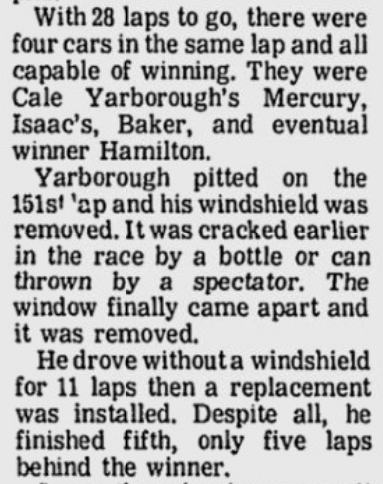
Another driver with a memorable day was NASCAR Hall of Fame member, Cale Yarborough. He ran with no windshield for eleven laps but still finished 5th. Let me repeat that race challenge for the  Timmonsville, SC driver: NO WINDSHIELD ... at Talladega ... for 11 laps. (Greg Fielden writes in Forty Years of Stock Car Racing: Volume 3 that Cale only ran five laps without a windshield. But either way...wow.)

Source: Spartanburg Herald-Journal via Google News Archive (p. 39)
With most of the action behind him, Pete did his job and led the rest of the way to pick up his second win of the 1970 season.


Though Pete's win is obviously known today, apparently ABC's live TV coverage at the time left a bit to be desired in clearly describing who won the race. Bernard Kahn of the Daytona Beach Morning Journal lit into ABC's coverage of the finish - while also tagging Ken Squier and his Motor Racing Network team (referring to them as "radio hacks"). Kahn's criticism of the broadcast coverage of the race was a bit of a forerunner to the contemporary job done today by John Daly in his blog, The Daly Planet.

Article courtesy of Jerry Bushmire
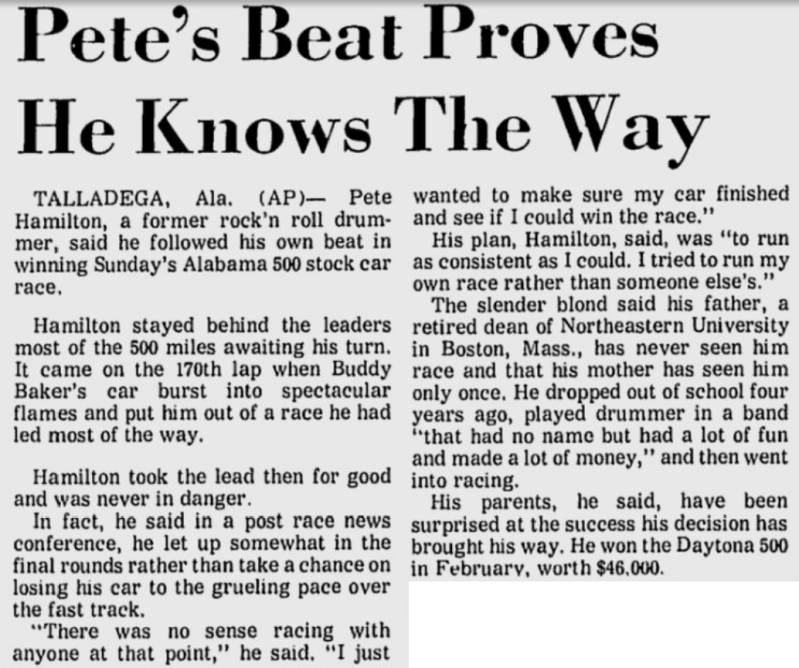
Pete is almost larger than life amongst long-time, devoted Petty fans for his wins in 1970 at the wheel of a Superbird. So many fans know him as a wheelman for the 40 who should have earned another shot in 1971. Most don't know him as a rock-n-roll drummer.

Source: Daytona Beach Morning Journal via Google News Archive
Pete had one more win in him for 1970 - the summer race at Talladega. He also won the pole at Michigan, and had ten Top 5's and twelve Top 10's in his 17 starts. At the end of 1970, however, Chrysler withdrew its funding for a second Petty Plymouth. As a result, Hamilton was let go after only one season. Chrysler then funded Petty Enterprises for a Dodge to run with The King's Plymouth in 1971. Baker, the long-time Dodge driver, was hired to pilot it on a limited schedule. 

TMC

Friday, February 22, 2013

February 22, 1970 - Pete Pockets Daytona

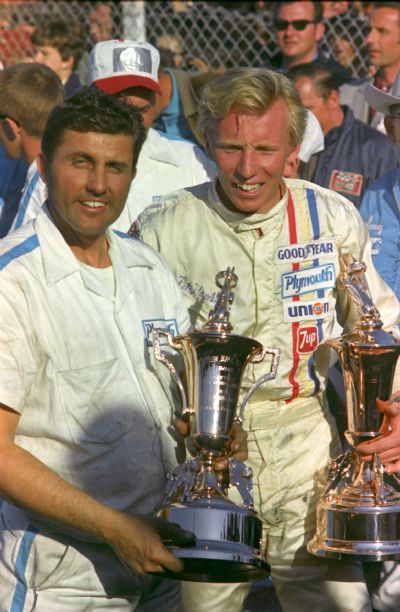
February 22, 1970: Pete Hamilton from Dedham, Massachusetts - yes, MASSACHUSETTS - wins the Daytona 500 in a winged Plymouth Superbird.

As the 1970 season opened in January, the Pettys fielded a second Superbird at Riverside's road course. But it was for road course ringer Dan Gurney, the car wasn't originally built by Petty Enterprises, and the color and font of the number 42 didn't remind anyone of a Petty entry.

The arrangement with Gurney was a one-race deal. In the same month as the Riverside race, Petty Enterprises and Chrysler Corporation announced the hiring of Hamilton for a limited number of races the rest of the season, and Pete's car was assigned #40 - a number not previously fielded by PE and never used again after Hamilton's single season with the team.

Hamilton won honors as the 1968 NASCAR Grand National Rookie of the Year, but he couldn't land a solid ride in NASCAR's top series in 1969. He was delighted to be hired by the factory-supported Petty team in 1970 and planned to make the most of his new gig.

With a team headed by Richard's brother and engine builder, Maurice "Chief" Petty, Pete didn't take long to make his presence known. He laid down a solid qualifying lap, started sixth in his 125-mile qualifying twin, and finished fifth in it - one spot better than his teammate, King Richard. Their finishes in the twin placed them nose-to-tail, 9th and 11th, in the starting line-up for the 500.

Photo courtesy of Smyle Media
Pete lined up behind the two Fords of Lee Roy Yarborough in Junior Johnson's #98 and Donnie Allison in Banjo Matthews' #27.

Photo courtesy of Ray Lamm from RacersReunion.com
Chief was masterful as Hamilton's crew chief with solid pit strategy and keeping the young and relatively inexperienced driver calm as he made each stop. Note the lack of a window net for the driver. Use of the nets didn't come into favor until after The King's violent wreck at Darlington two months later.

Photo courtesy of Ray Lamm
Hamilton and David Pearson, the two-time and reigning NASCAR Grand National champion, swapped the lead a couple of times over the last few laps. Coming to the white flag, Pearson gave it his all to dive under the 40. But his Holman & Moody Ford broke traction, his tires went up in smoke, and the Silver Fox did an incredible job regathering the wheel and regaining his pursuit. Hamilton pulled away for three-quarters of the lap. Pearson shoved his accelerator through the firewall in an effort to catch the Superbird. But Pete had too much and beat Pearson to the line by about 3 car lengths.

Photo courtesy of Richard Guido
To the victor belongs the spoils such as:
  • The congratulatory embrace from your crew chief.
  • Hardware for the trophy case
    Credit: Daytona Beach Morning Journal
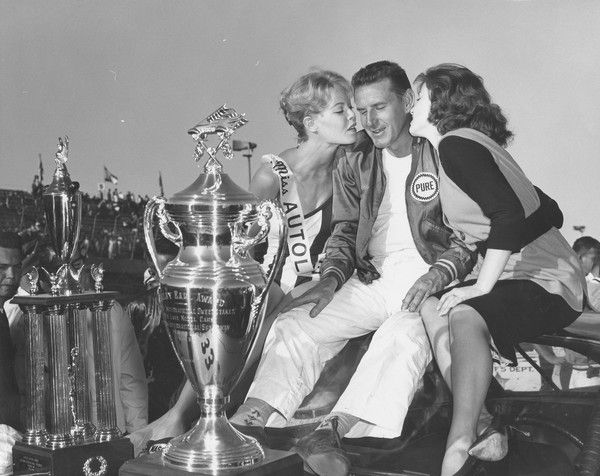
  • And maybe best of all, nice snug hugs from the pretties, including from Miss Hurst Shifter, Linda Vaughn.
Photo courtesy of Ray Lamm
Parts of the race including the finish were aired on ABC's Wide World of Sports. Keith Jackson - better known for his Whoaaa Nellie college football calls - was the lead anchor the iconic Chris Economacki from National Speed Sport News on color.

The start of the race - with pole sitter Cale Yarborough setting a fast pace early... and an early departure by The King. He completed only seven laps, broke an engine, and finished 39th in the 40-car field.


And the finish - with the battle between Pearson's Ford and Pete's Plymouth.


Article courtesy of Jerry Bushmire
Pete's surprise win earned him a feature article in the June 1970 issue of Stock Car Racing magazine.


Article courtesy of Jerry Bushmire

Edited 2013-02-26: Here is a photo of the winner's trophy. Its on display at the Georgia Racing Hall of Fame in Dawsonville.

Photo courtesy of Cody Dinsmore at RacersReunion.com
TMC

Monday, January 28, 2013

The other Petty winners

The King - Richard Petty - He is the name most closely associated with the record books of NASCAR. Well, at least within the circle of fans whose knowledge of NASCAR pre-dates 1979. All but four of his 200 career wins were behind the wheel of a Petty Enterprises-fielded race car.

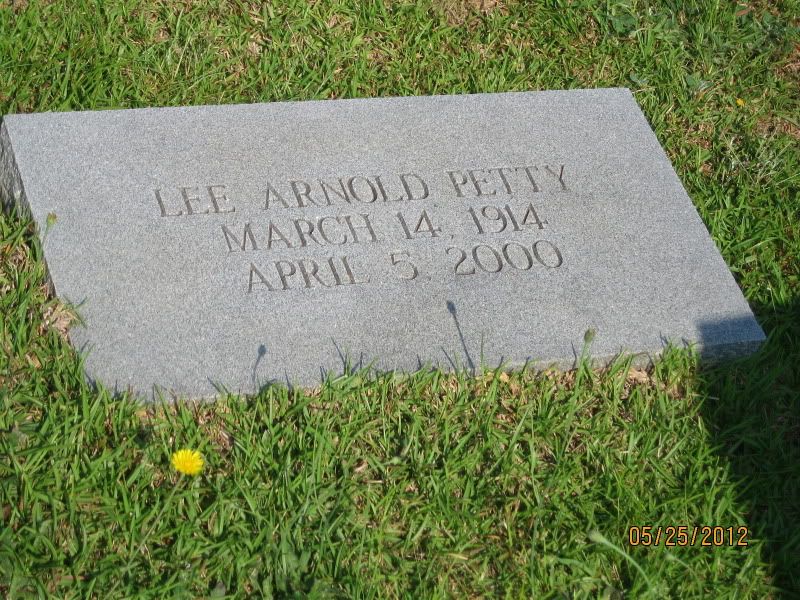
Petty Enterprises as a company, however, has a legacy even richer than the King himself. Richard's father, Lee Petty, set the original bar with 54 NASCAR Grand National wins. All of his wins were earned driving his own cars fielded originally under the name of Petty Engineering (later renamed Petty Enterprises). Richard eventually broke his father's wins record with victory number 55 in the 1967 Rebel 400 at Darlington.

In the 1950s, Lee occasionally hired drivers to pilot a second Petty car. Drivers with names such as Bill Lutz, Johnny Dodson, Tiny Lund, Jimmy Lewallen, Bobby Myers, and yes... Ralph Earnhardt took turns behind the wheel of a Petty-built car.

In 1961, Lee was critically injured in a qualifying race for the Daytona 500 - a wreck that for all intent and purposes ended his driving career. As Petty Enterprises changed its focus to grooming young Richard as a driver, the company hired a number of drivers from 1961 through 1966 to help keep the momentum going and and the Chrysler checks flowing. Some raced for a single event - others raced a handful or more. Drivers such as Buck Baker, Art Malone, Bunkie Blackburn, LeeRoy Yarbrough, G.C. Spencer, Jim Hurtubise and Jimmy Massey helped keep Petty Enterprises vibrant as Lee's son evolved from Squirrel Jr. to Dick Petty to Richard Petty to The King.

From 1970 through 1972, Chrysler Corporation provided financial and other support to Petty Enterprises to field a second Plymouth and later a Dodge team for drivers Pete Hamilton and Buddy Baker. The team also built, supported and crewed cars for drivers in supporting series such as Woody Fisher in ARCA and Joe Millikan in ARCA and NASCAR's late model sportsman series.

When Kyle Petty began his driving career in 1979, the team fielded a car for him from his debut at Daytona in 1979 through his departure for the Wood Brothers team in the mid 1980s. Kyle returned to PE in the 1990s after banking eight Cup wins driving for the Woods and SABCO Racing.

In the post-Richard career of 1993-forward, Petty Enterprises fielded multiple cars until the demise of Petty Enterprises in 2008. Drivers varying from Buckshot Jones to Bobby Labonte and Jerry Nadeau to Jeff Green to John Andretti. Other Petty cars were raced by Greg Biffle, Boris Said, Christian Fittipaldi, Steve Grissom and most poignantly Adam Petty.

But of all the drivers hired to drive a Petty car, only a handful found their way to victory lane in NASCAR's Grand National / Cup races. Beginning February 1, I plan to blog about each of those wins. I'm not sure I'll have 100% success. Media coverage of NASCAR races - especially in the 1950s - was pretty limited. Finding a news article, photo, race program, ticket stub, and/or a personal anecdote for each of Lee's 54 wins will be awfully tough. But we'll give 'er a good run.

Here is a very quick overview of the other Petty winning drivers.

Lee Petty (1949-1963) - The patriarch started the organization late in life by racing's standards. A 35 year-old route truck driver said "well shoot, I can do that." And he did!

Jim Paschal (1961-1964, 1966) - This High Point NC driver - and a World War II naval vet - was hired at the right time by Petty Racing and delivered the right results. As Lee's career ended and Richard's career coming up through the gear box, the company needed some wins, cash and a nod to Mopar's management of "Yep, we got this." He notched 9 of his 25 career wins in Petty Plymouths, and all of them were during the critical period of 1962-1964 as the company rallied around a rising King.

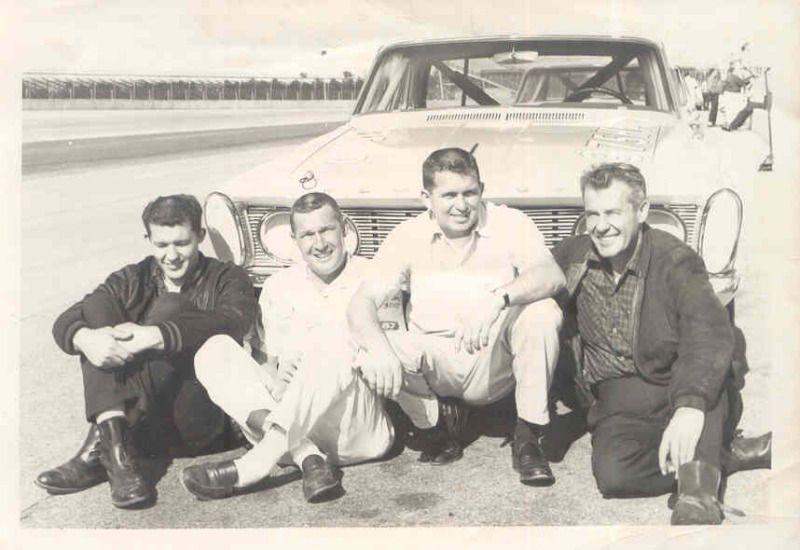
Richard Petty, Jim Paschal, Jim Hurtubise, Lee Petty
Photo courtesy of Jerry Bushmire

Marvin Panch (1966) - The long-time Ford driver was sidelined in 1966 because of a FoMoCo boycott of NASCAR. But he broke ranks and drove a Petty Plymouth "because Lee Petty called" and won the 1966 World 600 at Charlotte.


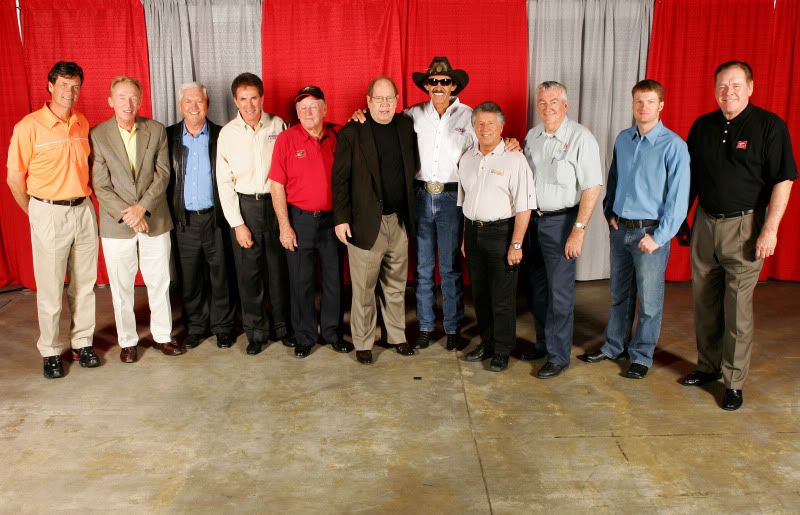
Daytona 500 winners gathered in 2005: Michael Waltrip, Pete Hamilton, 
Junior Johnson, Darrell Waltrip, Marvin Panch, Bill France Jr., Richard Petty, 
Mario Andretti, Bobby Allison, Dale Earnhardt Jr., Buddy Baker

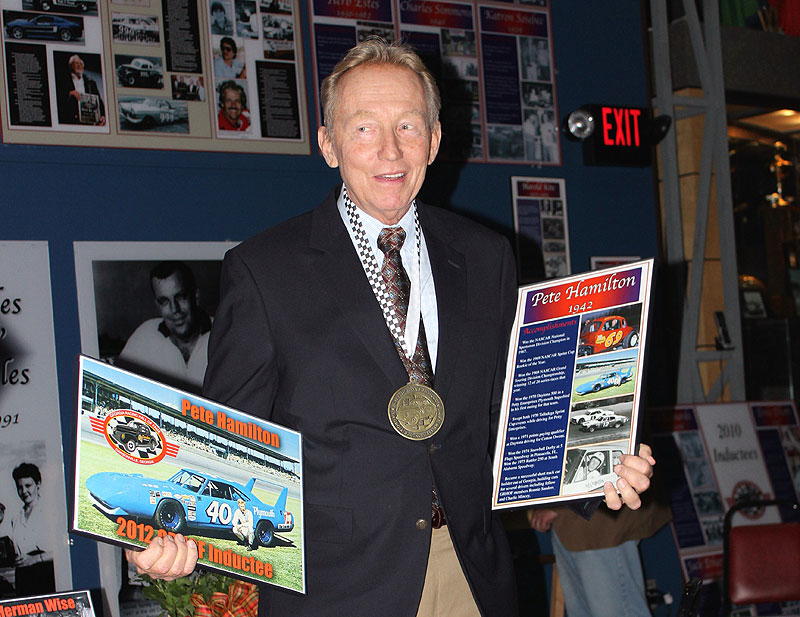
Pete Hamilton (1970) - The 1968 NASCAR Grand National Rookie of the Year was put in a second Petty Plymouth Superbird for a single season in 1970. The kid made the most of a prime opportunity. In his first race with the team, he won the big 'un - the Daytona 500. He continued his winning ways at Talladega.


Buddy Baker (1971-1972) - NASCAR Hall of Famer Buck Baker's big boy Buddy was put in Petty gear for two years. The Pettys fielded a factory-backed Dodge for Buddy in 1971 and ran him again with STP colors in 1972. The decision to do so was rewarded with wins at Darlington and Charlotte.

Credit: SI.com

Bobby Hamilton, Sr. (1995-1997) - Nashville's Bobby Hamilton is arguably the best driver to have piloted the 43 since the King himself. While he only had two wins to show for his three years of racing for Petty Enterprises, Bobby made the rest of the field aware that the 43 was still in the show even if The King was on top of the hauler vs. holding the wheel. For Petty fans, it was tough to see him leave PE for Morgan-McClure's #4 team. For racing fans in general, it was even tougher to see him succumb to the ODB Cancer in 2007.


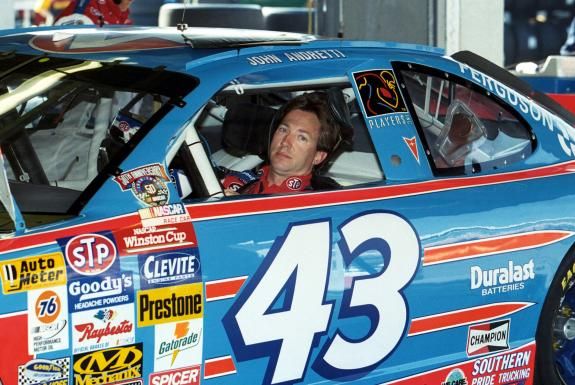
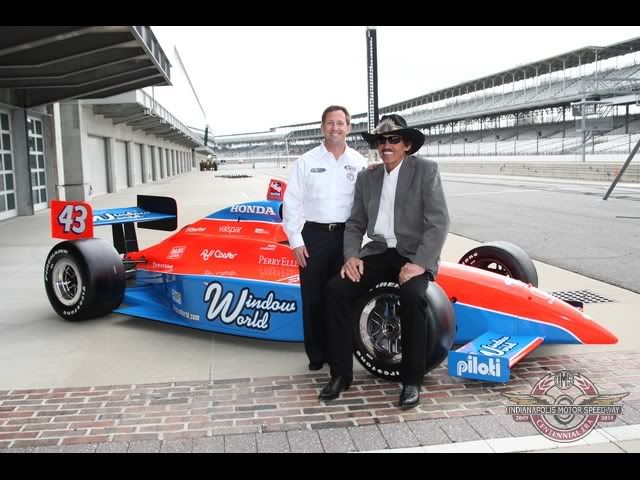
John Andretti (1994,1998-2003) - The son of Aldo Andretti and nephew of racing great Mario Andretti was the last driver to win for Petty Enterprises. The last one. That reality is still tough to comprehend. John and The King apparently remain close. In recent years, Andretti, Richard, Andretti Autosport and Window World teamed to field a #43 red and blue car for John in the Indy 500. Though the car each year was one badass looking ride, John didn't drink the milk or wear the roses at the Brickyard.


Please contact me by leaving a comment below, tweeting me, or by e-mail if you have a memento, photo, personal story, etc. you'd like to share about a Petty win. I'd very much be interested in incorporating what you have to offer and give credit where its due.

TMC