Showing posts with label bobby isaac. Show all posts

Monday, May 17, 2021

May 17, 1969 - Langley's Tidewater 375

NASCAR's Grand National drivers battled in mid-May 1969 for the third time in a week and on back-to-back nights. After racing at Beltsville Speedway in Maryland on Friday night, the teams made the short trek to Langley Field Speedway in Hampton, Virginia for the Tidewater 375.
 
The six previous GN races at Langley Field had been 250-lap, 100-mile events around the 4/10-mile, paved oval. The distance was extended for the first time in 1969 to 375 laps for 150 miles. 

David Pearson captured the pole for the race and was flanked by Bobby Isaac. Pearson had already won four races during the season-to-date, and Isaac had claimed six victories - including at Beltsville the night before the race at Langley Field.

Independent, lower-funded drivers comprised much of the rest of the 24-car field. Virginia racing legend, Ray Hendrick, had planned to run the race. Hendrick knew the track like the back of his hand and won often at Langley Field in the track's modified and late model sportsman divisions.

Source: Newport News Daily Press
Hendrick raced in a handful of GN events - including a month earlier at Richmond. Though it's not clear if Hendrick failed to make the race during qualifying or if his expected ride didn't materialize, he wasn't on the track when the field took the green that Saturday night.

Another driver who wasn't in the field was Richard Petty. Two weeks earlier, Petty suffered what he says was the toughest hit of his career. He blew a tire coming out of turn four during the Fireball 300 at Asheville-Weaverville Speedway, and stuck it in the wall. Long before SAFER barriers and unlike many other tracks who used wooden or steel guardrails in that era, Petty's 43 Ford drilled the concrete wall and stopped suddenly.

The King rallied his sore body to qualify second and finish 11th the next weekend in the Rebel 400 at Darlington. The Petty Enterprises team, however, skipped the next two races at Beltsville and Langley Field. 

Physically, Petty may have been able to make the starts. The Weaverville wreck destroyed their short-track car; however, and it wasn't rebuilt in time to run the back-to-back races. 

A couple of calls were placed to other Ford teams to see if a spare car could be rallied for Petty to run the two races. When nothing surfaced, the team focused on readying Ol' Blue for the upcoming World 600 at Charlotte and getting the short-track car back in form for races beginning in June. 

With almost no other top team cars in the field, the race was a battle between rivals and friends Pearson and Isaac. Pearson leveraged his top starting spot to grab the lead at the start and hold it for the first 40 laps. Isaac then passed Pearson and paced the pack for about the next 30 laps when the race's first caution flew. 

Dick Hutcherson, Pearson's crew chief, called the #17 Ford to pit road. Isaac's crew chief Harry Hyde, however, made the call for Isaac to stay on the track. His plan was to have Isaac build a big lead over Pearson after the race returned to green and then pit under a subsequent caution.

With the race back under green, Isaac extended his lead over Pearson who was navigating traffic behind Isaac's #71 Dodge. Isaac remained out front for over 125 laps. 

As the race neared halfway, Hyde realized his pit strategy had backfired. The subsequent caution never occurred, and Isaac was forced to pit under green and surrender the lead back to Pearson. 

Though Pearson returned to the lead, Isaac tracked him down after 60 laps and motored by him with about 150 laps to go as he sought his seventh win of the year. 

About 25 laps later, Pearson made a second stop to ensure he had enough fuel to go the distance. Though the second stop put him well behind Isaac, Hutcherson firmly believe Pearson still had a shot at the win. 

Isaac continued to churn lap after lap as the race neared its conclusion. But then with about 15 laps to go, his Dodge's Hemi burped as the tank ran dry. As he coasted to the pits, Pearson flashed by to take the lead. Isaac's stop was agonizingly slow as the crew scrambled to get the car to re-fire. In the blink of an eye, Isaac went from a dominating day and a possible win to a P4 finish seven laps down to the winner.

Pearson led the rest of the way. He banked his 51st career victory, his fifth of the season, and his third consecutive win at Langley Field.

Source: Newport News Daily Press
TMC

Tuesday, May 11, 2021

May 9, 1970 - Darlington's Rebel 400

NASCAR began the second quarter of its 1970 Grand National division season with the Rebel 400 at Darlington on Saturday, May 9th. Because of state blue laws, Darlington's races were held for years on Saturday in the spring and Labor Day Monday in September for the Southern 500. 

The 1970 Rebel edition was the final one held on Saturday. A change in law or some sort of lobbying resulted in the 1971 race being scheduled for a Sunday. Darlington didn't host another Saturday Cup race until 2005 when their relocated Southern 500 was booked the day before Mother's Day for the better part of eight years.

Chargin' Charlie Glotzbach set a track record in winning the pole in his purple, winged Dodge Daytona. Bobby Allison timed second in another winged Daytona prepared by Mario Rossi. 

Defending and three-time NASCAR Grand National champion, David Pearson, qualified third. During practice prior to qualifying, Pearson clipped the wall four times. Crew chief Dick Hutcherson made several spring adjustments, and the changes helped as Pearson logged the third quickest lap without any additional misadventures with the fence. Nonetheless, the track's PA announcer had a bit of fun at Pearson's expense by introducing him to the crowd as David "Wall" Pearson.

Pearson was flanked by Pete Hamilton who was driving a second Plymouth entry for Petty Enterprises. After Hamilton's qualifying run, he commented candidly to reporter Bob Myers:
I honestly believe we are running too fast for this race track. In the fourth turn, we are headed straight for the wall coming out. There it is near impossible to avoid hitting the wall. - Charlotte News
Though Hamilton was in a second Petty team car, he had the only Petty Superbird in the race. His teammate, the King, qualified his Superbird seventh on the first day of time trials. After logging his lap, Petty returned to the track during a follow-up practice session. Just as Hamilton had observed, Petty lost the handle coming off turn four, popped the wall, sailed back across the track, and pounded the pit wall.

Source: Greenville News
Source: Charlotte News
The crew loaded the trashed Superbird, forfeited their starting spot, returned home to Level Cross, and readied the team's Plymouth Roadrunner short track car to qualify again the next day. After a quick night's work - likely with limited, if any, sleep - the team returned with its backup. The Roadrunner was plenty quick, and the King timed 12th - only five spots lower than his forfeited day one slot. Yet his weekend problems were far from over.

Glotzbach grabbed the lead at the drop of the green. After a few laps, Allison roared back by him to lead for over 50 laps. 


After the two Dodges led the first 60 laps, its factory cousin let it be known it wanted some prime time exposure. Hamilton's Superbird seized the lead for a couple of laps before teammate Petty put the Roadrunner out front. 

Allison, however, wasn't done. His red and gold Daytona returned to the point to lead a couple of stretches for another 30 laps or so. Near halfway though, the Dodge's Hemi could handle no more. Allison was done for the day, and he headed to the garage to join Glotzbach who'd also retired with engine issues about 10 laps earlier. After starting on the front row, Glotzbach and Allison ended their days by finishing 22nd and 20th, respectively.

Four laps after Allison's exit, Pete Hamilton spun and destroyed the Petty team's second Superbird in only a matter of days.

With Glotzbach's and Allison's winged Daytonas out of the race and Hamilton's wounded Bird loaded for the ride home, Petty's short-track Roadrunner suddenly became the stalwart Mopar on the track. The car was fairly sporty after having led a few laps. The 43 bunch just needed to wrap up the day and hope for better ones down the road.


About 25 laps after Hamilton's wreck, however, the Petty team's weekend devolved from bad to worse. Much worse. Similar to the wreck he experienced in the Superbird, the King destroyed a third team car with far more force and in the most spectacular fashion. As he did following qualifying, Petty pounded the wall coming off the fourth turn and drilled the pit wall. The force broke the cement wall and sent Petty's Roadrunner into a series of terrifying flips - right in front of the packed grandstands. 

The 43 crew, driver LeeRoy Yarbrough, Francis Allen (a Yarbrough crewman), and Glotzbach crewman Buck Brigance immediately broke into an all-out sprint to the car. Many fans and crew members feared the worst - especially when it seemed his body had come apart and ruptured blood onto the track. Though bad optically, it was several red shop rags that had flown out of the car. For much of his career, the King kept a wet rag in his mouth in an effort to help with hydration.

Though he was alive, the battered driver suffered a dislocated shoulder. The injury forced him to miss the next five races. The team skipped four short track races and fielded former team driver Jim Paschal in the World 600 at Charlotte.

After Petty's wreck, the race concluded with 100 caution-free laps. The final third featured great racing between factory rivals on the track but between drivers who were good friends off the track. Pearson in his Holman Moody Ford battled Bobby Isaac in the Harry Hyde-prepared Dodge Daytona. Each took turns leading sizable chunks of laps before the other went back out front.

With about 30 laps to go, however, Isaac drifted high with a cut tire. Pearson decided it was go-time and seized the moment. He eased by Isaac and led the remaining laps to capture his 58th career win. The victory was his second Rebel 400 win in three years after also capturing the 1968 Rebel 400. 

Though Petty spent the night in a hospital bed as his rival celebrated in victory lane, the King exhibited class as he always has. He called Pearson on Sunday morning to congratulate him on his win. 

Source: Charlotte Observer
TMC

Wednesday, February 10, 2021

Daytona's 1969 and 1971 Twins

David Pearson is the second winningest NASCAR Cup driver of all time. His 105 wins rank second only to the King, Richard Petty. Included in Petty's 200 wins are seven Daytona 500 victories. Seven! Pearson captured only a single trophy in the Great American Race. The one he nabbed, however, was certainly one for the ages: the 1976 Daytona 500.

Though the 1976 500 ranks as Pearson's best known Daytona victory, his win tally includes two additional February wins.

Pearson rolled into Daytona in February 1969 as the defending champion from 1968. Driving the blue and gold Holman Moody Ford, he piled up 16 wins and 36 top 5 finishes in 48 starts. Petty also won 16 races with his Plymouth in 1968 yet finished third in the points.

Things looked a bit different the following February though. Pearson returned in his #17 Ford...  
...but Petty was now in the Blue Oval camp as well after doing the unthinkable and leaving Plymouth.
 
Buddy Baker captured the pole for the Daytona 500 on February 9th with a speed of 188+ MPH. Bobby Issac laid down the second quickest lap locking him and Baker into the front row for the 500. Qualifying continued in the days to follow to set the line-up for the twin qualifying races. 

On Wednesday, February 19th, Pearson became the first driver to break 190 MPH. Though the fastest lap was now his record, Pearson had to start 15th in his qualifying twin because of when the lap was set. 

From 1959 through 1968, the qualifying races were 100 miles each. Beginning in 1969, the races were extended to 125 miles. The idea was the cars would have to pit at least once for fuel rather than stretching fuel mileage to run the full race distance without a stop.

Baker took the green from the top spot earned by his pole-day run in the first of the two twins on Thursday, February 20th. After a couple of laps out front, however, he pulled his Cotton Owens Dodge behind the wall to preserve the car for the 500. Pete Hamilton, the 1968 Rookie of the Year, took over the lead and held it for 14 laps in the #1 A.J. King 1969 Dodge Charger. A few years later, Hamilton's Charger became a late model sportsman car for Dave Marcis - and eventually a show car for Goody's Headache Powders and R.J. Reynolds.

As Hamilton pulled the field around the 2.5 mile superspeedway, Pearson made his way through the field from his 15th place starting spot. He went to the point on lap 18 and stayed there for six laps until surrendering the lead to pit. Cale Yarborough then set the pace for 19 laps in the Wood Brothers Ford. With six laps to go, however, Pearson's powerful Holman Moody Ford caught and passed Yarborough. The #17 led the remaining laps to capture the win.

The victory was Pearson's 47th career Grand National / Cup win and his first at Daytona since the 1961 Firecracker 250. Pearson could not extend his good fortune from the 125 to the 500. He finished sixth, two laps down to winner LeeRoy Yarbrough.

Source: Daytona Beach Morning Journal
Two years later, Pearson was back at the Beach with Holman Moody. The #17 had Purolator Filters on the side as a sponsor - a company that joined him in the years to follow with the Wood Brothers.
     
A.J. Foyt captured the pole for the 500 in the Wood Brothers' car. Isaac once again qualified second as he did two years earlier. Pearson's qualifying time placed him in the second twin rather than the first one that he won in 1969.

Isaac started from the pole in the twin as a result of his pole day second fastest time. Buddy Baker started alongside him in the Petty Enterprises #11 factory-backed Dodge.
 
Credit: Al Consoli
Though he started fourth, Pearson rocketed to the lead on the first lap and held it for the first three laps. The two powerful Hemi-powered Dodges of Isaac and Baker then diced for the next 20+ laps with neither leading more than a couple of laps at a time. 

With about 20 laps to go, Pearson went back to the front. Baker's Maurice Petty-built Hemi, however, refused to concede to Pearson's Ford and stormed back to the front to lead for nine laps. 

Pearson drafted Baker's Dodge and once again took the lead with 10 to go. Baker pursued Pearson's 17 doggedly and eked out the lead once again - but only for a single lap. Pearson found the extra oomph he needed and led the final fix laps to win his second twin in three years.
 
The win was Pearson's 59th victory of his GN/Cup career. As was the case in 1969, Pearson's success on Thursday did not transfer to the 500. He finished fourth to the King. Petty captured this third Daytona 500 trophy as Pearson continued to seek his first.

TMC

Sunday, October 22, 2017

October 22, 1972 - American 500

For the next to last race of the 1972 Winston Cup season, NASCAR's finest raced in the American 500 at North Carolina Motor Speedway - known simply to most as Rockingham.

Source: Motor Racing Programme Covers
The first round of qualifying was rained out on Thursday. The downtime created an opportunity for some great stories ... and lies ... to be told.

Source: Spartanburg Herald via Google News Archive
After a half-dozen successful years with the #71 K&K Insurance Dodge team - including the 1970 championship, Bobby Isaac suddenly left the team after the Southern 500 nearly two months earlier. As race weekend continued, Isaac provided a few more details - but not many more - about his decision to leave the #71 and join Banjo Matthews' team for a couple of races.

Source: Spartanburg Herald via Google News Archive
David Pearson captured the pole in the Wood Brothers #21 Purolator Mercury - as was frequently the case in the 1970s. Buddy Baker qualified the K&K Dodge next to Pearson. Baker left his STP Petty Enterprises Dodge part-time ride to join the #71 team on a full-time basis after Isaac's resignation.

Richard Petty timed third in what was to be his final career start in a Plymouth. Former Rookie of the Year and 1970 sensation for Petty Enterprises, Pete Hamilton, qualified fourth. Future NASCAR Hall of Famers and rivals Bobby Allison and Cale Yarborough made up the third row.

When the green dropped on Sunday afternoon, time at the front of the field was dominated by four of the top five qualifiers: Allison, Baker, Pearson, and Petty. Hamilton was the lone top five starter who didn't lead a lap; however, he ran a smooth, consistent race and finished fifth.

As the race entered its second half, however, Allison's Richard Howard-owned, Junior Johnson-prepared, Herb Nab-crewed Coke Machine seized control. Bobby led 217 of the race's 492 laps - including the final 176 - and easily won the race by 2 laps over second place Petty in his last hurrah with the STP Plymouth.

The first five qualifiers ended up being the top finishers of the race albeit in a slightly different order: Allison, Petty, Baker, Pearson, and Hamilton. The race was the 39th of 51 times that Petty and Allison finished in the top two spots.

Clarence Lovell finished twelfth in Don Bierschawale's car - his best finish of a twelve-race 1972 season. Sadly, Lovell would be killed in a passenger car accident near Talladega in May 1973.

Marty Robbins started 36th and finished 26th in the only Rockingham start of the Twentieth Century Drifter's 35-race Cup career. Hmm, 36-26-35. Pretty good sequence of numbers if you ask me. But I digress.

Source: Spartanburg Herald
Allison noted his chances of catching The King for the championship in the season's final race at Texas World Speedway were between slim and none. He was right. Buddy Baker won the race at Texas, Petty was third, and Allison finished fourth. As a result, Richard locked up his second consecutive and fourth overall NASCAR Winston Cup championship - surpassing Lee Petty and David Pearson.


Embed from Getty Images

TMC

Monday, July 4, 2016

July 4, 1972 - Firecracker 400 - That's 1

David Pearson started the 1972 Winston Cup season without a guaranteed, solid ride. He finished 26th in the season opener at Riverside, California's road course and fourth in the season's sixth race, the Atlanta 500. In both races, Pearson drove Bud Moore's #15 Ford.

Meanwhile, the Wood Brothers continued with A.J. Foyt in their #21 Mercury in 1972 after several successful races together in 1971. Super Tex and the Woods were magic in their first four races of 1972:
  • won the pole at Riverside, 
  • won the Daytona 500, 
  • won the pole and the race at Ontario, and 
  • finished 2nd in the Atlanta 500.
Foyt, however, needed to turn his attention to preparing for the Indianapolis 500. He chose to step away from the 21 ride. Glen and Leonard Wood phoned David Pearson to see if he'd be interested in driving for them. The rest, as they say, is history.

Pearson won the pole and the race in his first start with the Woods, the Rebel 500 at Darlington. Pearson also captured wins at Talladega and Michigan as the Cup season hit its midpoint.

The Cup teams returned to Daytona for the Firecracker 400 - the traditional beginning of the second half of the season. The race was held on Tuesday, July 4th.

The grand marshal for the race was Don Shula, the head coach of the the Miami Dolphins. Shula's experience at witnessing the speed, sounds, smells and incredible competition dropped his jaw. The day may have also inspired him to become an even better as coach as well. A few months after teh Firecracker race, Shula coached the Dolphins to a 17-0, Super Bowl-winning season.

Bobby Isaac, the 1971 Firecracker winner, won the pole for the 400 with Pearson qualifying on the outside of the front row. Petty Enterprises and STP Dodge teammates Richard Petty and Buddy Baker made up the second row. Bobby Allison rounded out the top five starters.

Isaac and his Harry Hyde-led Dodge team arrived in Daytona a bit like the walking wounded.
  • Isaac was nursing a broken rib suffered in a golf cart accident.
  • Hyde was awaiting knee surgery to repair damaged cartilage.
  • Hyde injured his thumb with a drill bit after arriving in Daytona.
  • Crewman Buddy Parrott's broken jaw was wired shut after a diving board accident.
  • Crewman Harlan Cox couldn't work the race because of a slipped disc.
Despite the multiple injuries, the #71 team didn't get much sympathy from folks in the garage. Quite the contrary - at least by Pearson who took a good natured jab at Isaac after time trials:
I never worry about Isaac. I can beat him even if his car stays together. The way he looks now, his crew's in such bad shape he needs an ambulance instead of a race car.
At the drop of the green, Baker drafted by both of the front row starters to lead lap 1. Pearson returned the favor to lead lap 2, and the duo repeated process for laps 3 and 4.

For the first half of the race, fans saw much of the same. Baker, Pearson, Allison, Petty, and Isaac all swapped the lead. Only three times did a leader hold serve for more than a single-digit number of laps - and all three times it was Pearson.

Halfway was all Isaac had to offer. Engine woes put the 71 out of commission and on the trailer early. His DNF also continued the Firecracker pole winner curse. From 1959 through 1972, the pole winner had never won the race.

As the race neared the 100-lap mark, the twin STP Dodges showed the way. Baker found his way back to the front for a few laps, and then the King pulled the lead for a 10-lap stretch. Then, as often happened in Baker's career, misfortune whacked him upside his noggin. He blew a tire in the second turn. The shredded tire knocked the oil filter off Baker's red #11 Dodge, and he was doomed to a 24th place DNF.

The final sixty laps were dominated by the trio of Pearson, Petty and Allison. Pearson wanted to do all he could to set the pace, and he led a bit more than half of those remaining laps. Petty wasn't done though. With 25 to go, Petty put the day-glo red and Petty blue Charger in the wind for a stretch of 11 laps. Allison let the two know that his Junior Johnson-prepared Coke Machine was going to have a say in the finish, and he passed Petty to lead 4-lap segment. But the 43 Hemi found another gear, and the King re-assumed the lead with about 10 to go.

As Petty and Allison went toe-to-toe, Pearson watched from third. Then with about five to do, he put his research to work. He drafted by both of them and sailed into the lead yet again. Petty made a final pursuit on the last lap. He closed up as he and Pearson sailed down the backstretch, and he tried to side draft the 21's outside as they came through the tri-oval. But it was not to be. Pearson kept the Purolator Mercury glued to the inside and nipped Petty at the line by about a half a car-length.


The victory was Pearson's first full-length race win at Daytona since the 1961 Firecracker 250. (He also won two Daytona 500 qualifying races in the 1960s that counted as official races in that era.) Pearson knew he had a strong car, but he also thought Petty might made a stronger and/or earlier move to grab the win away from him at the last moment. The race was the 45th of 63 times Petty and Pearson finished in the top two spots.


Source: The Gaffney Ledger
TMC

Sunday, June 26, 2016

June 26, 1969 - Raleigh's North State 200

With the state of North Carolina being such a hot bed of NASCAR racing since its formation in the late 1940s, one would think the capital of the state be the site of several races. As it turns out, however, the state fairgrounds in Raleigh only hosted three Grand National (later Cup) races. The first was won by Junior Johnson in 1955. The third one - and final GN race run on dirt - was the Home State 200 on September 30, 1970 won by The King, Richard Petty. (Raleigh Speedway, a one-mile paved oval, hosted seven GN and three convertible races in the 1950s.)

The middle one at the fairgrounds - the North State 200 - was run June 26, 1969. Bobby Isaac won the pole, one of nineteen top sports he earned in 1969. David Pearson qualified alongside Isaac. Neil 'Soapy' Castles, the King and James Hylton rounded out the top five starters. Though 24 cars took the green, the starting top five was about the extent of star power for the race.

And among the top five, Pearson was in a league of his own. He owned the night. The wire service race report noted Pearson led all but two of the 200 laps on the half-mile dirt track. Other sources note Petty was credited with leading sixteen laps. Two, sixteen, whatever. In the end, the lap leader discrepancy had no effect on the domination of the race.

The only bit of drama took place with about 20 laps to go. Pearson's Ford started belching smoke from a failing engine and slowing. Petty sensed blood in the water and gave chase to catch and pass the ailing car. Instead, the King took it too deep into the number one corner. His 43 Ford blew the turn on the half-mile, and he lost a couple of laps as tow trucks assisted him in getting back into the flow of the race.1 Though Petty didn't present much of a threat to Pearson, the race was the 35th time the duo finished one-two.

If Pearson's ailing car provided the drama, Isaac's race provided the dark comedy. After winning the pole, his night went a little something like this:
  • Laps led: zero.
  • Isaac mistimed a pit stop as a caution flew resulting in the loss of a lap to Pearson.
  • He was black flagged following a pit stop because his crew failed to replace the gas cap after refueling.
  • His #71 Dodge developed ignition issues resulting in two more stops.
  • With 70 laps to go, Isaac's night mercifully ended after losing his brakes.
Despite the DNF, Isaac still finished 10th because more than half the field was already out of the race!

Source: The Robesonian
1 Credit to Greg Fielden's Forty Years of Stock Car Racing: Volume 3

TMC

Wednesday, March 16, 2016

March 16, 1969 - Augusta's Cracker 200

Bobby Isaac was inducted into the NASCAR Hall of Fame in January 2016. Isaac won the 1970 NASCAR Grand National title and 37 GN/Cup races. He won 19 pole positions in 1969 - nineteen! Having an upfront starting spot should have tee'd him up for more success that year than he actually accomplished. His 19 poles were combined, however, with 19 DNFs along with a gaffe or two by his team.

Augusta Speedway in Georgia had a record of holding some really great races. As the 25 cars checked in to compete for 200 laps and 100 miles in the March 16, 1969 Cracker 200, fans anticipated another great show.

Richard Petty arrived wearing a patch over one eye as though he should be sailing, sailing over the bounding main rather than preparing to race for 200 laps. He injured his eye in an accident at the Petty shop and was told by the doctors to keep the eye covered for a period of time.

Isaac won the pole in the K&K Insurance Dodge. Pirate Petty started second in his #43 Ford, and David Pearson timed third in the Holman-Moody Ford. Dave Marcis qualified fourth in the Milt Lunda Dodge, and James Hylton lined up fifth in his own Dodge.

The race had only two leaders. Bobby Isaac led the first 119 circuits. Pearson then took over on pit stops and led the remaining 81 laps. Isaac's pit stop was rough. The 71 team took 28 seconds to change two outside tires as the crew had difficulty with the change. Isaac's pit woes went from bad to worse. NASCAR black flaggged Bobby as soon as he returned to the track because his gas cap was loose.

By the time the pitting disaster was concluded, Isaac was almost two laps behind. He went on a rampage with the rapid red Dodge; however, and he made up the time to get back on the lead lap. In the end though, Isaac ran out of laps and couldn't catch the winner Pearson and second place Petty.

Source: Rome News Tribune via Google News Archive
The race was the 32nd of 63 times that Petty and Pearson finished in the top two spots.

Thanks to Tim Leeming of RacersReunion.com for the assist in composing this post.

TMC

Sunday, March 1, 2015

March 1, 1970: An 1ndependent Has H1s Day

Some folks who have become a NASCAR fan only within the last 20 years or so may have tuned in to the most recent NASCAR Hall Of Fame induction ceremonies just to see Bill Elliott. Some may have heard of Wendell Scott or Fred Lorenzen, but they may not have known some of the others - including the presenters.

James Harvey Hylton is one man I suspect many contemporary fans didn't recognize that night. Hylton wasn't inducted into the Hall, but he was there to present the Hall of Fame ring to his friend and former employer, Rex White.


If you saw that night's events, you'll recall poor ol' James didn't get to say much. White was so excited about being inducted that he pre-empted Hylton's remarks before James even got a chance to begin! Hylton didn't seem to mind though. He stood quietly and patiently by his friend's side - biding his time until the moment was right.

In some respects, that typified Hylton's driving career. Hylton began his racing career as a mechanic. He crew'd for drivers such as White, fellow NASCAR HOFer Ned Jarrett and Dick Hutcherson. He joined the Grand National ranks as a drive and was named NASCAR's 1966 Rookie of the Year. He finished second to David Pearson for that season's title - despite not winning a race.

Hylton knew his way around a car and around a track, but the promising young driver just could not find his way to victory lane. Not in 1966 or 1967 or so on. Hylton was an independent driver. He bought and built his own stuff and did not have financial advantages of being associated with a factory-supported race team. Yet he rolled in to the track each race and gave it all he had.

The 1970 season began in Riverside, California in mid-January. Super Tex A.J. Foyt won the race, but Hylton trekked back east with a 35th place finish after losing an engine in his Dodge. In late February, folks were stunned when a Petty Plymouth Superbird won the second race of the season, the Daytona 500 - but without The King at the wheel. Pete Hamilton pulled off the surprising victory to become a first-time GN winner.

As the Petty team celebrated, Hylton's Speedweeks was pretty only so-so. He wrecked his recently acquired Ford during practice before the qualifying twins and had to borrow a year-old #23 Plymouth from owner Don Robertson to race to a 22nd place finish in the 500.

One week after Daytona, the GN circus rolled into Richmond, Virginia for the season's third event. After racing the winged Superbird in the first two races of the season, Richard Petty went to his bread-and-butter, short-track special, Plymouth Roadrunner. With the ease that Petty got around Richmond, no one was all that surprised when he won the pole.

Source: Spartanburg Herald via Google News Archive
Fellow Mopar driver, Bobby Isaac, timed second in his short-track #71 K&K Insurance Dodge. Hylton was perhaps a mild surprise in qualifying with the third quickest time in his Ford. His Blue Oval, however, wasn't just any Ford.

Perry Allen Wood interviewed Hylton for his book Declarations of Stock Car Independents:
I had just bought a Holman Moody Ford, an ex-David Pearson car. I run it under Pearson’s colors. It was pretty. We just had time to put the 48 decals on it... Picked it up at Holman Moody, Ralph Moody set the car up, took it up to Richmond, unloaded it, qualified either second or third... Petty had the hotrod. He was the fastest car there. He was factory backed, I was independent. Havin’ a Holman Moody car kind of put us on an equal basis temporarily anyway. ~ p. 229
Courtesy of Jeff Droke
Though Hylton was excited to have his new ride, it was business as usual for the big boys. When the green flag dropped, Petty leveraged the top starting spot to begin his domination of the race. He led 303 laps and buried the field by lapping every competitor multiple times. As the race hit the 300 lap mark, he had second place running Isaac pinned down three laps and third place Hylton six laps.

Courtesy of Ray Lamm
But racing luck can be fickle. With the race solidly in hand, the 43 developed electrical issues. The King hit pit road - yet the #43 stayed as P1 on the leader board for the next few laps as Isaac circled to make up lost ground.

Petty's problem could not be solved quickly, and his huge cushion quickly evaporated. Meanwhile, Isaac took over the top spot and paced the field for about the next 40 laps. It seemed Petty's misfortune became a gift to Isaac who had a multi-lap lead on Hylton. As with Petty's Plymouth, however, Isaac's Dodge experienced an unexpected problem. An oil line came loose, and the 71 was forced from the lead to the pits.

Hylton then found himself in the lead with the top two Mopars having issues. He went from being six laps down to Petty to having a three lap lead on the 43. Yet, the Dale Inman-led Petty crew didn't crater. With the electrical issues resolved, Petty resumed his assault on the track. He clicked off lap times far better than Hylton - yet he was running out of time.

Remarkably, Petty made up the three laps on Richmond's half-mile bullring. He then tried to track down Hylton's Ford to get the win I'm sure he felt he'd earned. Hylton, however, didn't waver either. He hit his marks, kept a good pace, and led lap after lap after lap for the final 160 circuits.

With Petty within range, Hylton kept the big picture in mind. Finally the white and then the checkered flags fell over him, and James Hylton was able to notch that elusive Grand National victory - the second first-time winner in two weeks.

Hylton continued in Wood's book:
Richard had trouble early with his ignition. They lost several laps gettin’ his car runnin’ again. He was unlappin’ himself to the point where at the end I won the race by 15 seconds, which on a track of that size was a good half a lap. He was within 15 seconds of havin’ a shootout… That’s the hardest I probably ever drove in my life. That was before we had power steering. And 500 laps! It wasn’t no 300 or 400, it was 500 laps. At the end of the race, you had to pry my hands off the steerin’ wheel. Had gloves on of couse, and blisters through the blisters. My hands were like raw steak or somethin’…  In the end, it was Petty and myself and was, without question, the best race I ever drove. ~ p. 229
Courtesy of Ray Lamm
Source: Times-News via Google News Archive
Hylton had to wait two more seasons to see victory lane again. He won the Talladega 500 in 1972 - a track five times the size of Richmond. But that was it - those were his two GN/Cup wins. He continued racing and ended his driving career with 602 Cup starts. Hylton continued to stay active in racing with almost 200 ARCA starts as well as fielding cars for up-and-coming young drivers.

Yet on that winter Virginia day in 1970, Hylton's independence prevailed. He was finally able to convert the 48 into a #1.

TMC

Wednesday, May 7, 2014

May 7, 1972: Pearson Begins His Talladega Triad

After parting ways with Holman-Moody after several successful seasons including two championships, David Pearson ran a pretty spotty schedule in 1971.

In spring 1972, Pearson joined the Wood Brothers' Purolator Mercury team. The Woods already had a great start to the season with A.J. Foyt's winning the pole at Riverside and wins in the Daytona 500 and Miller High Life 500 at Ontario. With Foyt's commitment to Indy cars, he clearly wasn't in a position to run a limited yet regular NASCAR schedule. When Pearson was hired, so began a remarkable team whose success was also immediate and lasted through 1978.

In 1972, the team won the pole and the race in their first outing together - the Rebel 400 at Darlington. Two races later, the NASCAR circuit rolled into Talladega for the Winston 500.

Source: Motor Racing Programme Covers
Bobby Issac won the pole in his Harry Hyde-prepared K&K Dodge Charger.

  Pearson plunked his Mercury right alongside him on the front row. Three legends rounded out the top 5 - King Richard, Bobby Allison and Buddy Baker. Though Petty Enterprises fielded Dodges for Baker in 1971 and 1972, the King was making his first start in a Dodge after switching from Plymouths as was announced before the spring Martinsville race. The 43 team ran a mixture of the two for the rest of the year before turning to Dodges full time in 1973.

Buddy absorbing some race strategy with Maurice Petty and long-time Petty crewman Richie Barz.

A notable racer making his first Talladega start was country music superstar and frequent racer Marty Robbins. He qualified his purple and canary yellow Dodge Charger 9th in the 50-car field.

Over the weekend of Marty's first Talladega first start, some footage was shot for a movie titled Country Music featuring Robbins. Adversaries on the track, Richard Petty and Bobby Allison, became co-stars in the footage. Allison plays the foil to Marty much as he did to the King by saying to Marty "Faron Young's one of my favorite singers."

Another driver making his first overall Cup start was newcomer Darrell Waltrip in a self-fielded #95 brown Mercury. Having relocated from Owensboro, KY to Franklin, TN, the two-time Nashville Fairgrounds Speedway late model champion Waltrip qualified mid-pack in 25th position.


The Alabama Gang was well represented in the race with Bobby and Donnie Allison, Red Farmer and Robert "Paddlefoot" Wales. Though I never met Paddlefoot, he frequently drove the #10 blue and gold Benward late model Chevelle at Nashville for a friend of my father's, Roy Counce.

Courtesy of Russ Thompson
Long time NASCAR independent driver J.D. McDuffie's car was 'sponsored' by Bro. Bill Frazier's ministry. Frazier's race day faith service was also broadcast over the track's PA system for what was believed to have been for the first time. As noted in the caption to the above photo of Marty Robbins, Marty agreed to sing a gospel number during Frazier's service.

Before the race, Pearson learned of the track's 'physical therapist'. Suddenly he developed a bad back and needed a massage. Who amongst us wouldn't find a similar catch in our back with such an available therapist?

Isaac and Pearson were pretty evenly matched most of the day. Pearson led 59 laps, and Isaac led 57. STP and Petty Enterprises teammates Baker and Petty led 32 and 14 laps, respectively.

Around lap 170, Isaac made his final pit stop & returned to the lead. However, the crew apparently didn't get the gas cap back on the car and it dangled in the wind for the next several laps. For reasons of who knows why, it took NASCAR officials about 10 laps to realize the 71's gas cap was indeed flopping and a couple of more to decide what to do about it.

They finally decided to black flag Isaac to force a return back to pit road. But Isaac and Harry Hyde hadn't come that far to give away a race on a technicality. So they continued onward and ignored the black flag. But with just a few laps remaining, Isaac inexplicably tangled briefly with Jimmy Crawford's Plymouth. Crawford went for a slide, and Isaac raced on. But the encounter was enough to let Pearson close the gap and motor on around Isaac to take the win.

NASCAR did not quit scoring the 71. I was under the impression even in the early 70s a driver got 3 laps to observe the black flag or risk having their scoring card pulled. If so, an EIRI interpretation was made that day. Isaac was able to retain his 2nd place finishing position - and apparently the driver and owner points that came with it. He was simply fined $1,500 for ignoring the black flag.

Source: Gadsden Times via Googles News Archive
I realize based on the purse sizes of that era that a $1,500 fine was more significant then vs. now. The amount was about 10% of Isaac's earnings for the day. Perhaps NASCAR felt the penalty was more significant than the points or purse he may have lost had his scoring card been pulled with only a couple of laps to go.

Pearson apparently liked Talladega's victory lane as he and the Woods returned there again in May 1973 and a third consecutive time in 1974. Surprisingly, he did NOT ever win the summer Talladega 500 race - even during that 12 year stretch when the race didn't have a repeat winner.


Finishing a strong fourth was The Golden (but Aging) Boy Fred Lorenzen in Hoss Ellington's Ford. Lorenzen who didn't have near the level of success in his comeback from the late 60s through early 70s raced in only six more Cup events. He retired as a driver at the end of 1972.


Fortunately, there was no "Big One" wreck to wipe out a bunch of cars. By most Talladega standards, the race was a relatively uneventful one which allowed for some levity.

The funniest story from the race involved Marty Robbins. Marty knew his limitations as a driver. He was as passionate about racing as he was his music. He knew he could race with the drivers - but didn't want to do anything stupid to screw up things for the drivers who raced full time for a living.

During a mid-race pit stop, Robbins had his crew finagle his restrictor plate to essentially negate its intended purpose. As a result, he was able to hold 'er wide open. Just because he could, he mashed the gas and passed cars like crazy - if for no other reason than to see the expression on other drivers' faces as he passed them.

After the race ended, he was to be presented an award for rookie of the race. It was then he copped to Bill Gazaway what he'd done and why he'd done it. Gazaway at first didn't want to believe him, but Marty insisted he couldn't accept the award. NASCAR was then forced to disqualify Marty and bury him in 50th and last place. The finishing position really meant nothing to Marty - all he knew was how much fun he had dicing it up with the big dogs. Listen to him tell the story beginning about the 3:45 mark of the following video.

Pearson and the Woods kept the Big Mo' rolling. In 13 more starts together in 1972, the team notched another 5 wins and 10 more top 5's.

TMC

Friday, August 23, 2013

August 23, 1970 - Pete Doubles-Up At Dega

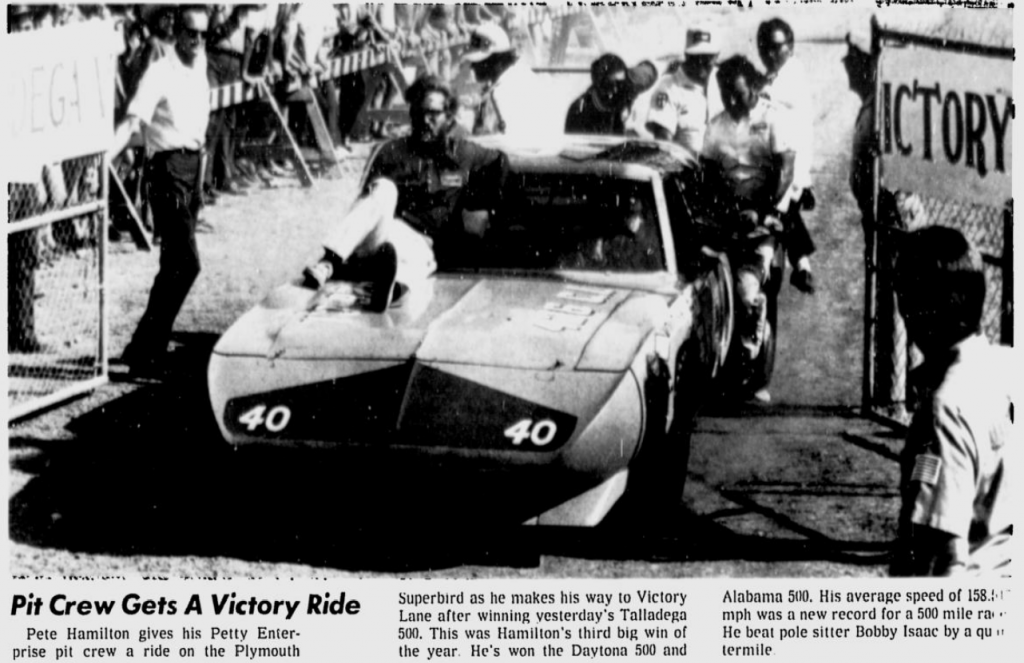
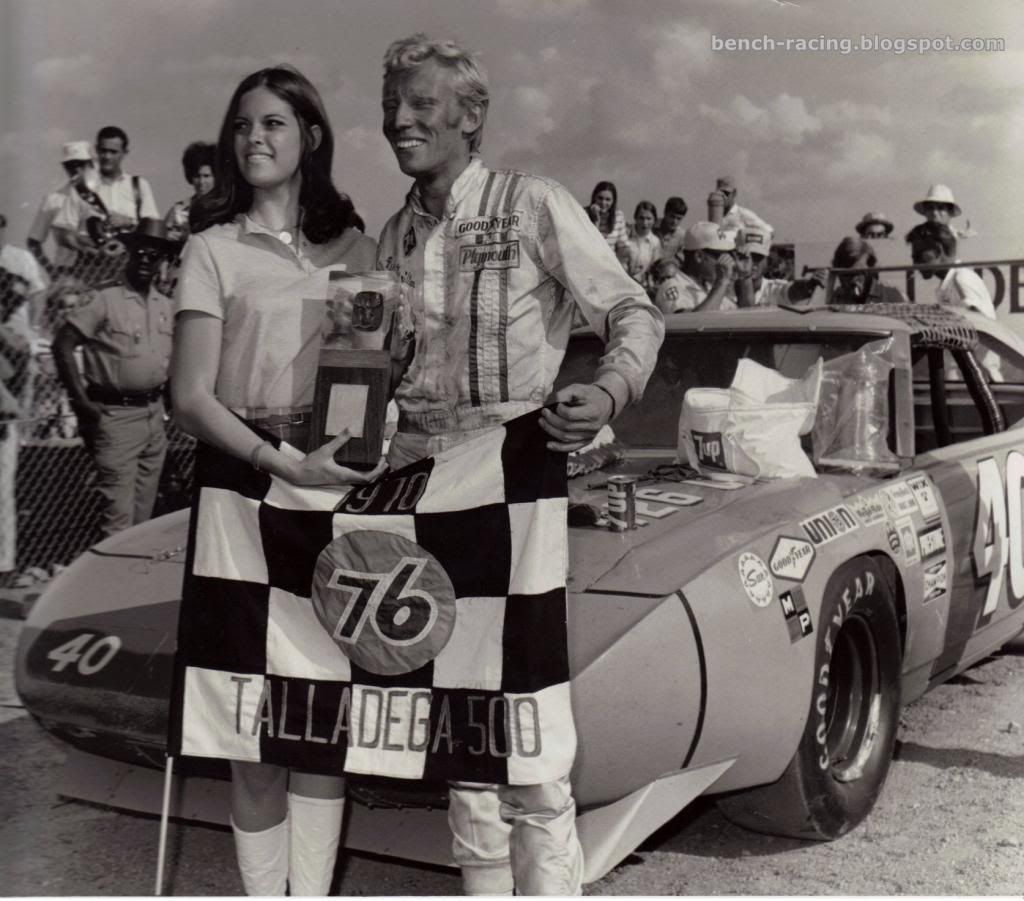
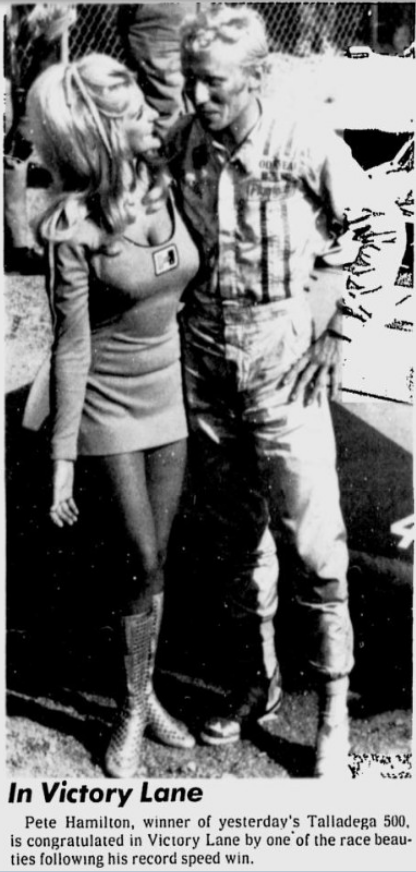
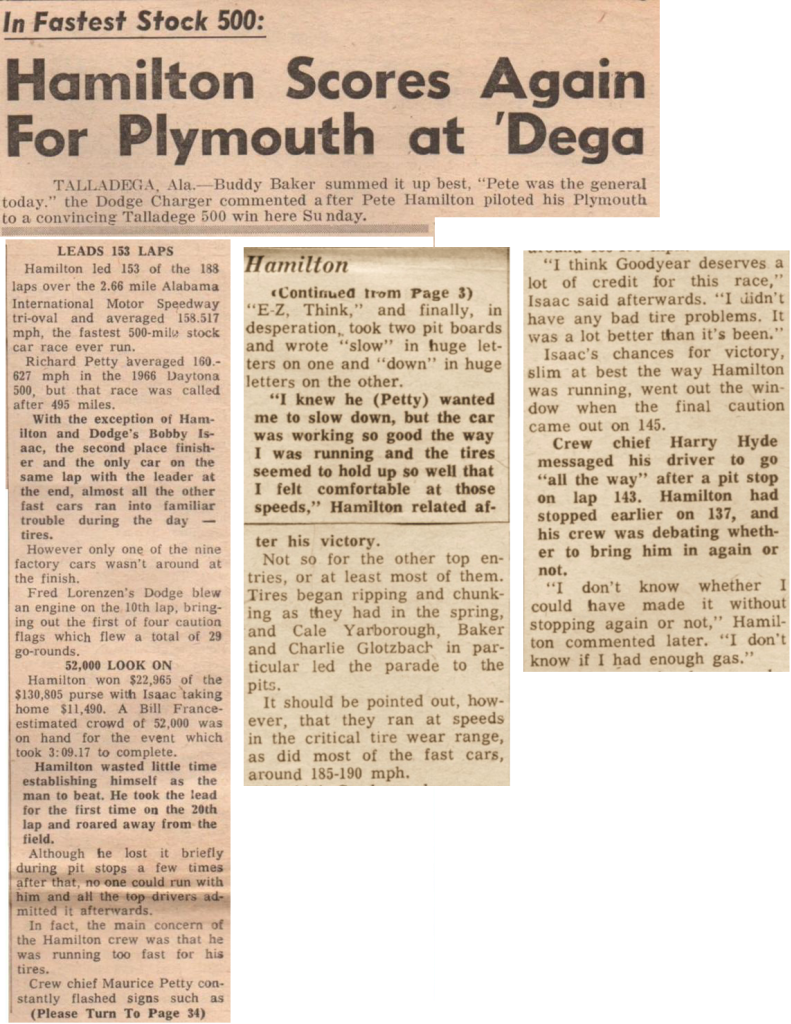
August 23, 1970: Starting fourth in the #40 Petty Plymouth Superbird, Pete Hamilton puts a whoopin' on the field in the Talladega 500. Hamilton led 153 of 188 laps. The remaining laps were sprinkled amongst Bobby Isaac (12), Charlie Glotzbach (6),and six others with five or less laps on point. Hamilton's Petty Enterprises teammate, King Richard, had a pedestrian day in his Bird. He started fifth and finished seventh but with but didn't lead a lap.

The King's 1970 Superbird is one of the two most iconic cars for him (the other being the mid-70s STP red / Petty blue Dodge Charger). In the five Grand National races held at Daytona and Talladega in 1970, however, the 43 ultra-smooth Superbird had zero wins, no top 5s, only three top 10s (1 of which was in a Daytona 500 qualifying race), and zero laps led. Pete, on the other hand, drove his #40 Petty Bird to three wins in his five races, racked up four top 5s, and led 25 percent of the laps in those five races.

Fifty cars started the race. The front row was comprised of Bobby Isaac in the #71 Harry Hyde-prepared winged Dodge Charger and David Pearson in his Holman-Moody Ford. The second row included Charlie Glotzbach and Hamilton. Chargin' Charlie finished second to Richard Brooks in the inaugural Talladega 500 a year earlier.

Fast Freddy Lorenzen, who won 26 Grand National races from 1961 to 1967 with more than 60 Top 5 finishes, still had to sport a yellow "rookie stripe" on his Ray Fox-prepared Dodge. The reason? He'd never raced Talladega before. This led me to wonder if every car ran the yellow stripe a year earlier in the first Dega GN race. Unfortunately for Lorenzen, his prep for his first Dega race and his visual warning to other drivers didn't help much. He finished 49th in the 50-car field after losing an engine only 9 laps into the race.

The race began with the various drivers mentioned earlier leading a lap here and there. Around 40 laps into the race, however, Hamilton began to show 'em who was boss. He went to the front for a 26 lap stint. After surrendering the lead for a lap (presumably for pit stops), the 40 Plymouth went back out front for a dominating 82 laps. With 35 to go, Hamilton passed pole-winner Isaac, waved good-bye, and set sail for the win.

The young driver swept the Talladega races and pocketed the Daytona 500 to boot. Yet that résumé wasn't enough to keep his job. Hamilton won three career Grand National races - all in 1970 - all for Petty Enterprises. Yet when Chrysler move its financial support of Ray Nichels' Dodge team to Petty Enterprises team for 1971, the decision was made to place Baker at PE for the Dodge program and let Hamilton go.


Hamilton raced another few years on a part-time basis, primarily for NASCAR Hall of Fame owner Cotton Owens. Pete's final race was in 1973 at the Atlanta 500. After getting his back nicked up pretty good in some accidents, Hamilton left NASCAR and focused on a successful trucking business he had grown near Atlanta, Georgia. Like many racing fans, I've never had the opportunity to meet Pete - yet I've always wanted to. Once he left NASCAR though, that was it. Except for a handful of appearances over the years for special occasions, he is not involved in the sport in any capacity.

Sports Illustrated latched on to Pete's magical 1970 season and wrote a feature article on him in the June 15, 1970 issue - several weeks before his second Talladega win and several months before he was told he wouldn't be returning to the Petty team in 1971.


The folks at RealRacinUSA.com did a half-hour phone interview with Hamilton back in 2007. For me, it is one of the few extended sessions I've ever heard with him. Your time will be well-spent taking the opportunity to listen to his racing memories and what he does in more contemporary times.

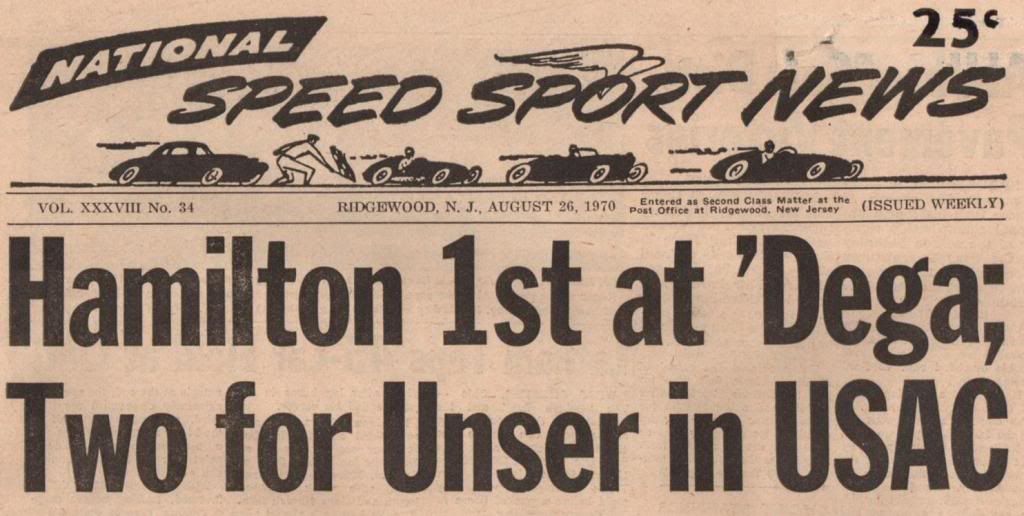
NSSN headline and article courtesy of Jerry Bushmire

TMC