Showing posts with label fred lorenzen. Show all posts

Wednesday, September 6, 2017

September 6, 1971 - Southern 500

Winston cigarettes became the title sponsor of NASCAR's top series in 1971. Because of the timing of the contract, the 1971 schedule was left largely "as is" with 48 races. Many races - primarily short tracks - were cut from the schedule as the modern era, as most refer to it, began in 1972 with 31 races.

In the first year of the Winston Cup Series, the traditional, Labor Day Southern 500 was held on Monday, September 6. The race was the 40th of the 48-race season.

Source: Motor Racing Programme Covers
A legit but convenient way for many to quickly highlight Richard Petty's career is to recall 1967 when the King won 27 of 48 races. A seldom quoted stat is his 1971 season which statistically was his second best career year. Through 39 races leading into the Southern 500, Petty had banked 17 wins, 30 top five finishes, nine poles, and his third Daytona 500.

Despite those gaudy stats, Darlington was a track often too tough to tame for Petty. He generally raced well at Darlington, and he won three times in 1966-1967. But his overall winning percentage didn't apply at Darlington. Yet he was in as good a position as he'd been in some time to win the '71 edition of the Southern 500.

Petty as a favorite was a storyline of the race; however, another one centered on a popular driver suddenly involved in a bit of Silly Season. Fred Lorenzen was a winning driver from the early through mid 60s and was always a Ford man. He then walked away unexpectedly in 1967. Lorenzen returned for a a handful of races in 1970 before signing a deal with STP to race Ray Nichels' Plymouth in 1971.

The #99 Plymouth car was sharp looking, and Lorenzen earned a top 5 finish in about half of his 13 starts prior to Darlington. But Lorenzen also complained the car wasn't where it needed to be. He quit Nichels' team after the Talladega 500 in late August - though technically he remained under contract with STP.

Interestingly, STP allowed him to step away from their sponsorship for one race - the Southern 500 - to race the Wood Brothers' famed #21 Purolator Mercury. The Woods' regular driver in 1971, Donnie Allison, had to skip the Southern 500 because of a commitment to race in the California 500 Indy car race at Ontario Motor Speedway the day before Darlington.

Source: Spartanburg Herald via Google News Archive
Credit: Wood Brothers Racing
STP didn't want to leave Nichels without sponsorship after Lorenzen's departure. Dave Marcis was hired to pilot the #99 Plymouth for Darlington for what was supposed to be a one-time deal.

Lorenzen's second career race attempt with the Wood Brothers went horribly wrong in pre-qualifying practice. He pounded the outside wall of the frontstretch, rode the outside wall, sailed off the wall, and then made a beeline to drill the inside pit wall. In doing so, his #21 Mercury tore a chunk out of the pit wall reminiscent of Richard Petty's hit a year earlier in the Rebel 400.

Lorenzen was knocked cold and had to dragged out of his smoldering car by drivers Joe Frasson and Bill Seifert rather than track emergency personnel. He wasn't critically injured and returned three races later (coincidentally in a reunion with Nichels), but he and the Woods were done for the weekend.

Source: Spartanburg Herald
The Wood Brothers loaded up their destroyed car and headed home to Stuart, Virginia. As a result of Lorenzen's wreck, Glen, Leonard, and Delano missed their first Southern 500 since 1962. The possibility existed the Woods may not race again. Glen was frustrated with many of NASCAR's quickly shifting rules and was shaken by Lorenzen's wreck.

Racing can often be brutally cold when a bad wreck happens because the show always continues. Qualifying was held after practice, and Bobby Allison won the pole in his Coca-Cola, Holman Moody Mercury. Pete Hamilton lined up outside of Allison in Cotton Owens' Plymouth. Charlie Glotzbach timed third, and Buddy Baker qualified fourth in the #11 Petty Enterprises factory-supported Dodge. Marcis locked in the fifth starting spot in Nichels' Plymouth.

Actor James Brolin was the race's grand marshal and a judge at the annual Miss Southern 500 pageant.

At the time, Brolin was known for his role on the TV show Marcus Welby MD. He had a few other minor roles over his acting career. Brolin is perhaps best known, however, for his scintillating role as Pee Wee Herman in the movie Pee Wee's Big Adventure.

When the green dropped, the race developed into one of high attrition and few lap leaders. Bobby Allison led 65 of the first 90 laps with Bobby Isaac leading a stretch of 24 laps to break Allison's lead time out front into two segments. Petty took the lead for a few laps before Allison again went to the point for nearly 200 of the race's next 210 laps.

Pete Hamilton, who started second, fell out of the race after completing 157 laps after his Plymouth's engine developed an overheating issue. He immediately went to Petty's pit to see if his employer from 1970 might need a relief driver. Petty waved him off at the next stop and went the distance. Isaac, however, was gassed and did need the help.

Dick Brooks was truly the yeoman of the race by driving three different ride and three different brands of cars. His own Pontiac was done after only eight laps because of overheating. A bit later, he was asked to relieve Bill Dennis in Junie Donlavey's #90 Mercury. That ride made it to around lap 265 before it lost power because of a failed battery.

Brooks then took over for country singer and part-time racer Marty Robbins. He helped Robbins' Dodge finish 7th - a career best at the time for Robbins and topped later only by a 5th place finish in 1974. Marty was pleased as punch at the finish. He was also voted rookie of the race - which is interesting considering he only raced about three-quarters of the race before turning the car over to Brooks.

Petty hounded Allison as the Coke Machine led lap after lap. After turning down Hamilton's offer to spell him, Petty's exhaustion began to set in a bit. With 50+ laps to go, Petty simply had to have a drink of water to continue. He hit pit road with the expectation of having a cup quickly shoved to him. Instead, the Petty crew had a mix-up on what was to happen. A crewman spun off the fuel cap in anticipation of adding gas. Petty took off with his cup of water - but also with his fuel cap dangling from its tether.

The King had to make a second unscheduled stop to replace the cap, and the race was then effectively over. Petty admitted he likely would not have been able to catch Allison - even without the botched stop for water.

Embed from Getty Images

Baker - winner of the 1970 Southern 500 for Cotton Owens and the spring 1971 Rebel 400 for the Pettys - finished third. Isaac's #71 Dodge finished fourth with Hamilton at the wheel, and Marcis wheeled Nichels' STP Plymouth to fifth.

The race was the 25th of 51 times rivals Petty and Allison finished in the top two spots. Allison won his first of an eventual four career Southern 500 races. Petty also finished second in 1975 when Allison captured his third Southern 500.


Source: Spartanburg Herald
After going home, cooling off, and rethinking things following their awful Darlington trip, the Wood Brothers agreed to continue doing what the Wood Brothers do: race. When the teams arrived in Martinsville later in September, the famed 21 Mercury was there with Donnie Allison at the wheel.

Two races after Darlington in the National 500 at Charlotte, Marcis was back in Nichels' STP Pontiac. But after a heated argument with the crew over handling and tires, Marcis parked the car and quit the team.

Three races after Darlington at Dover, Lorenzen was back at the wheel of the STP Plymouth. Once again, however, Lorenzen's day ended early, and he again parted ways with the team.

TMC

Sunday, October 18, 2015

October 18, 1964 - National 400

The fall 1964 race at Charlotte Motor Speedway was race number 59 of a long, grueling 62-race season. As is known to many, the 1964 auto racing season was filled with several tragic losses - both in NASCAR and in Indy Car. Two of those driver deaths came at the track which hosted the National 400. Yet, racers did what racers do - they continued.

Source: Motor Racing Programme Covers
As noted on the program cover, CMS hosted its first ARCA race in October 1964. Though banned from NASCAR by Bill France Sr., Curtis Turner returned to the track he helped build and won the 200 miler overseen by a different sanctioning body. Because of persistent rain all weekend, however, the ARCA race was postponed one week.

First-day qualifying was held on Wednesday before the rain spurred on by Hurricane Isbell arrived, and Richard Petty laid down a track record lap to put his Hemi-powered Petty Engineering Plymouth on the pole. Paul Goldsmith, driving a Ray Nichels Plymouth qualified second to reverse the front row starting order from the 1964 Daytona 500.

Fred Lorenzen in his Holman Moody Ford timed third, and Bobby Isaac in another Ray Nichels car - a Dodge - secured the fourth position. Jim Paschal rounded out the top 5 starters in a second Petty Plymouth. Practice, qualifying and and the ARCA race were washed out because of the rain on Thursday through Saturday.

Source: Daytona Beach Morning Journal via Google News Archive
The race at Charlotte was the first since the death of Jimmy Pardue who died during a Goodyear tire test in September. Pardue's death was the second resulting from accidents at Charlotte and the third Grand National driver to be killed in 1964.

Fireball Roberts suffered critical burns during May's World 600 and died about six weeks later. Joe Weatherly - the two-time defending GN champion - died during the Motor Trend 500 at Riverside in January 1964. In addition to those deaths in NASCAR, Eddie Sachs and Dave MacDonald perished after they wrecked and suffered critical burns on lap 1 of the Indianapolis 500. Another Indy driver, Bobby Marshman, died in December 1964 following a tire testing accident in Phoenix. 1964: a truly gruesome year for motorsports.

Source: Eugene Register Guard via Google News Archive
Paul Goldsmith led lap one when the race's green flag waved. Petty then took over for 26 laps before Goldsmith returned to the front. Lorenzen took the lead on lap 69 but only for three laps before Petty re-assumed the lead for 63 laps. Petty's teammate, Jim Paschal, took over on lap 199 but led only a single lap. Petty went back out front where he would stay until lap 265 of the race's 267 laps.

Courtesy of Jerry Bushmire
For the final 65 laps, Lorenzen ran right on Richard's back bumper and made move after move to take the lead. The two cars ran off and hid from the rest of the field, and the duo even lapped Paschal's third place car. But Lorenzen could not get his Ford past the rapid Plymouth. Fred tried lap after lap - high, low, and even moving Richard aside going into three - but he simply could not get past the 43.

Courtesy of Jerry Bushmire
As the two cars entered turn three on lap 265 and looking for the white flag coming off four, the blue Plymouth darted to the right and slammed into the guard rail with tremendous force. The blown right front and subsequent impact threw the 43 high into the air, but it came down on all fours and coasted to the inside of the track. Lorenzen darted to the inside and came off four to take the white and caution flag together.

When the Plymouth came to rest, Richard was lying down in the seat having been jerked out of the shoulder harness by the force of the impact. It was a scary moment for the fans because Pardue had hit the rail in the same place a month earlier. Richard said in an interview after the race, "When it blew, it seemed like it took two hours to get to that fence. I went the same route Pardue did. I was just lucky enough to stay inside the track".

Source: Daytona Beach Morning Journal via Google News Archive
Fellow Petty fan Tim Leeming recalls:
My friends and I were parked against the fence midway between turns three and four. We absolutely yelled ourselves hoarse with that battle between Richard and Freddie. Richard's tire blew almost in front of where were were standing. We watched the car hit the wall and thought for a minute it would be going over in the same place Jimmy Pardue was killed. Charlotte Motor Speedway said they had reinforced the rail there, and that may have been the difference that saved Petty from going over.

When the car slid to a stop, we were running in that direction. It was very scary not to see Richard sitting up in the car, but he almost immediately popped up. We didn't know he had come out of his shoulder harness at the time. We headed for the pits, happy Richard was OK but really upset because Freddie won that race. At that time, we rated Fords along with garbage trucks as our least favorite vehicles.

As soon as they opened the pit gate, which they did after the races back then, we headed for the Petty truck. We waited a while before Richard came over, nursing what appeared to be a very sore arm. I remember being so glad to see that he was OK. All of us started talking at once, and Richard smiled and waved his hand telling us one at a time. He explained to us that everything was OK and we would get 'em next time. And yes, he did use we. That was the way we talked back then. We (all of us who followed him from race to race) were unofficially part of the Petty team.
Lorenzen continued around the final circuit under caution to take the win. Paschal finished second in the #41 Petty Plymouth, one lap down to Lorenzen's pearl white #28 Ford.

Courtesy of Smyle Media
Source: Spartanburg Herald via Google News Archive
Despite the wreck, Petty finished third, two laps down to the winner. Petty's bad luck finish at Charlotte was just one of many for him through the 1960s and early 1970s. He seemed to routinely run well - and even dominate parts of races. But a win at the track just never seemed to fall his way. The King was finally able to grab a winner's trophy of his own in 1975 when he swept the season's races at Charlotte - the World 600 and the National 500.

Source: Spartanburg Herald via Google News Archive
As might be expected, the winner confidently concluded he had Petty right where he wanted him anyway. Regardless of Petty's blown tire and wreck, Lorenzen was certain he would have been able to pass the 43 on the last lap - though he had been unable to pass him throughout the rest of the race.

Source: Statesville Record and Landmark
Thanks to Tim Leeming for much of the text for this post.

TMC
Tuesday, July 28, 2015

July 28, 1963 - Fearless Freddy Bests Bristol

NASCAR's Grand National drivers migrated south to Bristol TN for the third Volunteer 500 on July 28, 1963. A week earlier, the cars had raced the road course in Bridgehampton, New York.

Fred Lorenzen won the pole in his #28 Holman Moody Ford. Fireball Roberts won Bristol's spring Southeastern 500 and took the outside spot on the front row for the Volunteer 500 in his #22 HM Ford.

Source: Spartanburg Herald
On the second day of qualifying, Jim Paschal was quickest in the #42 Plymouth as a teammate to Richard Petty. G.C. Spencer - who eventually settled in nearby Johnson City, TN - had to win a 20-lap hooligan race to make the race at his home track.

During a practice session the same day as the second round of time trials, Fireball just about lost his weekend. As he attempted a high-side pass of another car, he started to spin and clipped the guardrail with his right rear quarterpanel. He successfully righted the car and lived to see raceday - though his crew did have some body work to repair before Sunday's event.

It's hard to visualize Bristol in its early years compared to what it seats today. But for year 3, the race drew a great crowd.


Lorenzen led the opening lap as the green was dropped. Junior Johnson then went from his third place starting position to the lead on lap 2 and stayed there for 160 circuits. A faulty alternator and bad battery then took its toll on Junior's Holly Farms Chevrolet. He ended up finishing 22nd, 93 laps down to the winner.

Lorenzen's car began trailing smoke from the start of the race. As it turns out, the 28 had a broken piston. Many thought the Ford's engine would blow at any time. Instead, Fast Freddy rode his steed all. day. long. As Junior faded, Lorenzen went up front and led 154 of the next 155 laps.

The one lap during that stretch he didn't lead was claimed by Paschal. But right after taking the lead, Paschal hit pit road. He was suffering from heat exhaustion and needed an assist. Lee Petty, whose driving career was reduced to a handful of starts following a near-fatal accident at Daytona in 1961, took over in relief.  Lee served in the same role in April when Paschal needed relief during the Virginia 500 at Martinsville. Lee spelled Paschal for about 100 laps before Jim went back into the car. Amazingly, the 42 finished third just one lap down to the top two finishers - even with 2 driver changes!

The race had seven cautions. The most significant one of the day involved Fireball. Though he saved his car during Saturday's practice session, the same couldn't be said for the race itself. He popped the guardrail and went for a series of flips. Fortunately, a sprained back was his only notable injury.


Source: National Speed Sport News
With each lap Lorenzen led, the 43 of Richard Petty kept pace. The Plymouth driver hounded Lorenzen, but he couldn't (or wouldn't) make the pass. With just under 200 laps to go, the future King did get the lead - but only for 3 laps. Lorenzen retook the lead and decided he may as well keep it.

As the lap count hit 450, Petty decided it was go-time. He intensified the pressure on Lorenzen. The blue Plymouth pulled even with the white Ford - but again, he simply couldn't make the pass.

The duo battled for the final 20 laps. In the end, however, Lorenzen pulled ahead of Petty by several yards to notch his first of three consecutive Bristol wins. Petty's close-but-no-cigar P2 was his first of several moral victories at Bristol.

Petty likely couldn't complain too much though. With wins at Bridgehampton a week earlier and another win at Greenville-Pickens two days later, a second place at Bristol probably wasn't viewed as all that bad an effort.

Source: Spartanburg Herald
TMC
Sunday, July 26, 2015

July 26, 1964 - Oh so close in the Volunteer 500

Richard Petty finished second to Fred Lorenzen in the 1963 Volunteer 500 at Bristol. On that particular day, it was all Lorenzen all day. Except for an early stretch of 180 laps led by Junior Johnson and a smidgen led by others, Fast Freddy led the rest of 'em.

When the Grand National drivers returned the next March for Bristol's Southeastern 500, Lorenzen again showed the way. His domination was even more complete than the previous summer. He led a staggering 494 laps yielding only the first six to Marvin Panch who had started from the pole. Petty finished a pedestrian 8th in that race.

The circuit was back in East Tennessee on July 26, 1964, for the fourth annual Volunteer 500.

Lorenzen was obviously eligible to three-peat, but an element of doubt finally existed for him and those trying to de-throne him. During a July 2nd 50-mile qualifying race at Daytona for the Firecracker 400, Lorenzen was involved in a pretty significant wreck. Paul Goldsmith lost it during the event and spun. Several cars spun behind him, and one tagged Lorenzen hard into the driver's side "door".

Source: Daytona Beach Morning Journal via Google News Archive
Lorenzen was able to pull himself from the car, but he had to miss the Firecracker. He was hospitalized with seriously bruised ribs and a severed wrist tendon. After a couple of weeks of recovery, Bristol was slated as his first race back following the accident.

Country and pop singer Brenda Lee performed a pre-race show in the Tri-Cities. And by pre-race, it means she performed the Night before vs. Right before the race.

Source: Kingsport Post via Google News Archive
After finishing second to Lorenzen a year earlier and being a non-factor in March 1964, Petty got off to a good start by laying down the top qualifying speed in his Plymouth.


When the green flag dropped, the 43 put a hurtin' on the field as Lorenzen had done the previous two races at Bristol. Paul Goldsmith was back from his Daytona accident, qualified second, got the jump on Petty at the start, and led the first twelve laps.

Petty got by Goldsmith on lap 13 and then led just about the next 300 laps. Near the end of that stretch, Lorenzen was just about worn out in his first race since Daytona. He'd started eighth and hung around, but he was hurting. At lap 276, he hit pit road and let fellow Ford driver Ned Jarrett take over for a while.

Lorenzen wasn't the only one struggling to stay in the car. Jim Paschal won the 1962 Southeastern 500 driving for Petty Enterprises, and he was back in the #41 Petty Plymouth as a teammate to the King in the 1964 races. Around the mid-point of the race, Paschal could take no more. The summer heat combined with only one caution early in the race drained Paschal.

Billy Wade took over in relief to the surprise of many. Wade was riding the wave of a four-race winning streak in Bud Moore's Mercury. He was a FoMoCo guy. But after falling out of the race with engine woes, Wade didn't get hung up on manufacturer loyalties. He went to Paschal's pit, belted in, and drove the second half of the race.

After Petty's nearly 300-lap butt kickin' on the field, Junior Johnson then went to the point for 45 laps - presumably during a series of pit stops. But it wasn't as if Junior could stay there. It was Petty's day.

The King then went back out front for another almost 150 laps to end the race. The key modifier here is "almost". With a dominating day, a multi-lap lead on the second place runner and the the race well in hand, it was just a formality for the 43 to take the checkers.

But then it happened.

With four laps to go, Petty's Hemi soured. He limped around for three more laps in an effort to win the race. A broken power plant and declining inertia slowed the car. Finally, Petty brought the car to pit road on lap 499.


Lorenzen got a second wind and had taken back his #28 Holman Moody Ford from Jarrett with about 50 laps to go. Somehow even with two driver swaps, Lorenzen found himself in second place - though he had to make additional circuits to unlap himself. And then with the 43 sitting silently on pit road, he took the checkered flag for his third consecutive Bristol victory.

In somewhat of a statistical anomaly, Petty was credited with second even though he did not finish. Paschal was credited with third in the second Petty car and with Wade at the wheel.

Source: Free Lance-Star via Google News Archive
I believe one reason among many why Richard Petty won so many races over his career is that he didn't dwell on the races that he lost. When his driving career was complete, the King had raced sixty times at Bristol. Yet, he only had three wins in the bank in all those starts. A fourth one was his for the taking in 1964 but simply wasn't meant to be.

TMC
Thursday, August 7, 2014

August 7, 1966: A day of Blue and Yellow

Three years ago, I began a year-long project of blogging about each of Richard Petty's 200 wins. As I routinely reference many of the entries, I realize how little detail I included about the races as I began the series as compared to my content as I started winding down the series 10-12 months later. I've continued to tweak many of the blog posts as I learn new info, correct errors, find another photo or two, etc. - but I leave the original posted date "as is".

One of my posts was for Petty's win on August 7, 1966 in the Dixie 400 at Atlanta International Raceway. The victory was the King's 48th of his career but his first at Atlanta. I've got much more info I now want to include and decided to blog an entirely new post.

Source: Motor Racing Programme Covers
The combo of blue and yellow at the race track could be interpreted in a few ways such as...
  • The blue flag with yellow stripe move-over flag often displayed to slower drivers as leaders approach them
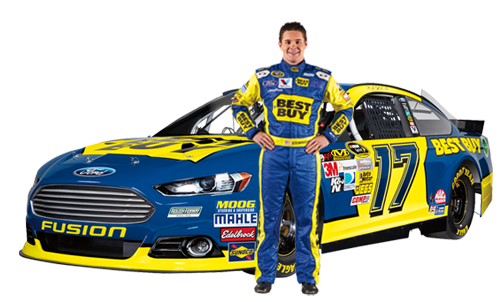
  • Ricky Stenhouse's Best Buy Ford in contemporary times
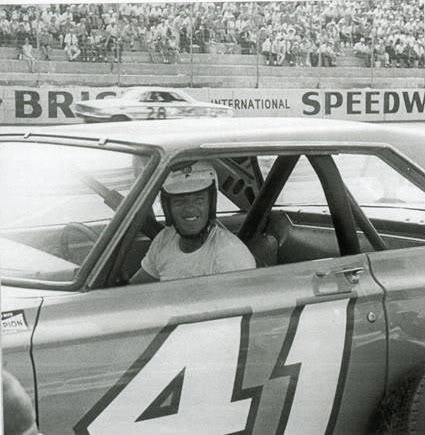
  • Jim Vandiver in the good ol' days. 
But on August 7, 1966, the two primary storylines at Atlanta were Richard Petty's Petty Blue Plymouth and Junior Johnson's infamous Yellow Banana Ford driven by Fred Lorenzen.

NASCAR made several rules changes to slow Chrysler's hemi engine that dominated many races in 1964. As a result, Chrysler parked its Dodge and Plymouth teams for over half the 1965 season. With stars such as David Pearson and Richard Petty on the sideline, NASCAR finally compromised so the money drawing starts would return.

The compromise didn't sit well with the brass at Ford Motor Company so they sat their factory-supported teams for much of 1966. Cooler heads again prevailed, negotiations were held, some backs were scratched I'm sure, and eventually Ford returned to the series.

Meanwhile, FoMoCo clearly wanted cars on the track to help sell ones in the show room. While the finer points of the rule book were discussed behind closed doors, John Holman of Holman-Moody apparently approached independent car owner and retired driver Junior Johnson about building a car for H-M superstar Fred Lorenzen to race. Junior built a Ford alright - but it didn't measure up against its street counterpart at all.

Source: Ray Lamm collection
Long-time NASCAR journalist Tom Higgins wrote in 2012 for ThatsRacin.com:
Junior and his crew arrived at the track with a car that immediately ignited a barrage of fireworks and howls of protest from rivals. The car was supposed to be a Ford, but its profile looked like nothing that had come out of Detroit.

The front sloped downward, the roof was cut very low and the rear end was raised. Because the car carried sponsor Holly Farms’ yellow paint scheme, it was likened to a banana. 

Smokey Yunick, another imaginative car builder, had brought an equally strange-looking Chevelle to Atlanta for driver Curtis Turner.

A ruckus raged over both cars, but they were cleared to race by NASCAR, which rejected three other machines, including those of Ned Jarrett, Bernard Alvarez and Cotton Owens, fielding a Dodge for David Pearson. Owens’ car was rigged with a device to lower the vehicle from the cockpit after the race started.

Turning away Jarrett, Alvarez and Owens – while clearing the cars of Junior and Smokey – further fueled an already incendiary situation.

“I realize that Lorenzen and Turner are valuable drawing cards,” said an irate Owens. “But that doesn’t make what’s happening right.”

The discord doubled, both among fans and competitors, when Turner won the pole at 148.331 mph. Lorenzen qualified third fastest.

“I built the car because John Holman was a friend and he asked me to help him out,” a smiling Junior Johnson said years later. “He said, 'Build me something that will run,’ and I did.

“We had a heck of a time getting through inspection. We took that car to body shops all around Atlanta, making changes before we got it close enough for NASCAR to approve.”

Read more here: http://www.thatsracin.com/2012/03/08/83199/junior-johnsons-one-off-draws.html#storylink=cpy
Though the two primary storylines may have been the Petty and Lorenzen cars, they weren't the only ones. As referenced in Higgins' article, Curtis Turner won the pole in Smokey Yunick's #13 Chevrolet. Earl Balmer in Nord Krauskopf's Dodge timed second. The Banana started third - right behind Turner's car.


Turner had raced only a limited GN schedule since Bill France reinstated Turner in 1965 from a 'lifetime ban'. And Smokey had fielded cars in less than a dozen Grand National races - total - since 1961. Yet here was the pairing with the quickest lap at Atlanta. Many believe Holman wanted that Junior Johnson specially-built Ford to run as a counter to what was expected to be a similarly tricked-up Chevy out of Smokey's Best Damn Garage in Daytona Beach.

The race had a double-helping of Petty Blue as Marvin Panch drove a second Petty Plymouth. It was Pancho's second of four starts for the Pettys in 1966. Unfortunately he lost the clutch, ended up in the fence, and finished 28th.

Ol' Blue and the Yellow Banana side by side - albeit in Black and White.


Schaefer Ring of Honor member "Bruton" (also known to many as as GaPettyFan) recalls:
The 1966 Dixie 400 - my first race and I had yet to even turn three. I don’t remember the events prior to the race, but my grandfather told me later that on the pace laps he picked up one of us while my Dad hoisted my twin brother. They pointed out Ol’ Blue and told us, “See that blue car? That’s Richard Petty. That’s who we pull for.” The King won my first time out! He started fifth, led 90 laps, and earned $13,525 for his efforts. [TMC: dang good memory for a kid who was three at the time!] My Dad had a brand new, bright red ’66 Chevelle that was gorgeous. He got good and drunk that day. After the race some poor schmoe backed into it. My Dad immediately jumped out of the car (my Grandfather was driving) and wanted to fight the guy. Yes, I come from impressive stock. I was so scared I peed all over myself. Sadly, I remember that part.
The big personalities of the race, however, didn't deliver. Turner lost a distributor in Smokey's engine around the halfway point of the race. Then a few laps later, Lorenzen blew a tire, slipped on a peel, and wrecked Junior's Yellow Banana. After starting first and third, the two cars finished 23rd and 24th.

Meanwhile, who spent the most time up front? The Mopars - the brand that dominated in 1964 - routinely flexed its muscle again in 1966. The Petty Blue 43 Plymouth paced the field for 90 of the race's 267 laps, and Buddy Baker led 62 laps en route to a second place finish in Ray Fox's Dodge.

Petty flashes across the finish line as he takes the checkers.


Time in victory lane never sucks - especially when you're the King.

Source: The Tennessean
Article courtesy of Jerry Bushmire
TMC
Friday, August 23, 2013

August 23, 1970 - Pete Doubles-Up At Dega

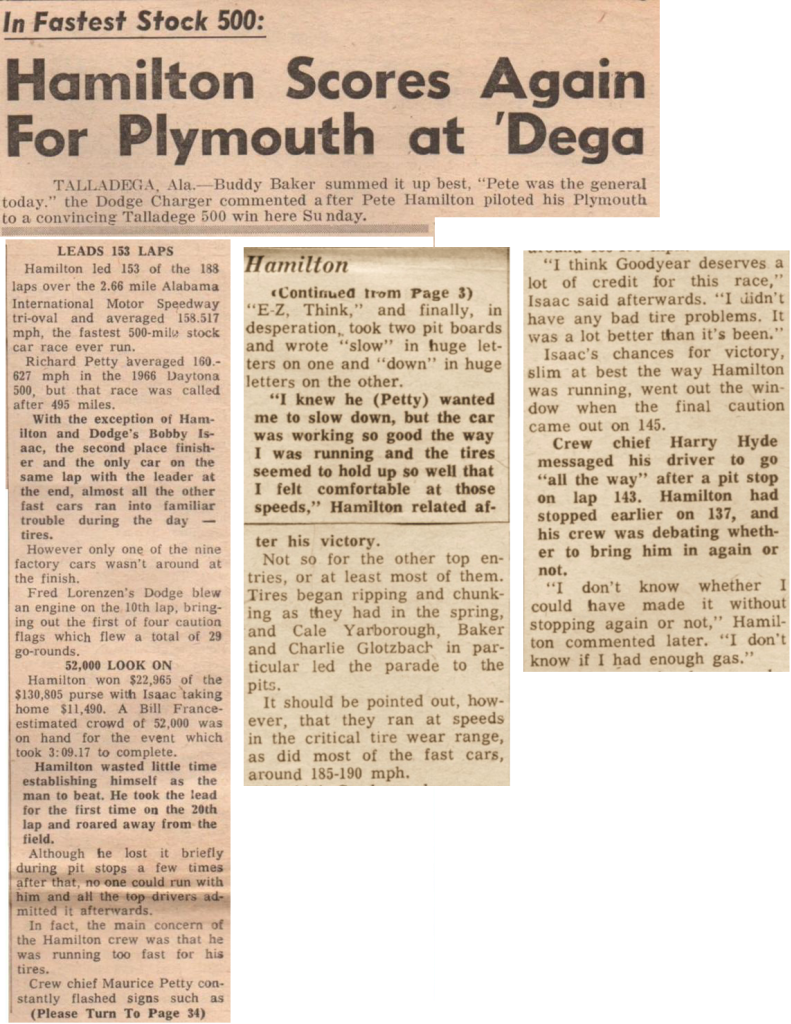
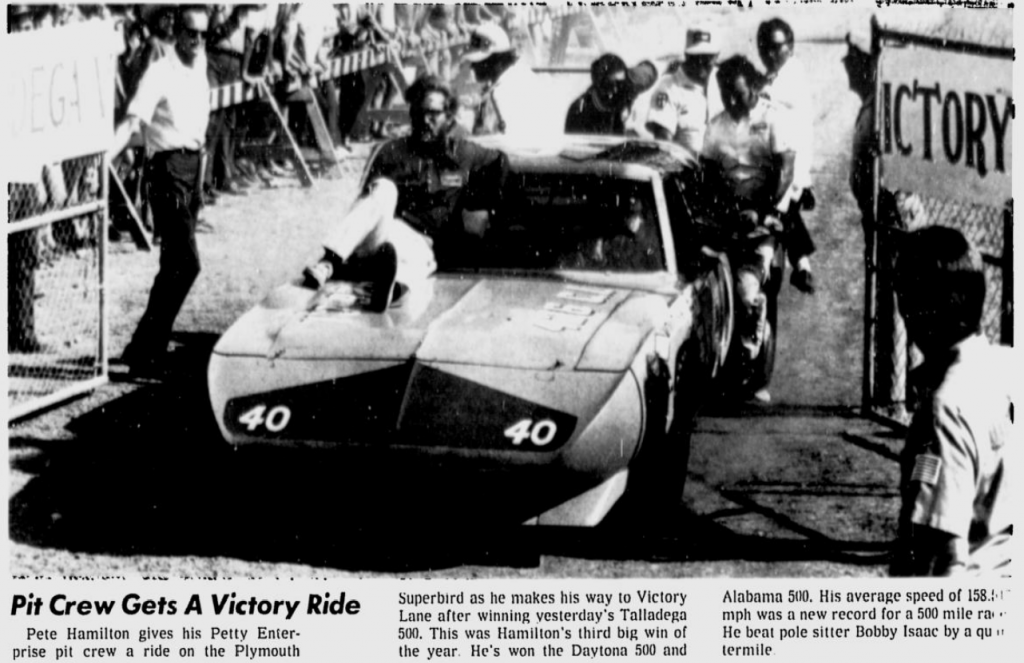
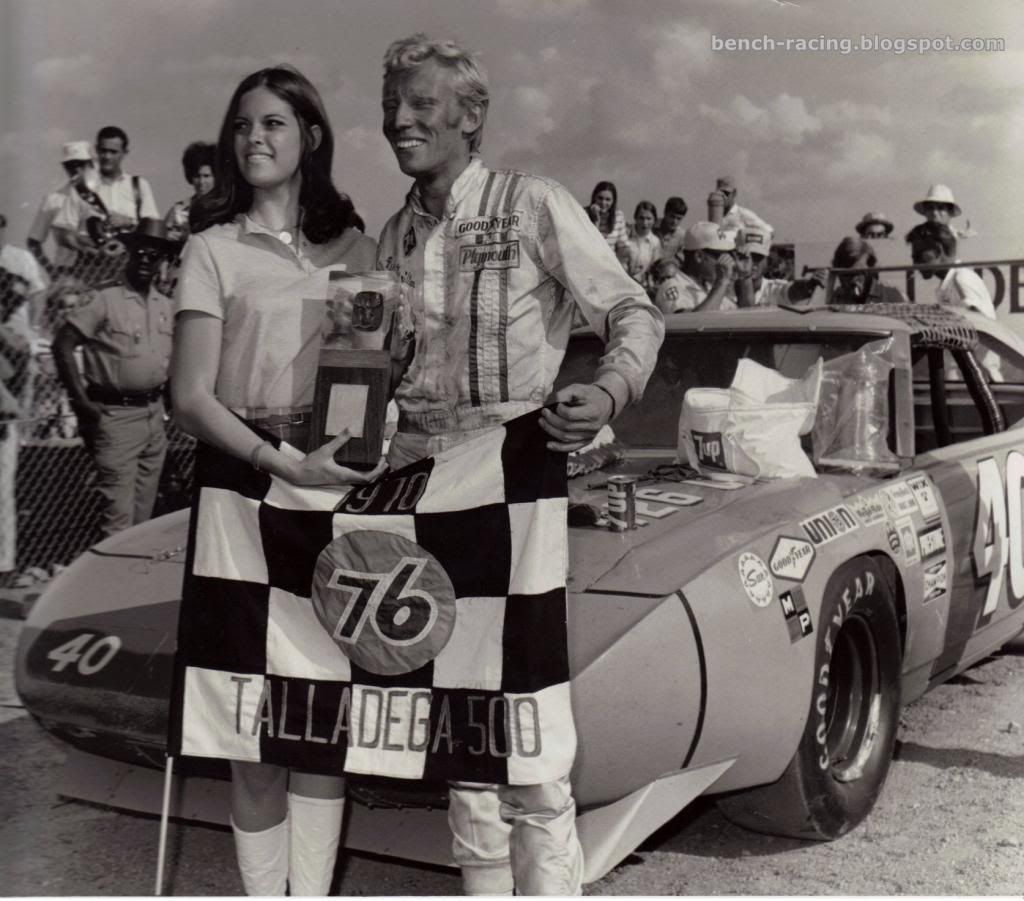
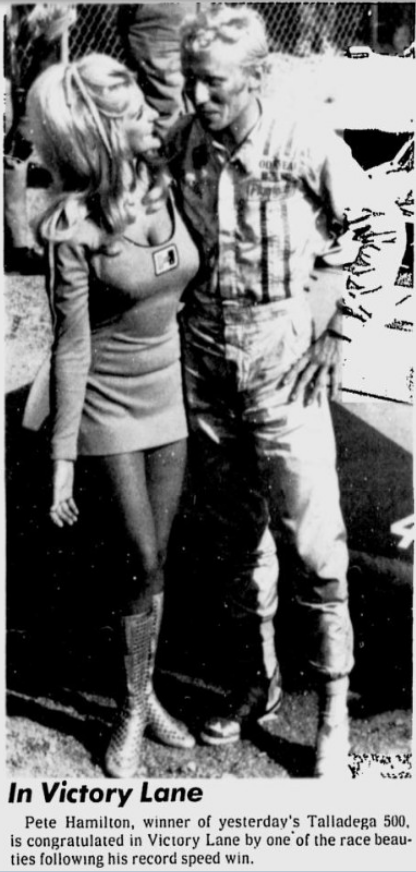
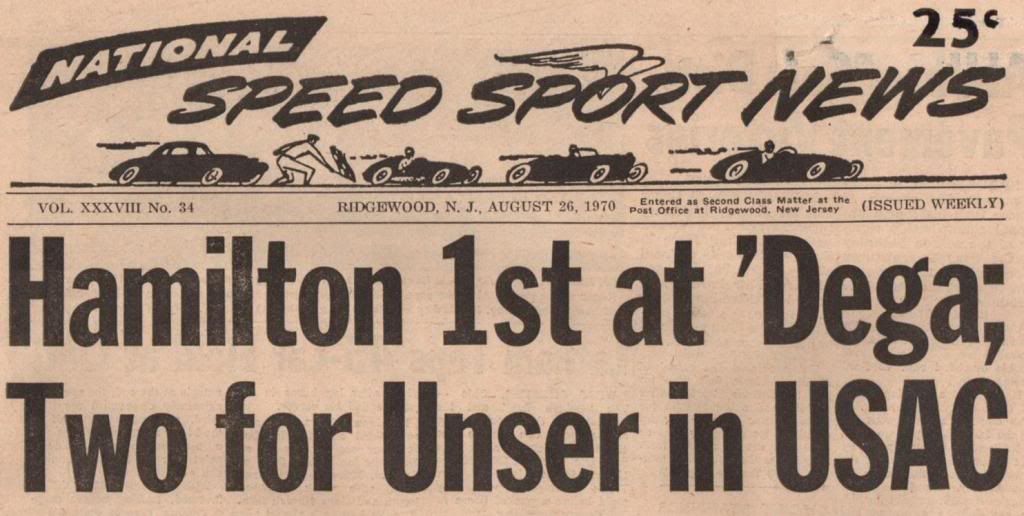
August 23, 1970: Starting fourth in the #40 Petty Plymouth Superbird, Pete Hamilton puts a whoopin' on the field in the Talladega 500. Hamilton led 153 of 188 laps. The remaining laps were sprinkled amongst Bobby Isaac (12), Charlie Glotzbach (6),and six others with five or less laps on point. Hamilton's Petty Enterprises teammate, King Richard, had a pedestrian day in his Bird. He started fifth and finished seventh but with but didn't lead a lap.

The King's 1970 Superbird is one of the two most iconic cars for him (the other being the mid-70s STP red / Petty blue Dodge Charger). In the five Grand National races held at Daytona and Talladega in 1970, however, the 43 ultra-smooth Superbird had zero wins, no top 5s, only three top 10s (1 of which was in a Daytona 500 qualifying race), and zero laps led. Pete, on the other hand, drove his #40 Petty Bird to three wins in his five races, racked up four top 5s, and led 25 percent of the laps in those five races.

Fifty cars started the race. The front row was comprised of Bobby Isaac in the #71 Harry Hyde-prepared winged Dodge Charger and David Pearson in his Holman-Moody Ford. The second row included Charlie Glotzbach and Hamilton. Chargin' Charlie finished second to Richard Brooks in the inaugural Talladega 500 a year earlier.

Fast Freddy Lorenzen, who won 26 Grand National races from 1961 to 1967 with more than 60 Top 5 finishes, still had to sport a yellow "rookie stripe" on his Ray Fox-prepared Dodge. The reason? He'd never raced Talladega before. This led me to wonder if every car ran the yellow stripe a year earlier in the first Dega GN race. Unfortunately for Lorenzen, his prep for his first Dega race and his visual warning to other drivers didn't help much. He finished 49th in the 50-car field after losing an engine only 9 laps into the race.

The race began with the various drivers mentioned earlier leading a lap here and there. Around 40 laps into the race, however, Hamilton began to show 'em who was boss. He went to the front for a 26 lap stint. After surrendering the lead for a lap (presumably for pit stops), the 40 Plymouth went back out front for a dominating 82 laps. With 35 to go, Hamilton passed pole-winner Isaac, waved good-bye, and set sail for the win.

The young driver swept the Talladega races and pocketed the Daytona 500 to boot. Yet that résumé wasn't enough to keep his job. Hamilton won three career Grand National races - all in 1970 - all for Petty Enterprises. Yet when Chrysler move its financial support of Ray Nichels' Dodge team to Petty Enterprises team for 1971, the decision was made to place Baker at PE for the Dodge program and let Hamilton go.


Hamilton raced another few years on a part-time basis, primarily for NASCAR Hall of Fame owner Cotton Owens. Pete's final race was in 1973 at the Atlanta 500. After getting his back nicked up pretty good in some accidents, Hamilton left NASCAR and focused on a successful trucking business he had grown near Atlanta, Georgia. Like many racing fans, I've never had the opportunity to meet Pete - yet I've always wanted to. Once he left NASCAR though, that was it. Except for a handful of appearances over the years for special occasions, he is not involved in the sport in any capacity.

Sports Illustrated latched on to Pete's magical 1970 season and wrote a feature article on him in the June 15, 1970 issue - several weeks before his second Talladega win and several months before he was told he wouldn't be returning to the Petty team in 1971.


The folks at RealRacinUSA.com did a half-hour phone interview with Hamilton back in 2007. For me, it is one of the few extended sessions I've ever heard with him. Your time will be well-spent taking the opportunity to listen to his racing memories and what he does in more contemporary times.

NSSN headline and article courtesy of Jerry Bushmire

TMC