Showing posts with label foyt. Show all posts

Monday, April 4, 2016

April 4, 1971 - Atlanta 500

NASCAR's 1971 season got underway in January at the road course in Riverside, California. West coast regular Ray Elder won the first NASCAR Grand National race branded as a Winston Cup Series race by title sponsor R.J. Reynolds. A month later in the Daytona 500, Richard Petty took advantage of a rare pit stop gaffe by the Wood Brothers for their driver A.J. Foyt.

Two weeks later at Ontario Motor Speedway, Foyt and the Wood Brothers returned the favor. Foyt topped the two Petty cars of Buddy Baker and the King to capture the win. Foyt and the Woods skipped the next four races. Petty ripped off three straight wins at Richmond, Rockingham and Hickory; and David Pearson pocketed his final win with Holman Moody in the Southeastern 500 at Bristol.

Foyt and the Wood Brothers 21 team returned about six weeks after their Ontario win. Super Tex was ready to saddle up to race in the Atlanta 500.

The annual race at Atlanta Motor Speedway in today's era stirs a good bit of debate.
  • What is the ideal date? 
  • How do you gamble against the weather? 
  • Why aren't the stands full? 
  • Why doesn't the track get more support from the greater Atlanta MSA?
In many ways, questions and doubts about the track have lingered for decades. The spring race was anything but a certainty as the calendar turned to January 1971. Atlanta International Raceway - as it was known then - had problematic finances and frequent management turnover throughout the 1960s and was now bankrupt. The owners of Charlotte Motor Speedway had proposed a merger with Atlanta before withdrawing the offer. Another 20 years passed before Charlotte under the corporate name of Speedway Motorsports acquired Atlanta and renamed it.

Rather than liquidating the track's assets for cents on the dollar and stiffing a bunch of lenders and investors, the court fortunately allowed the board of directors to proceed with a restructuring of its finances and operations - including the running of the Atlanta 500 in April.

Source: Wilmington Star-News via Google News Archive
Regardless of one's personal political persuasions, leaders of a business should develop a solid relationship with whoever is in charge at the time. Kind of like Brian France's March 2016 endorse... oh, right. Never mind.

Georgia's governor, Jimmy Carter, professed to be a NASCAR fan. He attended the 1971 Atlanta 500 as he did other races at the track. When elected President, he also invited many NASCAR drivers and others from racing to a dinner at the White House.

Source: Fort Scott Tribune via Google News Archive
Foyt has long been known as a tough old bird. He raced hard, won often, cared little about making friends in racing, and spoke his mind when asked a question. Some have labeled him a jerk - many called him a hero - most have revered him as a legend. But one thing he was for certain - fair. After his Ontario win, he was allegedly quoted by Sports Illustrated as having made a pretty rough statement against NASCAR's regulars.

The statement was provocative in 1971. Had the quote been attributed to Foyt - or anyone else - in today's PC climate, Twitter would explode, the driver would be sent away for weeks to undergo sensitivity training, sponsors would likely bail, and TV "partners" would inexplicably apologize on behalf of the offending driver.

Foyt was pissed, however, as he insisted he did not make the remark. Before the racing action got underway at Atlanta, A.J. wanted to speak to the drivers as a group, explain the situation, and apologize for the whole hullabaloo.

Source: Spartanburg Herald via Google News Archive
After setting the record straight, Foyt went back to work. He put the #21 Purolator Mercury on the pole. Bobby Issac qualified next to him in his #71 Dodge. Two Petty Enterprises Mopars made up the second row - King Richard in 3rd in the Petty blue #43 Plymouth and teammate Buddy Baker 4th in the white #11 Dodge.

Foyt seized the lead when the green was dropped for the first time, and he led the first 36 laps. Petty then paced the field for the next 15 circuits. The exchange of the lead between the two set the tone for the rest of the race. Cale Yarborough and David Pearson - a past and future driver for the Wood Brothers - each led some laps as did Pete Hamilton.

The race, however, was mainly a battle between Foyt and Petty. Each time a driver led a lap or two, Foyt returned to the point for a double-digits chunk of laps.

Despite Foyt being the lap-bully, the 43 Plymouth hung tough. With about 25 laps to go, Foyt hit pit road for the final time. Petty inherited the lead once again and was hoping he'd have enough fuel to stretch it to the end. Instead, crew chief Dale Inman called Petty to pit road seven laps after Foyt's stop. The Plymouth simply didn't have enough gas to go the distance.

Foyt reclaimed the lead for the final time during Petty's stop. He led the remaining 13 laps and won for the second time in only three starts of the 1971 season. Gov. Carter greeted the winner in victory lane along with Miss Falstaff. The late Barney Hall handled the PA duties.


Source: Spartanburg Herald via Google News Archive


True to his word, Foyt did sue Time, Inc., parent of Sports Illustrated, for libel. Two years later in 1973, the court awarded him $75,000.


TMC

Friday, March 6, 2015

March 6, 1977 - Jimmy Insolo wins Ontario

Through much of the 1970s, NASCAR's Winston Cup Series began its season in January at Riverside's road course in California. When Ontario Motor Speedway closed in the early 1980s, Riverside's season opener was moved to the end of the season. Then began the tradition begin of starting the season in February with the Daytona 500.

USAC had its own stock car division for about three decades from the mid-1950s through the mid-1980s. Though the division had several name drivers, many of them were 'double-dippers' - Indy car drivers who also raced in USAC's other divisions - including the stock car one.

USAC started its 1977 season with a twin-bill event at Ontario, another southern California track. Modeled after Indianapolis Motor Speedway, Ontario was a track ahead of its time, but it was woefully underfunded. From the early 70s through 1980, Ontario was the site of NASCAR's season-ending race.

On March 6, 1977, the track promoted the Datsun Twin 200, a pair of 80-lap, 200-mile races for USAC's stock cars and Indy/Champ cars.

A couple of drivers - Bobby Unser and A.J. Foyt - were looking to turn the double by entering both events. Foyt threw down the gauntlet early by winning the pole for the stock car event in his #51 Chevelle. Making his first USAC stock car start, west coast regular, Jimmy Insolo, qualified on the front row alongside Super Tex in his Chevelle. Unser lined up behind Foyt in the third spot in his Camaro.

The 30-car field was a hodgepodge of cars. Some were from the muscle-car class of Detroit such as Unser's Camaro. Others ran full-size sedan models such as Foyt and Insolo in their Chevelles and the 8th place starter, Ohio's Woody Fisher in his 1974 Schlitz Beer Dodge Charger.

Fisher's Charger was built by Petty Enterprises and was the same one he raced to victory in the 1977 ARCA 200 at Daytona about a month earlier.

Foyt set the early pace and let the field know who was boss.

Source: Bakersfield Californian
Unser's day nearly ended before it really got going. With a nudge from Insolo, he spun off turn 3 on lap 16. Bobby sent up a plume of white tire smoke, but his car was otherwise unharmed. After a stop to replace his flat-spotted tires, he went back on the track and was a contender as the race neared its conclusion.

Source: Corona Daily Independent
Foyt was in control of the race though Unser had rallied. With 5 laps to go, however, Super Tex cut a tire and began to fade. Foyt's misfortune quickly became a huge opportunity for others. Insolo's hulking Chevelle and Unser's small Camaro hooked up in the race to the finish. The duo swapped the lead eight times in the final four laps.

Unser took the white lap with Insolo in tow. With the checkers in sight, the two drivers came upon a slower car. Unser went to the inside, and Insolo jumped to the outside putting the lapped car in the middle of a 3-wide sandwich. Insolo carried the momentum off the corner and won by less than a car-length over Unser.

Photo courtesy of Jerry Bushmire
Though the race was Insolo's first USAC stock car race, it was not his first Ontario race nor his first close win. A year earlier, he narrowly defeated L.D. Ottinger in a 250-mile NASCAR late model sportsman race.

Foyt managed to keep his ride under him and came home a disappointing third. Chuck Bown - who later won NASCAR's Busch Series championship in 1990 - finished fourth, and Ron Hutcherson rounded out the top five. Full-time beer distributor and part-time racer Woody Fisher brought home the Petty-built Charger tenth.

Foyt's day wasn't a complete loss. After finishing third in the day's opener, he dusted the field to easily win the Indy car main event race.

The two winners

Photo courtesy of Jerry Bushmire
Source: Corona Daily Independent
Two years later, Insolo played a significant role in Richard Petty's seventh Winston Cup title. When The King needed relief help in the NAPA 400 at Riverside, Insolo was called upon to belt into the 43. He rallied the STP Monte Carlo to a third-place finish behind second-place finisher Darrell Waltrip. Considering Petty won the title over Waltrip by a razor-thin margin, Insolo was instrumental in Petty getting his seventh Cup.

TMC

Sunday, January 25, 2015

19 Shades of (Henley) Gray Part 2

Here is part 1 of my 2-part series about Henley Gray.

Now where was I? Oh yeah...

Petty portion of the story

In mid-1978, Richard Petty made the stunning announcement that Petty Enterprises was leaving Dodge and moving to General Motors. Though the move was carefully made, the readiness for it was not. Petty made his final start in a Dodge in the Talladega 500. Then it was on to Chevy.

Without much lead time, the Pettys had to rally a car. They bought a Monte Carlo from Cecil Gordon, re-worked it, re-painted it, and hauled it to Michigan for its debut. The car ran pretty well and Petty landed a 14th place finish, but he wrecked the car - the only one he had - near the end of the race.

With only six days to spare before the following race, the Volunteer 500 (Bristol's first night race), the team arranged with Gray to borrow his Monte Carlo. The car Henley provided seems to be the same one Elmo Langley raced at Dover - though originally slotted for Woody Fisher.

Credit: Richard Stockman of RIS Photography
The Pettys masked the blue, painted STP day-glo red over the yellow, and raced the car to a fifth place finish.

Credit: Donald Evans at RacersReunion.com
The unfortunate part of the transaction for Gray, however, is his regular #19 Chevy was heavily damaged in a wreck with Dave Marcis and Frank Warren. Photographer David Allio captured the trio as the three cars came together.

Source: Spartanburg Herald Journal via Google News Archive
Super Tex part of the story

When the Pettys decided to switch to GM, they purchased two cars - the Monte Carlo from Cecil Gordon and a Buick from A.J. Foyt. The Buick wasn't a popular choice for teams in 1978, but Foyt and car-builder Hutcherson-Pagan believed the body style had a favorable aero package.

Source: Reading Eagle via Google News Archive
Foyt was lightning quick in the Buick at Speedweeks. He won his 125-mile qualifying twin (the same race in which Woody Fisher exited on lap 1 in Henley's car) and was considered among the favorites in the 500.

About a third of the way through the 500, Benny Parsons blew a tire going into turn 1 with Foyt behind him. Parsons spun down through the grass, had little damage and continued. Foyt had to check up as Parsons began to spin but then lost the car. He spun down to the grass water logged from several days of rain and then began to flip as his car caught the wet grass. He was taken from his destroyed Buick and transported to the hospital.

Foyt spent a significant amount of time rehabbing his injury. But as he proved countless times in his decades of racing, a wreck never kept Super Tex down for long. A new Buick was constructed, and A.J. was ready to run again - this time at Talladega.

He qualified second but started at the rear of the field after pitting on the pace lap to fix an issue with his in-helmet radio. Once the green dropped, however, he served notice the Buick was back in business. In short order, he was up front with the Cup regulars. He finished third proving yet again the Hutcherson-Pagan built Buick was a hoss. It was logical Petty would be interested in the car.

The Petty team examined their new purchase and apparently ran some aero tests on it to compare to the numbers for other makes. At the time, they may have considered running it in superspeedway events in 1979 as A.J. had done in 1978. Instead, the team made the decision to build a new Olds Cutlas 442 speedway car to take to Daytona. The decision was a good one as the King won his sixth Daytona 500. Coincidentally, Foyt was third in his own, new Olds.

Back to Henley

Once the decision was made to build an Olds, the Pettys had no need for the Buick. The sheet metal was removed and given to Henley - perhaps as thanks for letting Richard borrow the Monte Carlo at Bristol. (What Petty Enterprises did with the Foyt chassis remains unknown.)

Henley and his son Steve re-skinned one of their cars (perhaps the one Dick May wrecked at Bristol) with the hand-me-down Buick sheet metal. Dick May raced the 'new' Buick at Martinsville and North Wilkesboro, and Elmo Langley was back behind the wheel of it at Rockingham - still painted in Foyt's Poppy Red paint.

With the 1979 season underway, Henley relied primarily upon the Monte Carlo as the car of choice for the drivers he hired. The Buick was brought to the track only a couple of times for back-to-back races at Nashville and Dover in May. Steve Spencer - Nashville's 1977 late model sportsman division champion - got the opportunity to make his Cup debut in the 1979 Sundrop Music City 420. He drove Henley's Buick, still painted Poppy Red, to a respectable 12th place finish.

The Monte Carlos continued to be painted yellow-and-blue - the scheme that began when it seemed Woody Fisher would be Gray's regular driver in early 1978. Virginia's Lennie Pond, the 1973 Winston Cup Rookie Of The Year, raced the #19 Monte Carlo in the 1979 Champion Spark Plug 400 at Michigan. Coincidentally, Richard Petty won the race - one year after he debuted his newly purchased Monte Carlo at the same track

Courtesy of Ray Lamm
As the 1980 season began, NASCAR's teams faced a mandated obsolescence deadline. NASCAR had announced all cars would be downsized to a 110-inch wheelbase chassis beginning in 1981. The teams had one remaining year to get all they could out of their 1970s era cars. Gray's team again used the Buick - presumably the same one used since getting the old Foyt sheet metal - but focused its use on the superspeedways. J.D. McDuffie raced it in the Daytona 500. John Anderson and Dick May raced it in the two Talladega races - now painted yellow-and-blue.

Source: Rome News-Tribune via Google News Archive
Dick May raced the Buick again at Texas World Speedway, and Henley's son - Steve Gray - raced the #1 Buick for what seems to be the final time in the CRC Chemicals 500 at Dover. (John Anderson raced Henley's #19 Chevy.)

Credit: Steve Gray Facebook
Though 1981 brought new cars and the shorter wheelbase, it didn't bring a new car make or colors for Henley Gray's team. As did many other Cup teams in 1981-1982, Gray chose to run the Buick Regal. He kept the blue and yellow scheme and hired many familiar names to drive it including Dick May.

Credit: John Betts of RacersReunion.com
Henley dramatically cut back the number of races in which he fielded cars beginning in 1981. He continued to build cars on his own - as he'd done from the beginning - and entered a few races each year until he finally called it a career in 1993.

Gray is still around today. He runs his own trucking business in Rome, Georgia.

Thanks to John Evanich, Mark Agee, Jeff Droke, Chris Hussey and Russ Thompson for their assistance. 

TMC

Wednesday, May 7, 2014

May 7, 1972: Pearson Begins His Talladega Triad

After parting ways with Holman-Moody after several successful seasons including two championships, David Pearson ran a pretty spotty schedule in 1971.

In spring 1972, Pearson joined the Wood Brothers' Purolator Mercury team. The Woods already had a great start to the season with A.J. Foyt's winning the pole at Riverside and wins in the Daytona 500 and Miller High Life 500 at Ontario. With Foyt's commitment to Indy cars, he clearly wasn't in a position to run a limited yet regular NASCAR schedule. When Pearson was hired, so began a remarkable team whose success was also immediate and lasted through 1978.

In 1972, the team won the pole and the race in their first outing together - the Rebel 400 at Darlington. Two races later, the NASCAR circuit rolled into Talladega for the Winston 500.

Source: Motor Racing Programme Covers
Bobby Issac won the pole in his Harry Hyde-prepared K&K Dodge Charger.

  Pearson plunked his Mercury right alongside him on the front row. Three legends rounded out the top 5 - King Richard, Bobby Allison and Buddy Baker. Though Petty Enterprises fielded Dodges for Baker in 1971 and 1972, the King was making his first start in a Dodge after switching from Plymouths as was announced before the spring Martinsville race. The 43 team ran a mixture of the two for the rest of the year before turning to Dodges full time in 1973.

Buddy absorbing some race strategy with Maurice Petty and long-time Petty crewman Richie Barz.

A notable racer making his first Talladega start was country music superstar and frequent racer Marty Robbins. He qualified his purple and canary yellow Dodge Charger 9th in the 50-car field.

Over the weekend of Marty's first Talladega first start, some footage was shot for a movie titled Country Music featuring Robbins. Adversaries on the track, Richard Petty and Bobby Allison, became co-stars in the footage. Allison plays the foil to Marty much as he did to the King by saying to Marty "Faron Young's one of my favorite singers."

Another driver making his first overall Cup start was newcomer Darrell Waltrip in a self-fielded #95 brown Mercury. Having relocated from Owensboro, KY to Franklin, TN, the two-time Nashville Fairgrounds Speedway late model champion Waltrip qualified mid-pack in 25th position.


The Alabama Gang was well represented in the race with Bobby and Donnie Allison, Red Farmer and Robert "Paddlefoot" Wales. Though I never met Paddlefoot, he frequently drove the #10 blue and gold Benward late model Chevelle at Nashville for a friend of my father's, Roy Counce.

Courtesy of Russ Thompson
Long time NASCAR independent driver J.D. McDuffie's car was 'sponsored' by Bro. Bill Frazier's ministry. Frazier's race day faith service was also broadcast over the track's PA system for what was believed to have been for the first time. As noted in the caption to the above photo of Marty Robbins, Marty agreed to sing a gospel number during Frazier's service.

Before the race, Pearson learned of the track's 'physical therapist'. Suddenly he developed a bad back and needed a massage. Who amongst us wouldn't find a similar catch in our back with such an available therapist?

Isaac and Pearson were pretty evenly matched most of the day. Pearson led 59 laps, and Isaac led 57. STP and Petty Enterprises teammates Baker and Petty led 32 and 14 laps, respectively.

Around lap 170, Isaac made his final pit stop & returned to the lead. However, the crew apparently didn't get the gas cap back on the car and it dangled in the wind for the next several laps. For reasons of who knows why, it took NASCAR officials about 10 laps to realize the 71's gas cap was indeed flopping and a couple of more to decide what to do about it.

They finally decided to black flag Isaac to force a return back to pit road. But Isaac and Harry Hyde hadn't come that far to give away a race on a technicality. So they continued onward and ignored the black flag. But with just a few laps remaining, Isaac inexplicably tangled briefly with Jimmy Crawford's Plymouth. Crawford went for a slide, and Isaac raced on. But the encounter was enough to let Pearson close the gap and motor on around Isaac to take the win.

NASCAR did not quit scoring the 71. I was under the impression even in the early 70s a driver got 3 laps to observe the black flag or risk having their scoring card pulled. If so, an EIRI interpretation was made that day. Isaac was able to retain his 2nd place finishing position - and apparently the driver and owner points that came with it. He was simply fined $1,500 for ignoring the black flag.

Source: Gadsden Times via Googles News Archive
I realize based on the purse sizes of that era that a $1,500 fine was more significant then vs. now. The amount was about 10% of Isaac's earnings for the day. Perhaps NASCAR felt the penalty was more significant than the points or purse he may have lost had his scoring card been pulled with only a couple of laps to go.

Pearson apparently liked Talladega's victory lane as he and the Woods returned there again in May 1973 and a third consecutive time in 1974. Surprisingly, he did NOT ever win the summer Talladega 500 race - even during that 12 year stretch when the race didn't have a repeat winner.


Finishing a strong fourth was The Golden (but Aging) Boy Fred Lorenzen in Hoss Ellington's Ford. Lorenzen who didn't have near the level of success in his comeback from the late 60s through early 70s raced in only six more Cup events. He retired as a driver at the end of 1972.


Fortunately, there was no "Big One" wreck to wipe out a bunch of cars. By most Talladega standards, the race was a relatively uneventful one which allowed for some levity.

The funniest story from the race involved Marty Robbins. Marty knew his limitations as a driver. He was as passionate about racing as he was his music. He knew he could race with the drivers - but didn't want to do anything stupid to screw up things for the drivers who raced full time for a living.

During a mid-race pit stop, Robbins had his crew finagle his restrictor plate to essentially negate its intended purpose. As a result, he was able to hold 'er wide open. Just because he could, he mashed the gas and passed cars like crazy - if for no other reason than to see the expression on other drivers' faces as he passed them.

After the race ended, he was to be presented an award for rookie of the race. It was then he copped to Bill Gazaway what he'd done and why he'd done it. Gazaway at first didn't want to believe him, but Marty insisted he couldn't accept the award. NASCAR was then forced to disqualify Marty and bury him in 50th and last place. The finishing position really meant nothing to Marty - all he knew was how much fun he had dicing it up with the big dogs. Listen to him tell the story beginning about the 3:45 mark of the following video.

Pearson and the Woods kept the Big Mo' rolling. In 13 more starts together in 1972, the team notched another 5 wins and 10 more top 5's.

TMC

Sunday, April 27, 2014

April 27, 1975: USAC's Trenton Twin Bill

On April 27, 1975, the NASCAR Cup teams raced on the half-mile paperclip at Martinsville. King Richard won the Virginia 500 to claim his 14th victory at the track.

About 450 miles northeast of Martinsville in New Jersey, USAC ran a twin bill at the famed, kidney-shaped Trenton Speedway billed as the World Series of Auto Racing. (I'm curious as to how they may have secured the rights to use the name World Series. Or did they?)

From Motor Racing Programme Covers
The day featured two 100-lap, 150-mile races for the 'champ' cars and USAC stock cars. The races had short fields - 12 in the Indy car event and 10 in the stock car race. Apparently this was by design. Long before the days of NASCAR's The Winston but akin to the early years of IROC, participation in the WSoAR was by invitation only.

Johnny Rutherford won the open wheel race with a one-lap victory over second place Gordon Johncock.

In the stock car race, Super Tex A.J. Foyt continued to show his versatility in all forms of auto racing. The skills he'd honed on USAC's stock car circuit as well as his periodic starts (and wins) in NASCAR paid off again at Trenton. Driving a #28 Hoss Ellington prepared Chevy, he led all 100 laps and cruised to the victory.

What interests me about the race, however, is the SECOND place finisher. Bobby Unser - known more for his champ car results than his stock car career - drove a Norm Nelson 1972 Plymouth to a second place finish, the only car on the lead lap with Foyt. Unser's sponsor? You got it - a Bench Racing fave - Schaefer Beer.


Source: Reading Eagle via Google News Archive 
TMC

Monday, July 29, 2013

July 29, 1973 - Petty Poaches Pocono

Throughout 2013, I've focused on blogging about Petty Enterprises wins by drivers other than Richard Petty. I figured I'd already given The King his due with my blog series about his 200 wins. But Richard also competed in a few races not sanctioned by NASCAR, and he won one of them back in 1973. Because the win isn't part of his 200-win GN/Cup tally, I didn't blog about it back then. So now - bonus edition time! A Petty Enterprises win - with Richard as the driver - but in a series other than NASCAR.

July 29, 1973: After qualifying second, Richard Petty wins the Acme SuperSaver 500 USAC stock car series race at Pocono Raceway in Pennsylvania.

NASCAR's Winston Cup series had a couple of open weekends between its July 22nd race in Atlanta and August 12th at Talladega. So Petty took the opportunity to head north to race in the Poconos - perhaps even to enjoy a brief respite from the summer southern heat and humidity.

Other NASCAR regulars who made the trek with the Petty Enterprises included long-time Petty rival Bobby Allison and independent drivers Dick May, Bruce Jacobi, D.K.Ulrich, Frank Warren and H.B. Bailey. The race also featured several USAC drivers who occasionally dabbled in Cup racing including Super Tex himself - A.J. Foyt, Ramo Stott, Gordon Johncock, and Jim Hurtubise.

Bob Whitlow, former center for the NFL's Cleveland Browns, Detroit Lions and Atlanta Falcons, started the race as well. Following the end of his football career, Whitlow built a #51 Dodge Charger and raced in about 20 USAC and NASCAR stock car events from 1973 through 1976.

In his book Pocono: NASCAR's Northern Invasion, author Joe Miegoc writes:
Petty took control in the Acme 500 in 1973, beating [Butch] Hartman in a close finish that saw Petty lead 124 of the 200 laps, yet earn $10,730, or about two-thirds of what Hartman received for winning the Pennsylvania 500 in 1971.

Hartman led 39 laps and [Roger] McCluskey, who finished third, led 24. Foyt, back after skipping the 1972 race, led the other 13 laps and finished seventh after starting from the pole. Ron Keselowsi, who came out of nowhere to win in 1974 in USAC's last stock-car gasp at Pocono, was 17th, with Bobby Allison, who would be the only NASCAR driver to also run an Indy car race at Pocono, finishing 25th. Gordon Johncock who would beat Rick Mears in 1982 in the closest finish in Indianapolis 500 history, ran this stock car race for Hoss Ellington and finished 34th, losing his brakes after just 34 laps.

Petty was the big draw, but among USAC officials, the welcome mat was not exactly out for the King.

Under the organization's rules, a driver or team had to be a USAC member and run the entire series to get a garage spot at any race. Without points in the series, you were an outsider.

And that included even Richard Petty.

"We weren't exactly welcome, not really," Petty said with a laugh in 2009. "When we got there, they had some garage area, and there were some of them that were still empty, but we didn't get one. They made us park out in a tent in the gravel area, work on the car behind the garage area."

Then [track owner Joe] Mattioli, who insists he didn't pay Petty any appearance money to run at Pocono before NASCAR officially ran a race there, put his foot down.

"I told them (USAC officials) if Richard Petty didn't run that race, there would be no race," said Mattioli, who also once faced down an ABC Sports official by telling him there would be no Schaefer 500 on Wide World of Sports if the Schaefer name couldn't be used. The ABC guys, while trying to avoid giving sponsors free advertising, buckled then too.

"The gentleman that owned the track (Mattioli) decided us out in the gravel wasn't going to work,' Petty said. "He told them guys that if Richard Petty did not get in the garage area, he was going to run them all out. So that pretty much took care of all of it. Once we got there and started talking to all the guys and such, we realized that, 'hey, it wasn't the drivers, the guys we were competing against. It was the officials.' But I think everybody got on their fanny and by the time it was time to race, everybody had come around.

"We came back the second year and we were welcomed with open arms."

And true to his heritage, Petty ruled that Acme race.

Oddly, it was held as a prelude to the Pennsylvania State Fair, which among others, featured Bob Hope and the Jackson 5, with a youngster named Michael singing lead.

The King and the later King of Pop at Pocono in one weekend. Strange indeed. ~ pp. 109-110
The King and Super Tex go at it during the race.

USAC regulars Hartman and McCluskey were left to battle it out for second. Hartman tried to hang tough with Petty near the end of the race, but it wasn't to be.

Photo courtesy of Russ Thompson
The starting line-up ... and the finishing order.

So once again in his career, The King got the opportunity to snuggle up to Miss Hurst Shifter, Linda Vaughn, in victory lane.

As was so often the case, The King was the class of the field. His NASCAR rival Allison was a non-factor. Foyt - the larger-than-life personality of various open-wheel racing series over the decades - couldn't beat Ol' Blue. And the cast of USAC regulars and NASCAR independents were no match for the 43. So like the old Loony Tunes cartoons, the Coyotes couldn't catch the Road Runner (or the Dodge Charger) even with an assist from Acme.

Article courtesy of Jerry Bushmire
The race was also featured in the November 1973 issue of Stock Car Racing magazine. Writer Richard Benyo was complimentary of the NASCAR and USAC drivers and the show put on for the fans. But he was very biting in his criticism of the USAC sanctioning body and the Pocono track management for the underwhelming way the race was promoted.

A year later - plus a few days - Petty returned to Pocono for its inaugural Winston Cup race. The King picked up where he left off in 1973 by winning the 1974 Purolator 500.

Edited 2013-08-19: Petty raced the same Charger three years later at Pocono and won the 1976 Purolator 500 NASCAR Winston Cup race.
✮   ✮   ✮   ✮   ✮

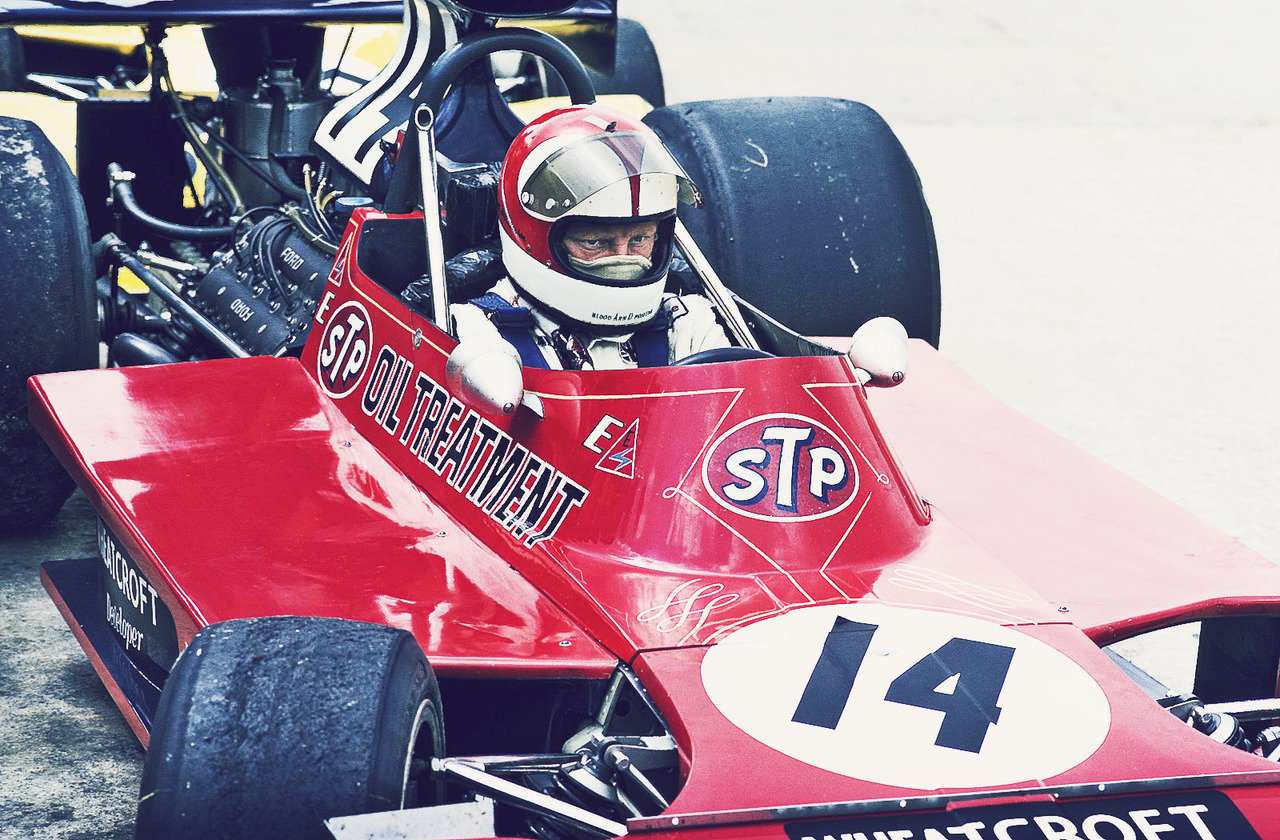
July 29, 1973 is also memorable for another racing event - but for a painful, gut-wrenching memory. As Petty raced in the Pocono Mountains of Pennsylvania for a second time in his STP Dodge, fellow STP driver Roger Williamson of Great Britain suited up and belted in for his second career Formula 1 race. On the eighth lap of the Dutch Grand Prix in the Netherlands, Williamson's red March-Ford wrecked with David Purley, flipped, skidded a long distance, and caught fire - with Williamson trapped inside the car but not terribly injured.

As the flames began to engulf Williamson's car, Purley ran to help his friend and fellow driver. Track officials were pathetically inept and ill-prepared. A couple of Keystone Kop type characters jogged over to the car but really had no idea what to do or have any equipment to use even if they had been able to figure out what to do. Minutes passed before any sort of rescue truck arrived. Purley tried in vain to flip the car right side up by himself but got no assistance from the course workers. Williamson died while still trapped in his car - though interestingly not from the fire. Instead, he suffocated and must have endured an agonizing death on the track.

TMC