Thursday, August 29, 2013

August 29, 1959 - Lee Petty Cruises in Columbia

August 29, 1959: Lee Petty wins a 200-lap, 100-mile Grand National race on the half-mile Columbia Speedway in South Carolina. The race line-up wasn't exactly a who's who of NASCAR as only thirteen cars started the race.

In Perry Allen Wood's book, Silent Speedways of the Carolinas, he seemed to write about the race with a shoulder shrug of resignation that it wasn't the top showing by a NASCAR field.
The steamy Saturday night found the smallest field that would ever race at Columbia Speedway on hand for its third major race of '59. Of that Buck Baker's dozen, eight were zipper tops, which also ran the convertible circuit. That dinosaur of a tour concluded is fourth and final season the Sunday before... Combined with the fact that the Southern 500 was coming up in nine days, it made sense to convert the old ragtops to hardtops, the zipper tops, and use them instead of their good stuff. Even so, it seems odd that there were so few running that night... They drew for the pole and Ned [Jarrett]'s lucky streak continued as he literally grabbed the pole. The attrition on the tired iron took a heavy toll as a variety of mechanical ills depleted the field and Lee with usual top-notch equipment won handily. ~ p. 52
But Bob Talbert from Columbia's newspaper, The State, had a different slant when reporting on the race in the moment. In reading Talbert's recap of the night's events - heavy rains, a flu epidemic, and a tragic roaring pit fire - one might think the race should have been named the Pestilence & Famine 200.

Source: The (Columbia) State (HT to Gamecock43)

TMC

August 29, 1954 - Lee Petty Conquers Corbin

August 29, 1954: In the only Grand National / Cup race in Kentucky until NASCAR went to Sparta's Kentucky Speedway in 2011, Lee Petty wins a 200-lap, 100-mile race on the half-mile, dirt Corbin Speedway.

As was the case with many early NASCAR races, details of the Corbin race are pretty sketchy. Future Petty driver, Jim Paschal, won the pole but ended up with a 19th place finish in the 21-car field. The rest of the starting lineup and lap leaders remain lost to history.

Photo courtesy of John "IndyBigJohn" Potts
Hershel McGriff finished second. The seemingly ageless McGriff raced in the first Southern 500 at Darlington in 1950, drove a limited number of races for Petty Enterprises in 1973-74, and still made occasional starts as recently as a couple of years ago.

Eric Crawford wrote in his 2011 column for the Louisville Courier Journal:
Only two drivers, Petty and McGriff, finished on the lead lap. Twelve of the 21 starters were running at the end. The third driver out of the race was Jim Paschal, who blew a gasket on the 29th lap after winning the pole at 65.789 mph.

Paul Jones of Corbin was a driver himself but didn't take part in the Grand National race that day. He ran in the preliminary race, won by Vermillion, then found an advantageous perch to watch from the pits, out of the overflow crowd in the grandstand.

“It was packed, I'll tell you,” Jones said. “Standing room only. Some of us drivers were acting as hosts, I guess you would call us, to the drivers who came in. And we were in awe of the big names. It was like a major league ball club coming to visit.

In an interview with the Lexington Herald-Leader that year, [flagman Eddie] Poynter called the race “the greatest thing since peppermint candy around here.”

No doubt it was. But it failed to garner a single mention in either of the state's largest newspapers, the Herald-Leader or The Courier-Journal.
Photo courtesy of John "IndyBigJohn" Potts
In 2011, writer Mark Story penned a solid story about the Corbin GN race - and was even able to include a few personal memories from those who participated in it. Key excerpts include:
When Junior, Smoke, the Busch brothers and their Sprint Cup contemporaries take the green flag Saturday night at Kentucky Speedway, it will not be the first "Cup" race run in the commonwealth.

The memory is largely lost to the mists of history, but NASCAR's highest series has run in Kentucky once before. On Aug. 29, 1954, a field of 21 drivers — including four that would one day be named among the 50 greatest NASCAR drivers of all time — lined up on the half-mile dirt track that was then the Corbin Speedway.

An hour and 35 minutes later, Lee Petty — yep, that Lee Petty, father of The King — made a dramatic pass of Hershel McGriff and guided his No. 42 Petty Engineering Chrysler to victory in the 200-lap race.

In 1954, legends-in-the-making like Lee Petty, Buck Baker and McGriff came to race in Kentucky yet the state's main newspapers didn't give them even one paragraph.

Had you purchased the Aug. 29, 1954, Courier-Journal, you would have read about the "youth, grit and late-warming putter" that led a new golfer, chap by the name of Palmer, to the National Amateur Championship.

From the same day's Lexington Herald you would've read — I kid you not — stories on trap shooting and pro wrestling.

There was not one word in either paper about the Grand National Series, as NASCAR's elite division was then known.

It was an Oldsmobile owned by Frank Christian that Hershel McGriff drove to second place.

Actually, McGriff says, there were two 1954 Oldsmobiles in use by his team that year: The one he raced and the one that pulled his race-car from track to track.

"That's why you didn't want to tear up the front of your (race) car," McGriff said in 2004. If you did, "you couldn't get it back on the tow-bar" to pull.

Before a suspension problem knocked Ralph Liguori's Dodge out of the Corbin race, the driver from New York City spent the days leading up to the event sleeping in a local Nash dealership.

"For the life of me, I can't remember the guy's name, but he was a real neat guy," Liguori said in 2004. "Let me sleep and work right there."

In the current era, the business of NASCAR can overshadow the racing. Kentucky Speedway's decade-long pursuit of a Cup race has been one of the commonwealth's predominant sports stories of the 21st Century.

How Corbin, 1954, got a big-league race seems lost in the past.

The National Association for Stock Car Auto Racing sanctioned its first race in 1948. [Buz] McKim, the NASCAR historian, says that early in its existence the organization ran its top league in some unlikely locales.

"It raced once in North Dakota. Once in Oklahoma," McKim said in 2004. "It went to several tracks in the Midwest for one-shot deals."

There is not a specific answer, he says, to how NASCAR's big league came to Corbin.

We're left to the locals to fill in the blanks. Poynter, the race's flag man, said in 2004 that the connection that brought stock-car's big league to little Corbin was Bub King, a local driver.

King ran NASCAR events at both Daytona Beach and Darlington and the contacts he made eventually led to the Grand National Series coming to Kentucky, Poynter said.

"Bub just knew some NASCAR people," added Allen Dizney, the unofficial "historian" of Corbin, in 2004. "That was the connection."

The feel and flavor of Lee Petty's win in Corbin are also all but lost to the ages.

NASCAR can give you the race results. Of the 21 drivers, only Petty and McGriff finished on the lead lap. Jim Paschal laid down a 65.789 mph qualifying lap to claim the pole. The average speed of the race was a scalding 63.08 mph.

The four drivers in the field — Petty, McGriff, Buck Baker and Herb Thomas — who would go on to be named among the 50 Greatest NASCAR drivers of all time finished 1-2-3-4 in Corbin.

Petty earned a cool $1,000 for winning at Corbin; McGriff got $650 for coming in second. Everyone who finished below 10th got $25.

In 2004, I tracked down two drivers who drove in the race.

I asked Liguori what he remembers about the race in Corbin.
"I think I had one of my better days," he says.

You finished 16th of 21.
"I guess I had one of my bad days," he said, laughing.

Next, I called McGriff, a remarkable racing figure who raced as a driver well into his 70s.

What do your remember about Corbin?
Pause."I seem to remember the name Corbin," he said. "Where is it exactly?"

Southeast Kentucky.
"Oh."

Remember anything at all about the race?
"Well ... not really. It's been 50 years, that's a lot of races ago ..."

You finished second to Lee Petty.
"Then I finished behind a real good driver."
Kentucky driver Bub King - who apparently knew whose hand to shake, whose number to call, and whose knee to bow to land the one and only Grand National / Cup race in the commonwealth until the series debuted at Kentucky Speedway in 2011.

Credit: IndyBigJohn at TrackForum.com
Tim Branstetter
Tim Branstetter
Tim Branstetter
Tim Branstetter included these memories in an article he wrote for Corbin's Times Tribune in July 2011:
On Aug. 29, 1954, 20 drivers chased Lee Petty around the half-mile dirt track at Corbin Speedway for 200 laps. Corbin resident Allen Dizney was parked in the infield with his jeep that was painted up and ready to clean up any wrecks.

“It was an unusual service truck,” Dizney said. “It was a 4-wheel drive jeep and it was all fixed up with lights on it.”

That jeep didn’t get used much during the NASCAR race.

“They never really wrecked,” Dizney said. “They weren’t going fast enough to tear up cars. They only ran about 60 mph.”

Dizney didn’t have to do much work during the race, but he wasn’t getting paid either.

“We didn’t get paid nothing,” he said. “It was a volunteer thing. Just a city thing. I never made a dime, but I enjoyed it very much.”

Bub King was a NASCAR driver from Corbin and was the biggest reason that Corbin was able to host the event.

“Bub worked at it and got it done,” Dizney said. “We were tickled to death with it. Everyone was excited to have a NASCAR race.”

When asked if he was a friend of King’s, Dizney replied, “He was a friend of everybody. He was just a local boy like the rest of us. He was in the service and then got into racing.”

Dizney was a Petty fan, but he made it clear who he was cheering for during the race at Corbin Speedway.

“I was hollering for Bub (King) and Dick (Vermillion), he said. “They were local boys. I liked Petty, but that was on a national scale.”

Petty ended up winning the race, while Vermillion finished in 14th place and King finished in 18th place.

Petty won the race by passing Hershel McGriff on the last lap and Dizney decided to congratulate him after the race.

“I introduced myself to Petty after the race,” he said. “He was real cordial and very nice to me. He was checking the oil in his car.”

While tonight’s race at Kentucky Speedway will be exciting for the fans and leave its mark on NASCAR history, Dizney didn’t think anything about making history when he watched as Petty took home $1,000 for winning the first NASCAR race in Kentucky.

“It was just a race,” Dizney said. “It was just something that happened. We wasn’t trying to make history. At the time it was just an automobile race. It was just a race with some guys that we had read about in the paper.”

McGriff claimed $650 for second place, while Buck Baker took $450 for third and Herb Thomas won $350 for fourth place. Vermillion and King won $25 each. - See more at: http://thetimestribune.com/sports/x614902764/Corbin-hosted-NASCAR-first/#sthash.L31UOHGE.dpuf
Corbin resident Allen Dizney was parked in the infield with his jeep that was painted up and ready to clean up any wrecks.

That jeep didn’t get used much during the NASCAR race.

“They never really wrecked,” Dizney said. “They weren’t going fast enough to tear up cars. They only ran about 60 mph.”

Dizney didn’t have to do much work during the race, but he wasn’t getting paid either.

“We didn’t get paid nothing,” he said. “It was a volunteer thing. Just a city thing. I never made a dime, but I enjoyed it very much.”

Dizney was a Petty fan, but he made it clear who he was cheering for during the race at Corbin Speedway.

“I was hollering for Bub (King) and Dick (Vermillion), he said. “They were local boys. I liked Petty, but that was on a national scale.”

Petty ended up winning the race, while Vermillion finished in 14th place and King finished in 18th place.

Petty won the race by passing Hershel McGriff on the last lap and Dizney decided to congratulate him after the race.

“I introduced myself to Petty after the race,” he said. “He was real cordial and very nice to me. He was checking the oil in his car.”

“It was just a race,” Dizney said. “It was just something that happened. We wasn’t trying to make history. At the time it was just an automobile race. It was just a race with some guys that we had read about in the paper.”
I'm unsure why essentially all media outlets opted not to cover Corbin's GN race. Perhaps it was because the series only made the one stop and the track had no year-to-year opportunity to build momentum. Perhaps the state was preoccupied with its other passions such as horses and hoops. Or perhaps its because over time, Corbin became better known as the original home of Colonel Harlan Sanders and his Kentucky Fried Chicken vs. Lee Petty's victory.

Source: New York Times
Sometime after the 1954 race on the half-mile, dirt track, Corbin was re-designed into a paved, quarter-mile track. Though its gone through some tough stretches, the Eastern Kentucky track still operates today.

 
Information posted by the track's news director and arguably its greatest evangelist of its history, John "IndyBigJohn" Potts, can be read on the track's website and Facebook page.

TMC

Friday, August 23, 2013

August 23, 1970 - Pete Doubles-Up At Dega

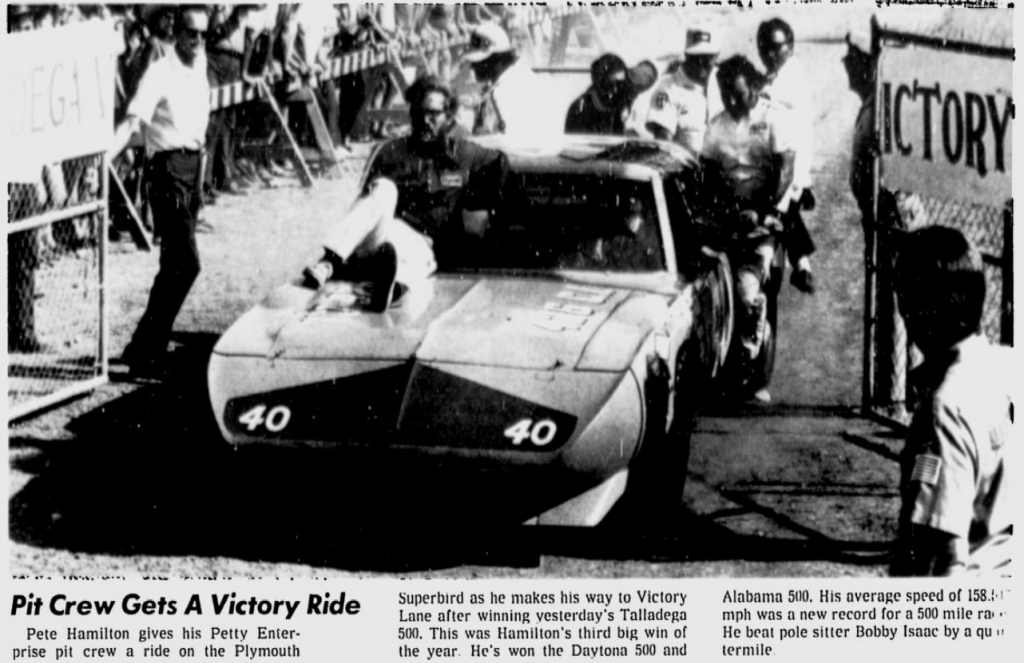
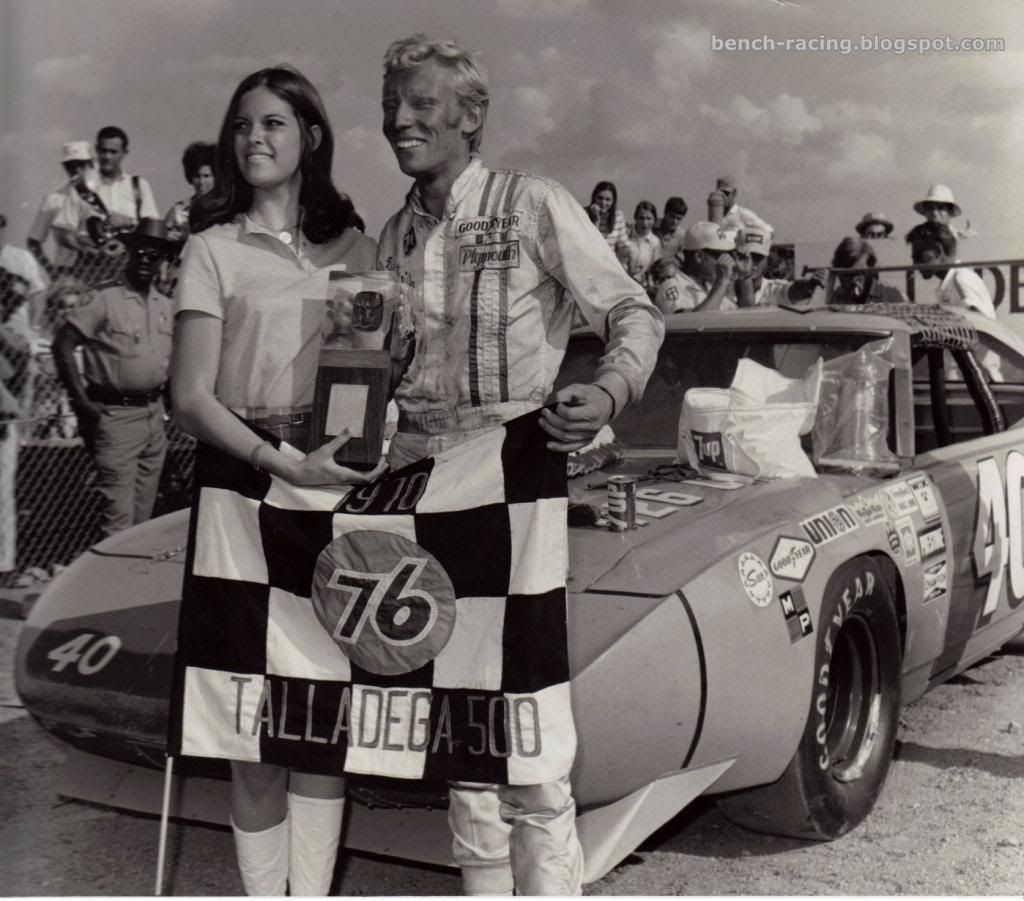
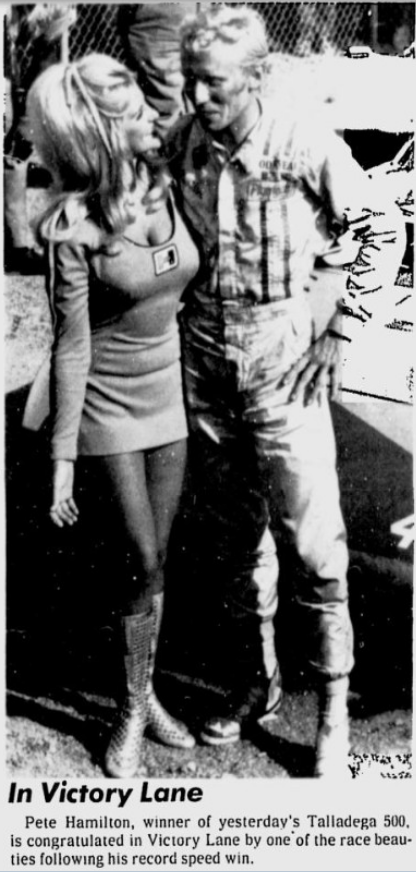
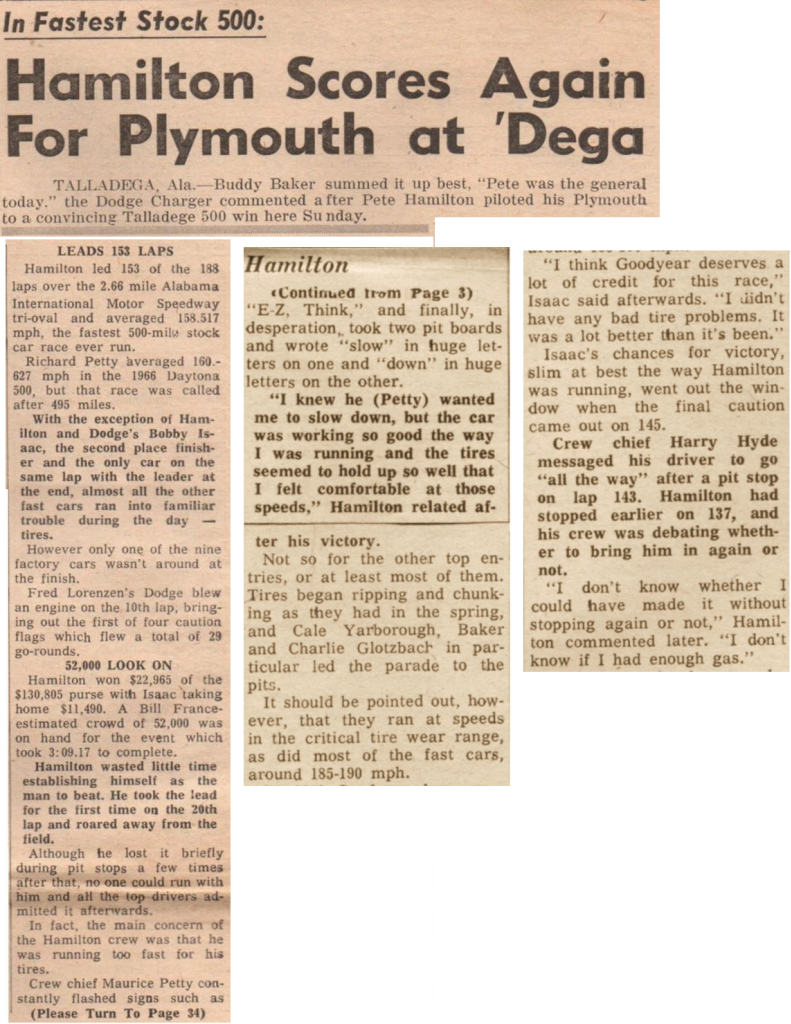
August 23, 1970: Starting fourth in the #40 Petty Plymouth Superbird, Pete Hamilton puts a whoopin' on the field in the Talladega 500. Hamilton led 153 of 188 laps. The remaining laps were sprinkled amongst Bobby Isaac (12), Charlie Glotzbach (6),and six others with five or less laps on point. Hamilton's Petty Enterprises teammate, King Richard, had a pedestrian day in his Bird. He started fifth and finished seventh but with but didn't lead a lap.

The King's 1970 Superbird is one of the two most iconic cars for him (the other being the mid-70s STP red / Petty blue Dodge Charger). In the five Grand National races held at Daytona and Talladega in 1970, however, the 43 ultra-smooth Superbird had zero wins, no top 5s, only three top 10s (1 of which was in a Daytona 500 qualifying race), and zero laps led. Pete, on the other hand, drove his #40 Petty Bird to three wins in his five races, racked up four top 5s, and led 25 percent of the laps in those five races.

Fifty cars started the race. The front row was comprised of Bobby Isaac in the #71 Harry Hyde-prepared winged Dodge Charger and David Pearson in his Holman-Moody Ford. The second row included Charlie Glotzbach and Hamilton. Chargin' Charlie finished second to Richard Brooks in the inaugural Talladega 500 a year earlier.

Fast Freddy Lorenzen, who won 26 Grand National races from 1961 to 1967 with more than 60 Top 5 finishes, still had to sport a yellow "rookie stripe" on his Ray Fox-prepared Dodge. The reason? He'd never raced Talladega before. This led me to wonder if every car ran the yellow stripe a year earlier in the first Dega GN race. Unfortunately for Lorenzen, his prep for his first Dega race and his visual warning to other drivers didn't help much. He finished 49th in the 50-car field after losing an engine only 9 laps into the race.

The race began with the various drivers mentioned earlier leading a lap here and there. Around 40 laps into the race, however, Hamilton began to show 'em who was boss. He went to the front for a 26 lap stint. After surrendering the lead for a lap (presumably for pit stops), the 40 Plymouth went back out front for a dominating 82 laps. With 35 to go, Hamilton passed pole-winner Isaac, waved good-bye, and set sail for the win.

The young driver swept the Talladega races and pocketed the Daytona 500 to boot. Yet that résumé wasn't enough to keep his job. Hamilton won three career Grand National races - all in 1970 - all for Petty Enterprises. Yet when Chrysler move its financial support of Ray Nichels' Dodge team to Petty Enterprises team for 1971, the decision was made to place Baker at PE for the Dodge program and let Hamilton go.


Hamilton raced another few years on a part-time basis, primarily for NASCAR Hall of Fame owner Cotton Owens. Pete's final race was in 1973 at the Atlanta 500. After getting his back nicked up pretty good in some accidents, Hamilton left NASCAR and focused on a successful trucking business he had grown near Atlanta, Georgia. Like many racing fans, I've never had the opportunity to meet Pete - yet I've always wanted to. Once he left NASCAR though, that was it. Except for a handful of appearances over the years for special occasions, he is not involved in the sport in any capacity.

Sports Illustrated latched on to Pete's magical 1970 season and wrote a feature article on him in the June 15, 1970 issue - several weeks before his second Talladega win and several months before he was told he wouldn't be returning to the Petty team in 1971.


The folks at RealRacinUSA.com did a half-hour phone interview with Hamilton back in 2007. For me, it is one of the few extended sessions I've ever heard with him. Your time will be well-spent taking the opportunity to listen to his racing memories and what he does in more contemporary times.

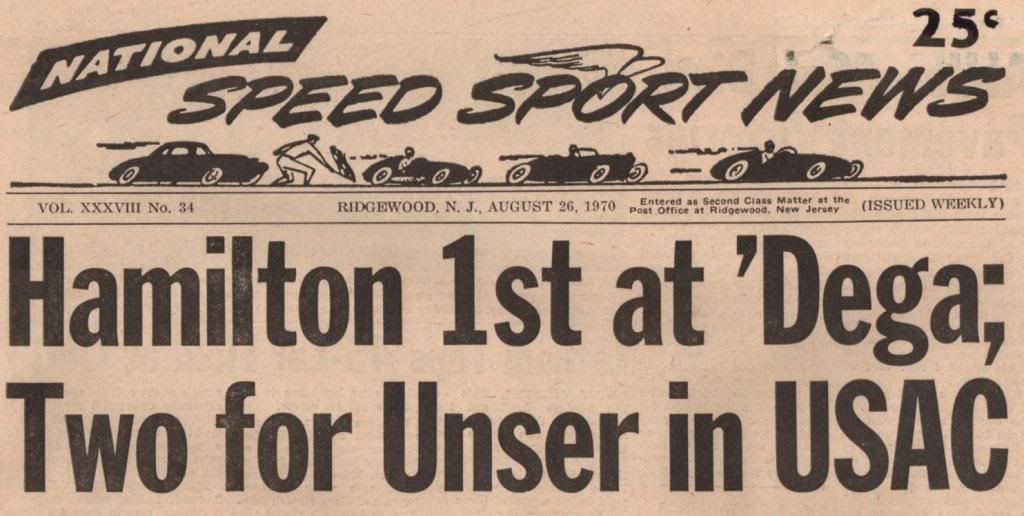
NSSN headline and article courtesy of Jerry Bushmire

TMC

Thursday, August 22, 2013

August 22, 1958 - Lee Petty Banks Bowman Gray

August 22, 1958: Starting second, Lee Petty piloted his #42 Oldsmobile to a spirited win over Shorty Rollins in a 200-lap, 50-mile race at Bowman Gray Stadium in Winston-Salem, NC. Rookie Richard Petty in a #2 1957 Oldsmobile started 11th and finished 20th. (There is a trivia question for you - what car number have Richard Petty and Dale Earnhardt shared?)

The race was Bowman Gray's second NASCAR Grand National event, and it was a 'sweepstakes' race - a blend of hard top and convertible series cars.. The first was about three months earlier on May 24, 1958, and it was won by Bob Welborn in a Chevrolet owned by ... Julian Petty, Lee's brother.

The August race was a reversal of fortune for Welborn. Julian Petty again fielded a Chevy for Welborn. Although he won the spring race, he completed only one lap in Julian's #49 Chevrolet and finished 23rd - dead last - in the August race. Julian fielded a second car in the August race for Ken Rush. He finished 14th in a #44 Chevrolet.

Greg Fielden writes in Forty Years of Stock Car Racing - Vol. 1:
Old pro Lee Petty eked out a half-car length victory over rookie Shorty Rollins in the exciting climax to the 50-mile sweepstakes race at Bowman Gray Stadium.

Petty took the lead from Rollins with 19 laps remaining on the quarter-mile paved oval. The two drivers treated the crowd of 12,000 to a spine-tingling conclusion. Rollins' last lap bid fell short by only a few feet.

George Dunn put his Mercury on the pole and led the first 10 laps. Petty, who started second, nosed to the front on lap 11 and stayed there for 126 laps. Rollins, who started sixth found the 'groove' and began pressing Petty at the half way point. He was able to push his Ford into the lead on lap 137 and led until Petty made the final pass.

Bob Welborn qualified third, but his Chevrolet was taken out with transmission failure after just one lap.

Petty won the 50-miler at an average speed of 39.258 mph. ~ p. 316
Source: Spartanburg Herald Journal via Google News Archive
TMC

Friday, August 16, 2013

August 16, 1957 - Lee Petty Owns Old Bridge

August 16, 1957: Starting third, Lee Petty leads a handful of laps early in a 100-mile race at Old Bridge Stadium in Old Bridge, New Jersey. Then with nine laps to go, he went back to the point and claimed his 28th career NASCAR Grand National victory.

Rex White won the pole and dominated the race by leading 177 of the 200 laps on the paved half-mile. But as Greg Fielden notes about the race in his book, Forty Years of Stock Car Racing - Volume 1:
Lee Petty used a late race caution to close in on the rear bumper of leader Rex White, then dashed to victory...

White finished second, 2.0 seconds behind the Petty Oldsmobile. Third place went to Jim Reed. Marvin Panch came in fourth, and Jack Smith finished 5th.

White, making a stab at his first Grand National win, had taken the lead in the 15th lap and was holding nearly a lap lead when a three car crash involving Chuck Hansen, Dick Klank and Bill Benson brought out the only caution flag. The yellow light was on for four laps.

White led the charge when the green came out with 10 laps to go. But Petty muscled his way under White and led the final nine laps. ~ pp. 275-276
TMC

Tuesday, August 13, 2013

August 13, 1954 - Lee Scores Southern States

Driving a #42 Chrysler, Lee Petty wins his sixth race of the season in a 200-lap, 100-mile race at Southern States Fairgrounds in Charlotte, North Carolina on August 13, 1954. The event was the first Grand National race at the track, and GN races continued to be promoted on the Carolina half-mile, dirt track through 1961.

Perry Allen Wood describes the track in his book Silent Speedways of the Carolinas:
At the southeast corner of Sugar Creek Road and US 29 in Charlotte stands a shopping center with lots of Asian and empty stores anchored by a Park N Shop that is as much eyesore at is is supermarket. Its stands on the site of the Southern States Fairgrounds that held 17 100-mile Grand National races from 1954 to 1961. It actually lasted two seasons after the opening of the Charlotte Motor Speedway. However, there is no trace of it left to stir the imagination; no rusting guardrails, no pine trees popping through the concrete grand stand, no wooden fairgrounds fence, not even a bullet-riddled light pole. There is no magic in a dirty asphalt parking lot 45 years after the show closed. Postcards of the old fairgrounds show a lovely lake in the infield that today has been reduced to a miserable little litter-strewn rivulet surrounded by scrub brush and all that nasty pavement. ~ p. 194
 The footprint where the track once stood...


View Larger Map

And a postcard view of the track as referenced in Wood's book... 

Lee won three Grand National races (1954, 1957, 1959) and one convertible series event at the track (1958). In 1960, Richard Petty won his first career Grand National / Cup race in the the next-to-last GN race at Southern States.

Future Petty Enterprises driver Buck Baker started from the pole in the 1954 inaugural race but finished fifth. The rest of the starting line-up and lap leaders apparently were not documented or simply were lost to time. Based on the article below, Lee didn't lead the entire race. He took over the lead from Baker with 50 to go, and then went on to a two-lap victory over second place Dick Rathman.

Source: Spartanburg Herald Journal via Google News Archive

TMC
Edited August 12, 2014

Monday, August 12, 2013

August 12, 1962 - Jim Paschal Wins Weaverville

August 12, 1962: Going three-for-three in three mid-season races after being re-hired as a Petty Enterprises driver, Jim Paschal wins the Western Carolina 500 at Asheville-Weaverville Speedway driving a #42 Plymouth. Teammate Richard Petty lost one spot from his 6th place qualifying run and finished 7th in his #43 Plymouth.

Jack Smith won the pole for the 500-lap race on the half-mile paved oval. Paschal's qualifying speed matched Smith's hot lap; however, Smith was awarded the pole simply because he qualified first. Go figure. Dadgum Petty drivers - they've never been able to catch a break over the years (tongue planted firmly in cheek).

Source: Daytona Beach Morning Journal via Google News Archive
Smith took the lead from the drop of the green and led about one-third of the laps. But Paschal then took over the lead from Smith on lap 164, and he led the remaining 337 laps for a dominating victory.

In his book, Silent Speedways of the Carolinas, Perry Allen Wood writes:
The Fifth Annual Western North Carolina 250 ran on Sunday, August 12, 1962, under beautiful summers skies. The question was whether the track could handle 500 summertime laps. A field of 25 took the green, led by pole-sitter Jack Smith, who paced the field for 163 laps until tire troubles gave the lead to Paschal. Unchallenged in a Petty Plymouth, Jim led 337 circuits for his fourth win of the year at a race record of over 77 miles per hour. ~ p. 224
Source: Charleston News and Courier via Google News Archive
Earlier in 1962, Paschal raced several times for car owner Cliff Stewart. Then in the summer, he was hired to once again pilot a Petty Plymouth. (He'd previously driven for the team a few times in 1960-61.) In the next five races, he rattled off three wins - all in the Petty car - at Bristol, Nashville and Asheville-Weaverville. Sandwiched between the three wins were two more starts for Stewart in Chattanoga, TN and Huntsville, TN. Following the race and win at Asheville-Weaverville, Paschal raced in the majority of races for the rest of the season, and all of his starts were for the Petty team.
 
TMC