Showing posts with label jim paschal. Show all posts

Sunday, October 18, 2015

October 18, 1964 - National 400

The fall 1964 race at Charlotte Motor Speedway was race number 59 of a long, grueling 62-race season. As is known to many, the 1964 auto racing season was filled with several tragic losses - both in NASCAR and in Indy Car. Two of those driver deaths came at the track which hosted the National 400. Yet, racers did what racers do - they continued.

Source: Motor Racing Programme Covers
As noted on the program cover, CMS hosted its first ARCA race in October 1964. Though banned from NASCAR by Bill France Sr., Curtis Turner returned to the track he helped build and won the 200 miler overseen by a different sanctioning body. Because of persistent rain all weekend, however, the ARCA race was postponed one week.

First-day qualifying was held on Wednesday before the rain spurred on by Hurricane Isbell arrived, and Richard Petty laid down a track record lap to put his Hemi-powered Petty Engineering Plymouth on the pole. Paul Goldsmith, driving a Ray Nichels Plymouth qualified second to reverse the front row starting order from the 1964 Daytona 500.

Fred Lorenzen in his Holman Moody Ford timed third, and Bobby Isaac in another Ray Nichels car - a Dodge - secured the fourth position. Jim Paschal rounded out the top 5 starters in a second Petty Plymouth. Practice, qualifying and and the ARCA race were washed out because of the rain on Thursday through Saturday.

Source: Daytona Beach Morning Journal via Google News Archive
The race at Charlotte was the first since the death of Jimmy Pardue who died during a Goodyear tire test in September. Pardue's death was the second resulting from accidents at Charlotte and the third Grand National driver to be killed in 1964.

Fireball Roberts suffered critical burns during May's World 600 and died about six weeks later. Joe Weatherly - the two-time defending GN champion - died during the Motor Trend 500 at Riverside in January 1964. In addition to those deaths in NASCAR, Eddie Sachs and Dave MacDonald perished after they wrecked and suffered critical burns on lap 1 of the Indianapolis 500. Another Indy driver, Bobby Marshman, died in December 1964 following a tire testing accident in Phoenix. 1964: a truly gruesome year for motorsports.

Source: Eugene Register Guard via Google News Archive
Paul Goldsmith led lap one when the race's green flag waved. Petty then took over for 26 laps before Goldsmith returned to the front. Lorenzen took the lead on lap 69 but only for three laps before Petty re-assumed the lead for 63 laps. Petty's teammate, Jim Paschal, took over on lap 199 but led only a single lap. Petty went back out front where he would stay until lap 265 of the race's 267 laps.

Courtesy of Jerry Bushmire
For the final 65 laps, Lorenzen ran right on Richard's back bumper and made move after move to take the lead. The two cars ran off and hid from the rest of the field, and the duo even lapped Paschal's third place car. But Lorenzen could not get his Ford past the rapid Plymouth. Fred tried lap after lap - high, low, and even moving Richard aside going into three - but he simply could not get past the 43.

Courtesy of Jerry Bushmire
As the two cars entered turn three on lap 265 and looking for the white flag coming off four, the blue Plymouth darted to the right and slammed into the guard rail with tremendous force. The blown right front and subsequent impact threw the 43 high into the air, but it came down on all fours and coasted to the inside of the track. Lorenzen darted to the inside and came off four to take the white and caution flag together.

When the Plymouth came to rest, Richard was lying down in the seat having been jerked out of the shoulder harness by the force of the impact. It was a scary moment for the fans because Pardue had hit the rail in the same place a month earlier. Richard said in an interview after the race, "When it blew, it seemed like it took two hours to get to that fence. I went the same route Pardue did. I was just lucky enough to stay inside the track".

Source: Daytona Beach Morning Journal via Google News Archive
Fellow Petty fan Tim Leeming recalls:
My friends and I were parked against the fence midway between turns three and four. We absolutely yelled ourselves hoarse with that battle between Richard and Freddie. Richard's tire blew almost in front of where were were standing. We watched the car hit the wall and thought for a minute it would be going over in the same place Jimmy Pardue was killed. Charlotte Motor Speedway said they had reinforced the rail there, and that may have been the difference that saved Petty from going over.

When the car slid to a stop, we were running in that direction. It was very scary not to see Richard sitting up in the car, but he almost immediately popped up. We didn't know he had come out of his shoulder harness at the time. We headed for the pits, happy Richard was OK but really upset because Freddie won that race. At that time, we rated Fords along with garbage trucks as our least favorite vehicles.

As soon as they opened the pit gate, which they did after the races back then, we headed for the Petty truck. We waited a while before Richard came over, nursing what appeared to be a very sore arm. I remember being so glad to see that he was OK. All of us started talking at once, and Richard smiled and waved his hand telling us one at a time. He explained to us that everything was OK and we would get 'em next time. And yes, he did use we. That was the way we talked back then. We (all of us who followed him from race to race) were unofficially part of the Petty team.
Lorenzen continued around the final circuit under caution to take the win. Paschal finished second in the #41 Petty Plymouth, one lap down to Lorenzen's pearl white #28 Ford.

Courtesy of Smyle Media
Source: Spartanburg Herald via Google News Archive
Despite the wreck, Petty finished third, two laps down to the winner. Petty's bad luck finish at Charlotte was just one of many for him through the 1960s and early 1970s. He seemed to routinely run well - and even dominate parts of races. But a win at the track just never seemed to fall his way. The King was finally able to grab a winner's trophy of his own in 1975 when he swept the season's races at Charlotte - the World 600 and the National 500.

Source: Spartanburg Herald via Google News Archive
As might be expected, the winner confidently concluded he had Petty right where he wanted him anyway. Regardless of Petty's blown tire and wreck, Lorenzen was certain he would have been able to pass the 43 on the last lap - though he had been unable to pass him throughout the rest of the race.

Source: Statesville Record and Landmark
Thanks to Tim Leeming for much of the text for this post.

TMC

Thursday, August 6, 2015

August 6, 1961 - Paschal Nabs Nashville

NASCAR brought its Grand National division to Nashville's Fairgrounds Speedway for the first time in 1958. Joe Weatherly won the inaugural 200-lap race. Rex White and Joe Lee Johnson split the two GN races in 1959, and Johnny Beauchamp captured the only one in 1960 (his second and final career GN victory).

The race distance was increased 100 laps each year, and the 1961 race was billed as the Nashville 500. Rex White, one of the track's race winners in 1959, captured the pole for the 1961 race. Starting up front at Nashville was nothing new to Rex. He had won the pole for the fifth consecutive race at the track (four Grand National races and one GN - convertibles "sweepstakes" race).

Source: The Tennessean
Any smiles Rex may have sported after qualifying quickest again likely faded quickly. He couldn't leverage his top starting spot to lead any early laps, and his day came to a sudden end on lap 15. White blew a right front tire, hooked right, popped the guardrail, and nearly launched through the the track's outer-ring billboards.

Source: The Tennessean
I had the opportunity to mention the wreck to White when I met him in October 2014. He laughed as he recalled it and noted some of the other drivers suggested he may have hit the billboard on purpose in an effort to meet "that purty girl" on it.

Source: Russ Thompson 
Richard Petty started on the front row alongside Rex, and he dominated the race from its beginning. A scenario then developed that seemed to mirror what has frequently been seen in the 2015 Cup season: rain. Showers began to fall around lap 220. NASCAR opted to let the cars ride around under yellow for eighty laps before finally displaying the red flag at lap 302.

After a delay of about 45 minutes, the cars were put back under the yellow where they rolled around for another 50 laps or so. When the green flag was finally displayed again at lap 351, the fans had endured approximately 130 consecutive caution laps plus a 45-minute halt in racing action.

Petty dominated the first 220 laps and paced the field through the extended rain delay. When the race went back to green, however, the engine in Petty's #43 Plymouth wasn't up to the challenge. The engine raced at optimal temps under green. When the rains fell and the engine cooled off substantially, however, the Mopar power plant wasn't ready to return to full song. The future King led 10 more laps when the race returned to green, but he then had to watch the rest of the race from a different vantage point than from behind the steering wheel.

With White and Petty sidelined, Jim Paschal went to the front in his #44 Julian Petty-owned Pontiac.

Source: Russ Thompson
Paschal led the next 41 laps before rain returned. Officials then called the race after 403 laps, and Paschal was declared the winner.

Source: Russ Thompson
Paschal's win was the last victory for a #44 Petty car until Kyle Petty won Daytona's ARCA 200 to begin his driving career in February 1979.

By 1961, Richard had already built a solid fan following. Many were disappointed to see such a dominant run end prematurely. And of course, most were disappointed when the last 20 percent of the race was cancelled because of summer showers and especially with 172 of 403 laps run under caution.

Source: The Tennessean
Ned Jarrett finished second to Paschal, and Jarrett eventually won the 1961 GN championship title - his first of two. Johnny Allen finished third in a Chevrolet owned by one of the 1959 Nashville winners, Joe Lee Johnson.

Source: The Tennessean
Paschal and Julian Petty parted ways at the end of 1961. Paschal began the 1962 as the driver for Cliff Stewart's Pontiac team. About half-way through the season, Paschal then moved to the other Petty team - Petty Enterprises. The pairing gelled immediately as Paschal won three consecutive races in the #42 Plymouth - including a second consecutive win at Nashville. With Lee Petty as his crew chief, Paschal kept his Music City mojo working and won a third consecutive time at Nashville.

TMC

Tuesday, July 28, 2015

July 28, 1963 - Fearless Freddy Bests Bristol

NASCAR's Grand National drivers migrated south to Bristol TN for the third Volunteer 500 on July 28, 1963. A week earlier, the cars had raced the road course in Bridgehampton, New York.

Fred Lorenzen won the pole in his #28 Holman Moody Ford. Fireball Roberts won Bristol's spring Southeastern 500 and took the outside spot on the front row for the Volunteer 500 in his #22 HM Ford.

Source: Spartanburg Herald
On the second day of qualifying, Jim Paschal was quickest in the #42 Plymouth as a teammate to Richard Petty. G.C. Spencer - who eventually settled in nearby Johnson City, TN - had to win a 20-lap hooligan race to make the race at his home track.

During a practice session the same day as the second round of time trials, Fireball just about lost his weekend. As he attempted a high-side pass of another car, he started to spin and clipped the guardrail with his right rear quarterpanel. He successfully righted the car and lived to see raceday - though his crew did have some body work to repair before Sunday's event.

It's hard to visualize Bristol in its early years compared to what it seats today. But for year 3, the race drew a great crowd.


Lorenzen led the opening lap as the green was dropped. Junior Johnson then went from his third place starting position to the lead on lap 2 and stayed there for 160 circuits. A faulty alternator and bad battery then took its toll on Junior's Holly Farms Chevrolet. He ended up finishing 22nd, 93 laps down to the winner.

Lorenzen's car began trailing smoke from the start of the race. As it turns out, the 28 had a broken piston. Many thought the Ford's engine would blow at any time. Instead, Fast Freddy rode his steed all. day. long. As Junior faded, Lorenzen went up front and led 154 of the next 155 laps.

The one lap during that stretch he didn't lead was claimed by Paschal. But right after taking the lead, Paschal hit pit road. He was suffering from heat exhaustion and needed an assist. Lee Petty, whose driving career was reduced to a handful of starts following a near-fatal accident at Daytona in 1961, took over in relief.  Lee served in the same role in April when Paschal needed relief during the Virginia 500 at Martinsville. Lee spelled Paschal for about 100 laps before Jim went back into the car. Amazingly, the 42 finished third just one lap down to the top two finishers - even with 2 driver changes!

The race had seven cautions. The most significant one of the day involved Fireball. Though he saved his car during Saturday's practice session, the same couldn't be said for the race itself. He popped the guardrail and went for a series of flips. Fortunately, a sprained back was his only notable injury.


Source: National Speed Sport News
With each lap Lorenzen led, the 43 of Richard Petty kept pace. The Plymouth driver hounded Lorenzen, but he couldn't (or wouldn't) make the pass. With just under 200 laps to go, the future King did get the lead - but only for 3 laps. Lorenzen retook the lead and decided he may as well keep it.

As the lap count hit 450, Petty decided it was go-time. He intensified the pressure on Lorenzen. The blue Plymouth pulled even with the white Ford - but again, he simply couldn't make the pass.

The duo battled for the final 20 laps. In the end, however, Lorenzen pulled ahead of Petty by several yards to notch his first of three consecutive Bristol wins. Petty's close-but-no-cigar P2 was his first of several moral victories at Bristol.

Petty likely couldn't complain too much though. With wins at Bridgehampton a week earlier and another win at Greenville-Pickens two days later, a second place at Bristol probably wasn't viewed as all that bad an effort.

Source: Spartanburg Herald
TMC

Friday, July 24, 2015

July 24, 1966 - Bristol's Golden Volunteer 500

Richard Petty raced in 60 Grand National / Cup races at Bristol from its opening in 1961 through the King's retirement in 1992. Sixty! Many might suggest Bristol wasn't of Petty's better tracks because he didn't rack up as many wins as he did at places such as Wilkesboro, Martinsville and Daytona.

Yet from 1961 through 1965, he averaged an 8th place finish. Excluding a couple of DNFs, he averaged about a 4th place finish. The 43 just had a tough time in the early to mid 60s finding victory lane at the East Tennessee half-mile.

Petty and the rest of the GN crowd got another shot at a Bristol win in the Volunteer 500 on July 24, 1966.

Source: Motor Racing Programme Covers
When Bristol opened in 1961, Curtis Turner had recently been sentenced to a lifetime ban from NASCAR by Bill France, Sr. Interestingly, the lifetime punishment lasted only about four years (a different story for a different post). Turner raced a few times in late 1965 after he was reinstated plus a few more times in 1966. As a Bristol rookie, Turner claimed the pole in first round qualifying.

Source: Free Lance Star
In the late 1950s and early 1960s, Turner was a Ford man in NASCAR's Grand National and Convertible divisions. When he returned, he drove a little bit of everything - Ford, Mercury, Plymouth and even Chevrolet.

Just because Pops won the pole didn't mean all doubt was erased by those in and around the garage area. No one was quite certain who owned Turner's Chevy. The records suggest owner Toy Bolton entered the car. Bolton was the owner of record for a number of drivers for about 125 races from the early to mid 1960s. The car was also believed to have been previously owned by Smoky Yunick - which raised the eyebrows of many.

Adding to the intrigue was the work on the car done by Turkey Minton, one of Junior Johnson's mechanics. Junior and his right-hand man, Herb Nab, lurked near the car during the weekend leading many to believe Junior actually owned the car. Imagine if such a scenario arose today in an era of Twitter and too much cable TV pre-race coverage.

Source: Spartanburg Herald 
David Pearson, in Cotton Owens' #6 Dodge, qualified second alongside Turner. Petty and Paul Goldsmith made up row 2. Former Petty driver Jim Paschal and Sam McQuagg qualified fifth and sixth, respectively.


Buddy Baker started the race in Emory Gilliam's #00 Dodge. He had interesting sponsorship from a Tennessee gubernatorial candidate - not a lady of the evening. John Jay Hooker was a lawyer, a businessman, and a career political gadfly. Hooker was running for Tennessee governor in 1966. Baker didn't win the race - nor did Hooker win his.

Turner put his top starting spot to good use. He may have been a track rookie and a bit rusty from a few years away from NASCAR Grand National racing. But he adapted quickly to Bristol's asphalt and led the first 80  laps.

Goldsmith then went to the point to nearly match the number of laps led by Turner.

Courtesy of Ray Lamm
Richard Petty then got by Goldsmith and settled into a dominating rhythm. He led lap after lap, and he put the field one or more laps down. But all was not well inside the 43. Petty began developing some significant pain with his neck, but he stayed on the track and in the lead.

Paschal fell out of the race a few laps shy of 300 when the engine in his Plymouth went south. He stuck around the track, and the Petty crew brought him to their pit stall about 100 laps later. Petty was able to pit for the driver swap, and Paschal was able to belt in and return to the action without losing the 43's lead.

When Lee Petty was critically injured in February 1961, his racing career essentially ended. Richard was not yet an established winner though he did pick up a few wins along the way in 1961 through 1964. Jim Paschal was hired by the Pettys in 1962, and my opinion is his multiple wins over the next three seasons helped keep the team in business. Consequently, Paschal was the logical choice to put in Richard's car when his neck discomfort became too much to handle.

Paschal kept the lead, but the 43 Plymouth started giving up a little bit each lap as the race near its conclusion. Goldsmith's Plymouth was the only other car in the lead lap with the 43. He was hauling the mail and began chipping away at the lead lap by lap over the last 50 laps of the race.

With five laps to go, Goldsmith got the opportunity he needed. He made the pass on Paschal and led the final laps to take the checkers.


Goldsmith picked up his ninth and final career GN win. It was also his 3rd win of the season across a wide variety of tracks - Daytona, Rockingham and Bristol.


For the second time in three years, Petty watched helplessly as a Bristol victory slipped through his grasp with just a few laps to go. Lee Petty was mad at the loss. He wasn't mad at Goldsmith for winning or Paschal for bringing home the 43 in second. Instead, he was angry at RICHARD for having exited the car.

Source: Spartanburg Herald 
The King finally did notch a Bristol victory in the 1967 Volunteer 500. He nabbed two more in 1975 when he swept the Southeastern 500 in March and the Volunteer 500 in November.

TMC

Sunday, July 19, 2015

July 19, 1958 - Bob Welborn Grabs Greenville

NASCAR's convertible division raced at Greenville-Pickens Speedway on July 19, 1958. The 200-lap, 100-mile race was the third of four ragtop races at the track from 1956-1959 in the short-lived series.

Greenville-Pickens (web | Twitter) continues to operate today with a full slate of late model hot shoes.

Car owner Julian Petty fielded three cars in the 1958 race. Two-time convertible division champion Bob Welborn drove his customary #49. Ken Rush belted into a #44 Chevy, and Jim Paschal - who later raced and won for Petty Enterprises in the 1960s - started 9th in #49A.

The race was held the day after Julian's brother Lee and nephew Richard raced north of the border in Toronto Canada. Lee won the race which frankly is better remembered as the King's first career Grand National / Cup start.

In looking at the finishing order, one might think the race was uneventful. The top 10 starters finished in the same order except for the third and fourth place finishers who swapped spots from where they began the race.

The race, however, did have some late race drama. Knoxville, TN's Tootle Estes made a late race pit stop with about a dozen laps to go.


Ken Rush - NASCAR's 1957 Grand National Rookie of the Year - was leading and headed towards the win. Instead of taking the checkers, however, Rush clipped Estes' car as he pulled back onto the racing surface after completing his stop. The collision caused Rush to hit a dirt bank, and the hit negated his chances for victory.

Welborn assumed the lead and led the remaining laps to claim his fifth convertible win of the season. Teammate Rush recovered from his late race encounter with Estes to finish 3rd - albeit 3 laps down to the winner.

Fin St # Driver
1 1 49 Bob Welborn
2 2 76 Larry Frank
3 4 44 Ken Rush
4 3 87 Buck Baker
5 5 21 Glen Wood
6 6 36 Tootle Estes
7 7 41 Whitey Norman
8 8 66 Roy Tyner
9 9 49A Jim Paschal
10 10 999 Wilbur Rakestraw

Source: Star-News via Google News Archive

TMC

Sunday, July 12, 2015

July 12, 1958 - Paschal Pockets The Asheville Cash

July 12, 1958 - What a day for Petty history.
  • 21 year-old Richard Petty debuted as a professional race car driver in a NASCAR Convertible Division race at Columbia Speedway in South Carolina
  • Bob Welborn won the Columbia race in a Chevrolet fielded by Richard's uncle, Julian Petty, and
  • Jim Paschal found a pot of gold on the speedway at McCormick Field in Asheville, North Carolina in Julian's hard-top Chevrolet.
In 1958, Welborn joined forces with Julian to run the full Convertible schedule for a championship and also a limited Grand National races with the goal of winning as many as possible. So ordinarily, Bob would have been at the wheel of the #49 Chevy. Welborn couldn't be in two places at once with the points-paying race at Columbia falling on the same day. So Paschal was tapped to sling it around McCormick Field.

For years, McCormick Field was a minor-league baseball park (and remains so today as the home of the Asheville Tourists). Several players who found their way to the bigs have passed through McCormick on at least one occasion. For a three-year stint in the mid to late 1950s, however, the bats were silenced at McCormick. While baseball was AWOL, a quarter-mile race track was shoehorned into the ball park.

And on a single occasion, the track promoter was able to host a NASCAR Grand National race. In 2010, legendary NASCAR beat writer Tom Higgins penned a column about McCormick's sole GN event:
Lee Petty came speeding toward home plate, slipped wildly and went crashing into the first-base dugout.

No, the patriarch of NASCAR’s most famous clan wasn’t playing baseball.

Petty was competing in a heat race preliminary to a 150-lap, 37.5-mile Grand National event at McCormick Field, a grand old park in Asheville, N.C.

I was in the press box on July 12, 1958, to cover the action as a raw rookie reporter for the Asheville Times, an afternoon daily.

The Grand National Division was destined to eventually become today's Sprint Cup Series. McCormick Field, dating to 1924, still stands and is home to Asheville’s minor league baseball team.

Many of baseball’s most famous stars played there, including Babe Ruth.

Bob Terrell, the late, great Asheville sports editor and columnist – one of my journalistic heroes – had termed races at the track “demolition derbies in the round.” He added: “When 25 cars start on a quarter-mile track, something has to give.”

It certainly gave for Lee Petty in that July heat race as he battled Cotton Owens.

It was “heat” all right, as Petty’s Olds briefly caught fire as fans in the packed grandstands stood and gasped in astonishment.

Incredibly, the car was pulled from the dugout and repaired in time for the main event. Jack Smith, Herman Beam and Matthews had also crashed in the heat races.

Matthews’ accident prevented him from delighting his many followers in the crowd by “beating the big boys.” Matthews was wildly popular in Western North Carolina, both because of his success and some of the antics attributed to him.

As one story goes, Matthews was said to have dressed as a woman to enter a “Powder Puff” race. When one of the cars came through the turns sideways and on two wheels, Matthews was black-flagged.

No one but Banjo could drive McCormick Field that way, it was figured, and his race was over. Said Lowe, according to the story: “Banjo is a fine driver, but he makes one ugly woman.”

Time finally came for that Grand National main event and a field of 15 cars lined up, stretching from the home-plate turn to where third base would have been.

Jim Paschal held the pole position in a '57 Chevrolet fielded by Julie Petty, Lee’s brother. Owens had the other front-row spot in a Pontiac.

Many speculated the pole winner wouldn't be passed if he didn’t experience any trouble. This proved to be true.

Paschal immediately pulled out front and no one could get around him. He led all 150 laps. Owens stayed right on Paschal’s rear bumper and was the runner-up by only a car length. White finished third, Lee Petty fourth and Smith fifth. Right behind came Junior Johnson and Buck Baker.
Source: Spartanburg Herald via Google News Archive
TMC

Tuesday, June 2, 2015

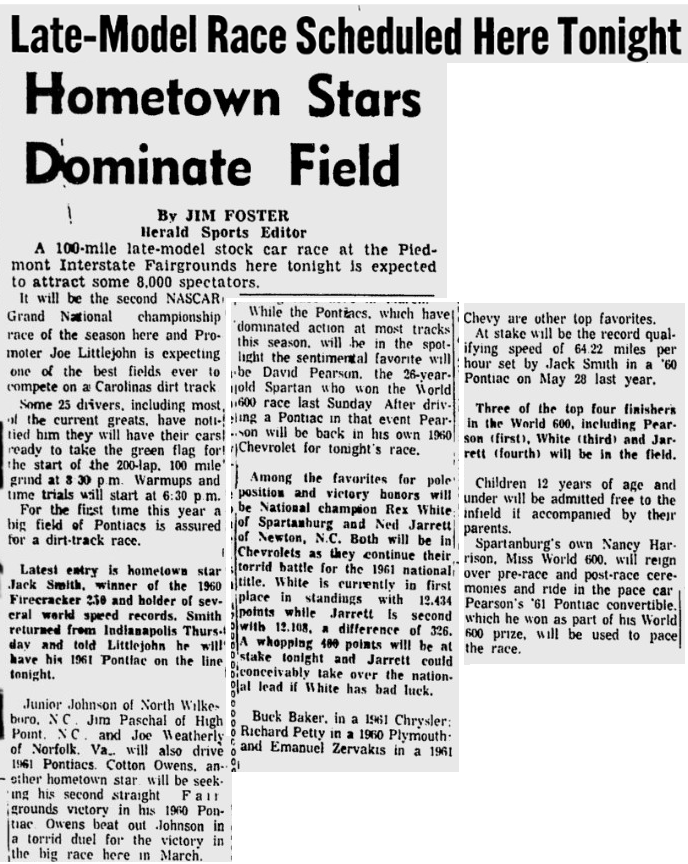
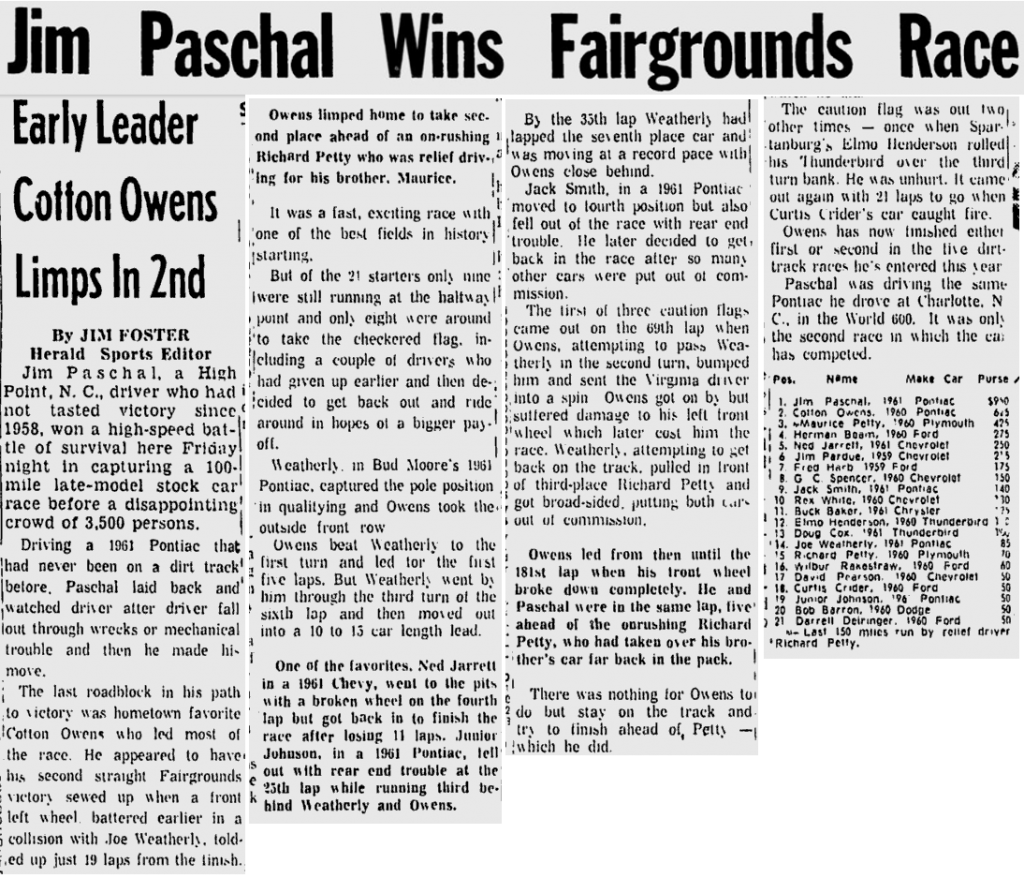
June 2, 1961 - Paschal Wins Spartanburg

Julian Petty's greatest success as a car owner took place in 1958 with Bob Welborn at the wheel. At the end of the season, Petty apparently sold his racing equipment and disappeared from the track. He returned, however, within a couple of years paired with Jim Paschal - who later would drive for his brother Lee as a teammate to rising star Richard Petty.

NASCAR's Grand National drivers rolled into Spartanburg, SC's Piedmont Interstate Fairgrounds on June 2, 1961 for a 200-lap, 100-mile race. A Who's Who of NASCAR legends made up most of the top 10 starters.
  •  Joe Weatherly in Bud Moore's Pontiac won the pole. 
  • Cotton Owens started alongside Little Joe. 
  • NASCAR Hall of Famer Buck Baker and Jack Smith made up row 2.
  • Another pair of NASCAR Hall of Famers, Ned Jarrett and Junior Johnson, timed 5th and 6th.
  • Yet another NASCAR Hall of Fame duo, Rex White and Richard Petty, started in the 4th row.
  • Doug Cox and Darel Dieringer rounded out the top 10.
Source: Spartanburg Herald via Google News Archive
When the race began, Owens beat pole-winner Weatherly to the first turn. He was able to power around Little Joe, and Cotton led the first five laps. Weatherly got his groove back, and he passed Owens on the sixth lap and built a comfortable lead as he paced the field for about the first third of the race.

Hometown hotshoe Cotton continued his pursuit of Weatherly. Around lap 70, Owens put a bump-and-run on Weatherly as he took the lead. Weatherly spun, and he then wiped out Richard Petty as he attempted to get going back in the right direction. Both were done for the night.

Once Weatherly and Petty parked their cars, Cotton began his domination of the remainder of the race. With a few laps to go and the checkers in sight, however, Owens broke a wheel - likely related somehow to the earlier incident with Weatherly. Maybe, maybe not.

Either way, Cotton's misfortune meant good times for Jim Paschal in Julian Petty's #14 Pontiac. Paschal took the lead from Cotton and nabbed his first victory in three years. Prior to Spartanburg, Paschal's last GN win was in July 1958 in a Chevrolet at McCormick Field in Asheville, NC  - coincidentally fielded by Julian.

Cotton limped along to settle for second - two laps down to Paschal. Maurice Petty finished third for his best career finish as a driver. Chief started near the end of the field, and his 3rd place finish came with an assist from his older brother. Richard took over Maurice's #41 Plymouth in relief after his own Plymouth was sidelined following the wreck with Weatherly.

Source: Spartanburg Herald via Google News Archive
TMC

Tuesday, May 13, 2014

May 13, 1972: Grand National East at Nashville

From the 1960s through 1970, NASCAR's Grand National (Cup) schedule averaged about 50 races each season. In 1971, R.J. Reynolds climbed aboard, and the Winston Cup Series was born. The series had a transition year in 1971 with 48 races before dropping back to around 30 that became the staple until the mid 1990s.

When the schedule was dramatically slashed, many traditional tracks - particularly in the eastern time zone - lost their race dates. Perhaps as a way to ease their way out of relationship vs. leaving cold turkey, NASCAR formed the Grand National East series. The series only lasted for a couple of years; however, NASCAR later formed the Busch North Series in the mid 1980s to fill a similar role.

The series ran several tracks discarded from the Cup schedule such as Columbia, Hickory, Myrtle Beach and Kingsport. In 1972, the series ran the Mr. D's 200, its one and only event at a track that remained on the Cup schedule - Nashville Speedway.

Mr. D's was a fast food seafood restaurant created by the parent company of Shoney's restaurants. The chain's name was a nod to one of Shoney's founders, Ray Danner. Its first store was opened in Donelson, a suburb of Nashville, and happens to be where I grew up and lived from the late 1960s through the early 1980s.

Within a year or two of its opening, the name was changed to one more widely recognized today - Captain D's. I guess Cap'n had more of maritime, 'fishy' name than Mister. (For those unfamiliar with Captain D's, think Long John Silver.)

On Saturday May 13, 1972 - Mother's Day weekend - the GNE series raced at the Fairgrounds. The race was co-sanctioned with NASCAR's Grand American division, a series made up of pony cars such as Mustangs and Camaros.
Source: Russ Thompson - Nashville Fairgrounds blog
Some of the drivers who entered the event were Winston Cup regulars - albeit independent drivers and/or those who weren't typically considered amongst the front runners. The field included such drivers as:
  • Jim Paschal who raced Cup actively through much of the 1960s and won frequently as a driver for Petty Enterprises
  • NASCAR HOFer Buck Baker whose heyday was in the 1950s when he won 2 GN titles
  • D.K. Ulrich - long-time driver and owner for a multitude of up-and-comers including Al Loquasto 
  • Richard Childress who struggled for 15 years as a driver before striking gold as the owner for Dale Earnhardt
  • Elmo Langley, a two-time GN winner who later became NASCAR's pace car driver
  • Dick May - an independent who later became a rep for STP
  • Wayne Andrews - a regular participant and winner in the Grand American series
  • Tiny Lund, winner of the 1963 Daytona 500 and a multi-race winner in the GNE division.
  • Cup regulars and brothers, Bobby and Donnie Allison
L to R: Tiny Lund, Bobby Allison, Jim Paschal
The Cup series raced on May 7th at Talladega but didn't run again until May 28th in the World 600 at Charlotte. Having a couple of weeks off gave some of the Cup regulars a chance to run the Nashville event (and presumably pocket a little show money from track promoter Bill Donoho).

Bobby Allison brought a #49 Coca-Cola Mustang Fastback to Nashville. The car was owned by Mel Joseph and had been raced in a few Grand National / Grand American combo races - including at Winston-Salem's Bowman Gray Stadium in 1971. Allison took the checkered flag over Richard Petty in the Mustang; however, NASCAR did not (and still doesn't) recognize the victory as an official Winston Cup win for Allison. (Interestingly, Petty wasn't given the win either.)

Perhaps as expected, Allison laid down the quickest lap to nab the pole. But the margin to second was maybe closer than he had counted as veteran Paschal showed he still knew the quick way around the track. (Paschal won three consecutive GN races at Nashville in 1961, 1962, and 1963).

Darrell Waltrip, Nashville's 1970 late model champion, won the preliminary late model race. He won the short, 30-lap feature six days after making his Cup debut in the Winston 500 at Talladega. The fans were winners because some of the national drivers also raced in the late model event plus were out-qualified by many of the locals.

Source: The Tennessean - May 13, 1972
For a while, Waltrip raced P.B. Crowell's creamsicle orange-and-white #48 Chevelle. But in 1972 as a new sponsor came aboard, Waltrip's 48 sported a transitional white with blue accent scheme.
Credit: Russ Thompson
Paschal had to give up his front-row starting spot after puking a motor in practice. Tiny Lund who was injured in a bizarre accident when a tire fell on him moved to the front row to take Paschal's vacated spot. With his injuries, however, his team made a driver swap at the first caution. Waltrip who'd won earlier in the day and obviously knew the track well took over for Tiny. (I am curious about how well Tiny's seat fit Waltrip back in those days!)

The Fairgrounds once had the oddest of pit roads. Drivers came through turn 4 on the .596-mile track, crossed the start-finish line, turned left onto the inner quarter-mile track, pitted, returned to the track, crossed the start-finish line again (though not completing another lap), and headed for turn 1. Drivers, officials and scorers were frequently confused as to who was on what lap, who had pitted, etc.

The confusion was present again during the GNE race. Rather than slow or stop the race to sort out things, officials let 'em race and tried to figure it out on the fly. As a result, the scoreboard was bouncing around with 'lead changes' though no passes were being made on the track.

Allison got out front about one-third of the way through the race. Waltrip tried to make the best of a good opportunity in Lund's car and did his best to track down Bobby. But after running like a scalded dog, Waltrip's car lost an engine with about 15 laps to go. Allison then cruised home to take the victory. Waltrip and Allison would wage many more battles over the next 10-12 years - especially in the early 80s on the Cup level.

Source: The Tennesseean - May 14, 1972
Courtesy of Russ Thompson
As Russ Thompson noted in his blog post, NASCAR apparently enjoyed what they saw at Nashville that weekend. Perhaps as a result, the track earned a second date on the Cup schedule. From 1973 through 1984, the Fairgrounds featured two races a season - a distinction several tracks didn't have, then or now.

I encourage you to visit GrandNationalEast.com authored by Jeff Droke, long-time crewman for James Hylton, for more information about the series.

TMC
Edited August 27, 2014

Friday, November 22, 2013

November 22, 1962 - Jim Paschal Tastes The Turkey

November 22, 1962: Driving a #41 Petty Enterprises Plymouth, Jim Paschal wins the Turkey Day 200 at Tar Heel Speedway in Randleman, NC. Maurice Petty finished fifth in his #42 family team Plymouth, and Richard finished 11th after losing a transmission with 12 laps to go.

Though run in November 1962, the race was actually the third event of the 1963 season. Petty Enterprises was on a roll by winning all three races - and racking up top 5s to boot:
  • November 4 at Fairgrounds Raceway in Birmingham AL - Paschal wins, Richard 2nd
  • November 11 at Golden Gate Speedway in Tampa FL - Richard wins, Paschal 2nd
  • November 22 at Tar Heel Speedway - Paschal wins, Maurice 5th
The race was the first of only three Grand National races run at Tar Heel - all as part of the 1963 schedule. Each race was 200 laps and 50 miles on the tight quarter-mile, paved track. Paschal won this first one, and he backed it up on May 5, 1963 with another victory in the second one. Richard finally broke through with a win on October 5, 1963 in the third and final race.

Glen Wood won the pole in his family team's #21 Ford, and Paschal started alongside him. Jimmy Pardue and Ned Jarrett made up the second row. Petty cars claimed three of the top 6 starting spots as Richard and Maurice timed 5th and 6th.

When the green flag waved, Wood set sail. The NASCAR Hall of Famer from Stuart, Virginia dominated the day by leading the first 173 laps. But with victory in the caution-free race seemingly in sight, Wood blew a tire, exited the race, and faded to a 15th place finish. Paschal took over the top spot and cruised unchallenged the remaining 27 laps to the win.

Article courtesy of Jerry Bushmire
Source: Spartanburg News Herald via Google News Archive
Parts of the speedway remain on a farm owned by the family of the late Frank Millikan. In May 2012, fellow Schaefer HOFer, Philly, and I gave it our best to visit what is left of the track. We found it - but had to leave before getting a chance to explore it.

This post concludes my 2013 series about wins by Petty Enterprises drivers other than by The King. If you've read one or more of the posts, tweeted about them, posted a link to Facebook, commented, emailed me, told someone about them, etc., THANK YOU. I've thoroughly enjoyed researching each of the races and finding supplemental information like photos, articles, program covers, etc. to add.

I'm not sure what direction I'll go next after having blogged about all of Richard's 200 wins and now the victories by other Petty Enterprises drivers. I'm open to ideas though - so let me hear them. Until then, GO 43!

TMC