Tuesday, January 3, 2017

TMC Racing Stories: Richmond 1

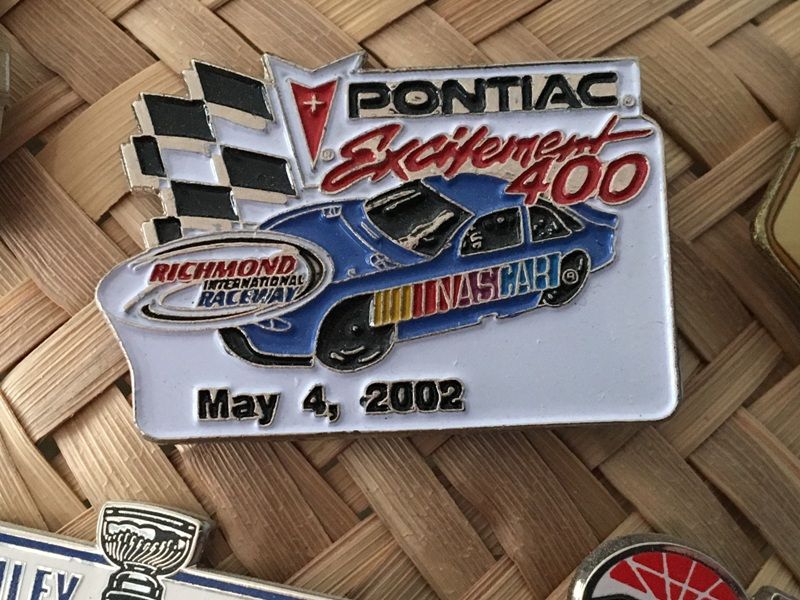
My one and (so far) only trip to Richmond for a race was in May 2002. I was scheduled to be in Cary NC the week after the race for work. So I left a few days early, jumped over to High Point to hang with friends, and left early Saturday morning for a planned, single-day trip to Richmond.

Our crew consisted of three Schaefer HOFers - Philly, Paduc and me - plus a friend of Paduc - a British chap. As we left from a Greensboro mall parking lot, we knew it was going to be a challenging trip. A persistent, misty rain followed us most of the way.

As we arrived, however, optimism returned as the rain had stopped. Philly and I parted ways from Paduc and his British bud as our pairs of tickets were in different sections of the grandstands. Philly and I tailgated with a few folks, watched several drivers cruise by on scooters, and then headed for seats as the skies again darkened and light precip returned.

NASCAR officials managed to put the race under green with Ward Burton starting from the pole. But the racing was short-lived, and the race was postponed until Sunday. The two of us donned our rain ponchos and began the slow walk back to the van.

Along the way, we began working through multiple iterations of Plan B.
  • Go home and lose the race? Unacceptable.
  • Go home and drive back Sunday? Long friggin' trip. A next-to-last resort.
  • Sleep in the van and fall out Sunday morning? Not desirable but acceptable and cheapest.
Though we were damp, we weren't soaked - though our shoes were steadily headed that direction. Yet, our two compadres hadn't arrived to unlock the door and help us agree on next steps.

After about an hour of standing in the rain, our feet had begun to grow gills and my temperature had started to rise from frustration. We finally spotted two sadsacks headed our way - fully drenched and without ponchos.

We laughed, they grumbled, and we all piled in the van. Still in race ready mode, I made the pitch to just stay where we were - in the dry van. No clean clothes, no toothbrush, wet shoes? Who cares - we'd be racing in about 15 hours! "Let's just sleep in the van, roll out tomorrow, find a Walmart, and go racing."

The Brit turned from behind the steering wheel, sneered, and chirped "You're a bloody fool. I need a room and a shower chap." 

The truth came out the next morning at breakfast. With the nighttime rain, an unfamiliar track, and a healthy consumption of beer, the two had walked the opposite direction of the van. We had parked behind the backstretch and walked to the front. When the race was called, they walked out the front gate - and kept going. Apparently after a half-mile or so, they realized nothing looked familiar. They had to retrace their steps to the track, rethink things, and then set out again towards the backside of the property.

So though I suppose I deserved to be called a bloody fool, I did get a good laugh out of it - plus a dry room, a shower, and a hot breakfast.

As an aside, the race was won by the recently retired Tony Stewart. It was the first of two times I saw Smoke take the checkers.

TMC

Wednesday, December 28, 2016

TMC Racing Stories: Talladega 2

The eventual co-founders of the Schaefer Hall of Fame hit Talladega for the 1991 summer race. The weekend was a return trip for me but the first Dega experience for Philly.

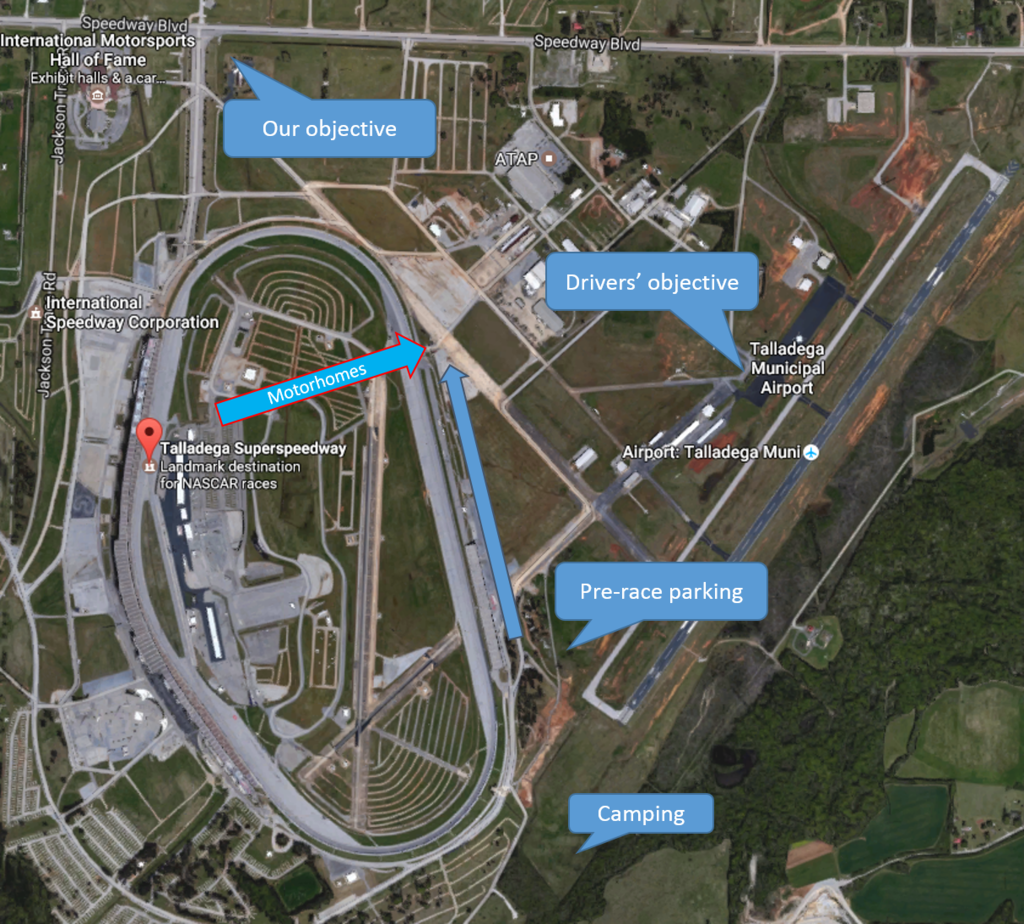
For the most part, my previous trips to the track served me well. We talked our way into the camping area behind turn two as I'd done before despite not having tickets in hand. On race morning, we also moved the car to just outside the camping area behind the backstretch. I'd parked in the same place for three or four races. The spot made for a pretty easy, post-race getaway after leaving the backstretch GA seats.

On this particular day, however, the spot was a bad call. We made it to the car and began a slow crawl down what was then a gravel road behind the back stretch through the throng of Talladega loonies.

As we got closer to turn three with a plan of getting to Speedway Boulevard, traffic flared to three or four makeshift - and gridlocked - lanes.

We soon realized the problem. Track officials had opened the crossover gate allowing cars and motorhomes to leave the infield. They did so with zero staff directing traffic at ground zero where the perpendicular flows of traffic intersected.

Once a couple of motorhomes eased their way through the cars, it was a bit like a procession of elephants. Several cars forced the issue by jumping between the vehicles leaving the infield. Zero progress.  

Finally, one good ol' boy had seen enough. Shirtless but with a beer in hand, scrawny chest puffed out, and middle finger extended, he made his way between two rows of cars to voice his displeasure at the column of campers.

The door slowly opened to one of them and out stepped an occupant. Giving the drunk redneck his due, he immediately recognized who it was.

He ran up to Bobby Allison, put his arm around him, flipped his scowl to a big grin, and started hollering at his crew somewhere back in traffic "It's Bobby Allison man! Bobby Allison!"

Allison was very calm about the encounter. He whispered something in the dude's ear and went back inside his motorhome. A split-second later, the guy went into Moses mode to part the seas. He directed cars to halt so Allison could continue - presumably to the neighboring airport for a quick flight home.

Once Bobby was rolling again, the self-designated traffic control official strutted back to where he began exclaiming "Bobby Allison y'all. F'n Bobby Allison."

TMC

Saturday, December 17, 2016

TMC Racing Stories: Atlanta 1

For the first half of the 1990s, I lived in Chattanooga, TN. Races at Talladega and Atlanta were easy day trips. In March 1992, however, we chose to live large, spend the night  in Atlanta, and then head to the track Sunday for the Motorcraft 500.

For the most part, the trip was at the right price: free.
  • Three of us crashed in the hotel room of a King Racing / Quaker State team member.
  • We were comp'd two hospitality passes. Through some creative logistics, we made two passes work for three of us - and even leveraged them into garage access.
  • A couple of additional friends bought and comp'd us tickets and agreed to bring sandwiches.
The hospitality event and garage access were amazing. The rest? Well...

Our friends were racing noobs. As we headed for the grandstands, we learned our friends bought seats on the fourth row of the frontstretch near the top of pit road. They believed preferred seating at a race would be similar to sitting near home plate at a baseball game or down low behind the bench at a football game.

For those unfamiliar with the original Atlanta configuration, the track was a true, tight oval. Long, high turns and short, fast straightaways. The stands were right up on the action.


But...beggars can't be choosy. We were at the track on a nice spring day...for free.

Shortly after the race began, I got a shoulder tap followed by some amateur sign language asking if we were ready for sandwiches. We replied with thumbs up.

Rather than pass pre-made sandwiches, subs, or wraps down the line, our ignorant but well-meaning friends broke out a loaf of white bread, a pack of bologna, cheese slices and a squeeze bottle of mayo.

We tried to balance the fixins as best we could. Shortly after the mayo hit the bread, however, it was peppered - but not with the seasoning.

Sitting on a low row at old Atlanta resulted in several hours of being sandblasted with track grit and tiny rubber pellets from the tires. With fresh mayo exposed on a piece of Wonder bread, all that grit settled evenly and provided an awkward crunch to our freshly made sammiches.

TMC

Thursday, December 15, 2016

TMC Racing Stories: Talladega 1

After several years of blogging detailed posts about racing history, I'm pretty tired.


So for the downtime of racing season between now and 2017 Speedweeks, I don't plan to do a lot of racing research or meaningful blogging. Instead, I thought I'd just share some random stories from days at the track over the years. I don't really have much of a plan or schedule. I'm guessing one story trigger a memory and will simply lead to another post. So here goes.

A bud of mine and I rolled into Talladega in May 1992 for a weekend of racing and fun. That weekend as has been documented previously is best remembed by us as the flashpoint for our Schaefer beer tradition. But we also met a few characters - as is generally the case with any trip to Talladega.

We were setting up our tent, readying the grill, unloading the coolers, etc. when a couple of good ol' boys wandered over. The conversation went a little something like this.

Bubba: Y'uns been down here afore?
Me: Yeah, a few times.

Bubba: Was y'all here last year?
Me: As a matter of fact, we were. We...

Bubba: Yeaaahhh man, we served a mess a'breakfast that day. Dang.
(Bubba #2 chuckled a bit to break his silence.)
Bubba: Man, we had people from everywheres over thar. Did y'all come over?
Me: No, we just had our thing going over here friend.

Bubba: I'm tellin' ya man. If I had a nickel for every cup of coffee we poured, damn. We woulda had about twen... well, we woulda had about four dollars.

TMC

Thursday, October 6, 2016

October 6, 1974 - National 500

As the 1974 Winston Cup season neared its conclusion, Charlotte Motor Speedway hosted its annual National 500 on October 6th as the third-to-last race of the year.

Source: Motor Racing Programme Covers
Credit: Bryant McMurray via University of North Carolina Charlotte
Though racing was in a much different place economically in 1974 than it is today, Cup still had a number of fixture teams and drivers including:
  • Petty Enterprises and Richard Petty
  • Wood Brothers and David Pearson
  • Junior Johnson and Cale Yarborough
  • L.G. DeWitt and Benny Parsons
  • Bud Moore and Buddy Baker
  • Nord Krauskopf and Dave Marcis
One driver who did not have the financial security to guarantee future races was second-year Cup driver Darrell Waltrip. After losing to 1973 Rookie of the Year award to Lennie Pond, Waltrip raced in about half the events in 1974. He won one pole and averaged a 14th place finish coming into the Charlotte race. But a second place finish in Darlington's Southern 500 was sandwiched between two rotten finishes - 44th in the Talladega 500 and 35th in the Delaware 500 at Dover. Anemic purse payouts and the absence of a backing sponsor led Waltrip to believe 1974 would be his second and final season in Cup.

Source: Spartanburg Herald-Journal via Google News Archive
Another driver facing tough times was California's Dick Brooks. After two years of driving for himself in the late 1960s, Brooks drove for couple of other owners in the early 1970s - including Jimmy Crawford with whom he won at Talladega in 1973. Brooks went back to driving his own cars in 1974 with limited support from Simoniz.

With less than a couple of weeks to go before Charlotte, a fire consumed much of Brooks' shop in Spartanburg, South Carolina. With the tireless efforts of several friends and crewmen, Brooks salvaged a car, had it painted, and readied it for the race.

Source: Spartanburg Herald
Source: Spartanburg Herald-Journal
When the cars hit the track for qualifying, Pearson laid down the quickest lap to nab the pole. His top spot came as a surprise to no one. Pearson's winning the pole at Charlotte in the 1970s was about as much of a given as the sun rising in the east. Beginning with the 1973 National 500, Pearson reeled off 11 consecutive poles in the Wood Brothers' Mercury.

Source: Sumter Daily Item
Petty qualified on the front row alongside his career rival and good friend. Baker, Donnie Allison in the #88 DiGard Chevy, and Yarborough rounded out the top five starters.

Source: The Monroe News Star
The race was only two laps old when a serious wreck unfolded. Jerry Schild in his fourth of what turned out to be only a five-race Cup career lost his car coming out of the number four corner. He fishtailed, slid through the infield grass, kicked up a dust storm for the cars following behind him, but continued without wrecking.

The problems unfolded, however, behind the crop-dusting Schild. Baker, Jim Vandiver, Joe Frasson, Soapy Castles and independent driver Richard Childress all barreled through the dust and wrecked as they headed for turn one. Brooks misfortune continued as well. After the shop fire and two-week thrash job, the multi-car wreck also snared Brooks' rebuilt Dodge.

Immediately behind that group was Marty Robbins, country music singer and part-time Cup racer. Robbins had a split second to make a decision between two unpleasant choices:
  • hammer Childress in the driver's side door or 
  • hook right and drill himself into the wall. 
Marty unselfishly chose the latter. He turned his purple-and-yellow #42 Dodge right and pummeled the concrete wall at about 160 MPH - without a five-point harness, full-face helmet or HANS device. Though Childress was spared, Robbins was pretty badly hurt with several broken bones and facial lacerations.

The race continued with additional wrecks and several engine failures. Yet, the event was competitive up front. Fans saw 47 lead changes throughout the day with each new leader spending only a handful of laps out front. Though the lead changed hands dozens of times, the laps were largely dominated by Pearson, Petty, Yarborough, Donnie Allison, and Waltrip.

Pearson led about 30 laps during a couple of segments in the early stages of the race before cutting a tire. Other drivers then took their turn dicing for the lead in the middle stages. With about 50 laps to go, however, Pearson decided it was once again go-time.

The #21 Mercury went to the point and brought the King with him. Petty, seeking his first 500-mile win at Charlotte, kept Pearson honest in the last few laps. He got within about three car lengths, but Pearson took the checkered flag for the win and the season sweep at the track. The Silver Fox also won the World 600 in May - coincidentally also over Petty. The race was the 53rd of 63 times Petty and Pearson finished in the top two spots.

Waltrip led 39 laps, finished a solid third, and was able to continue racing. A little over six months later, he found himself in victory lane for the first time at his home track (drink!), Nashville's Fairgrounds Speedway. Less than a year after Charlotte, he parked his own Cup team and began a six-year stint with DiGard replacing the fired Donnie Allison.

With his second place finish, Petty wrapped up his fifth Cup title. At the time, no driver had won more than three titles. Only two drivers have matched the feat since - Dale Earnhardt and Jimmie Johnson.

Source: The Robesonian via Google News Archive
Marty Robbins accident ended his 1974 racing season - though not his racing ventures. He returned in February 1975 to race in the Daytona 500. He did, however, end one part of his career in 1974. Marty was the last performer of the final Saturday night Grand Ole Opry at the famed Ryman Auditorium seven months earlier on March 9, 1974.

Source: Spartanburg Herald-Journal
TMC

Wednesday, October 5, 2016

October 5, 1969 - Wilkes 400

The Wilkes 400 at North Wilkesboro Speedway on October 5, 1969, was the 47th event of a 54-race season schedule!

The race was originally scheduled for September 21st - the Sunday after the inaugural GN race at Alabama International Motor Speedway, known today as Talladega Superspeedway.

When drivers associated with the Professional Drivers Association loaded their cars and opted not to race in the Talladega 500, Bill France Sr. ran the event anyway with a patchwork of largely independent drivers.

Afterwards, however, France wanted to make sure a similar situation would never happen again. NASCAR revised its driver entry forms to include provisions for guaranteed participation. Wilkesboro track owner Enoch Staley cancelled all the submitted entries for the Wilkes 400 and requested new ones. The race date was moved to October 5th to allow time for the new entries to be submitted and processed. (The next race after Talladega was on the following Thursday night at Columbia Speedway. It was held without any driver protests and without the revised entry form.)

Source: Statesville Record and Landmark
NASCAR Hall of Famer Bobby Isaac won the pole when the drivers arrived at Wilkesboro in October. The race was the sixteenth of nineteen times Isaac nabbed the top starting spot in 1969. David Pearson in his Holman Moody #17 Ford qualified on the front row alongside Isaac. Richard Petty and Buddy Baker made up the second row. Richard Brickhouse (the winner of the Talladega race) rounded out the top five starters.

When the green flag dropped, Isaac let it me known he could go fast for more than just one lap. He pulled the field around the track for the first quarter of the race and then some. Petty then put his Petty Blue Ford (yes, a Blue Oval) into the wind. He took the lead from Isaac and began his domination of the race.

After leading a stretch of 260 laps, the King was seemingly on his way to third consecutive Wilkes 400 victory...until. With only 13 laps to go, Petty's comfortable half-lap lead over second place Pearson was negated by a jerk who lobbed a bottle onto the track from the grandstands.

Petty's lead was erased because of the caution. As the race returned to green, Pearson made his way past Petty's 43, led the final four laps, and stole the win. Coincidentally, Petty won the Old Dominion 500 at Martinsville over Pearson a week earlier in an almost identical situation.

The race was the 39th of 63 times Petty and Pearson finished in the top two spots. Interestingly, the two drivers finished 1-2 in the 1969 championship standings as well - the only year for them to do so. Pearson's Wilkesboro win secured him his third GN title which tied him at the time with Lee Petty.

Source: High Point Enterprise
TMC

Saturday, September 17, 2016

September 17, 1972 - Delaware 500

As NASCAR's Winston Cup series schedule hit mid-September, only six races remained between Richard Petty and his pursuit of an unprecedented fourth title. Petty and his fellow drivers arrived in Dover, Delaware for the annual Delaware 500.

Source: Motor Racing Programme Covers
Bobby Allison won the pole in his Junior Johnson-prepared Coca-Cola Chevy. David Pearson lined up alongside Allison. Former teammates Buddy Baker (who had moved to the #71 Harry Hyde-led team) and Petty made up the second row. Coo Coo Marlin qualified fifth, one of his best career starting positions.

After a slam-bang affair at Richmond 500 a week earlier (and a handful of other on-track encounters over the years, Petty and Allison were reported by the media to be feudin'. Officially, both competitive drivers declined to take the bait - even in the face of a tight battle for the 1972 Cup.

Baker led a couple of sizable segments of around 50 laps each. Petty and Allison also led a few laps here and there. The day belonged, however, to the #21 Wood Brothers Purolator Mercury team. Pearson led 350 laps - including 345 of the final 350.

When the checkers fell, Pearson won over second place Petty by three laps. Though separated by three laps, the finish was the 46th of 63 times Petty and Pearson claimed the top two spots.

Source: York Daily Record
The rest of the top 10 was filled by some near-career days by independent drivers including:
  • 3rd: Ramo Stott driving for the Virginia gentleman car owner, Junie Donlavey
  • 4th: James Hylton
  • 5th: future Richard Childress Racing mechanic Cecil Gordon
  • 7th: future Winston Cup pace car driver Elmo Langley
  • 8th: Walter Ballard (Ballard fielded the car for Dale Earnhardt's second career Cup start)
Source: The Hour via Google News Archive
Before the race, Petty may have told the press any feud that may have existed with Allison was over. Few believed it. Though the two didn't swap much paint at Dover, the hard racing between them continued down the stretch of 1972 including the two post-Dover battles in the Old Dominion 500 at Martinsville and the legendary Wilkes 400 at North Wilkesboro.

Petty won two of the final five races as did Allison. When the season concluded, however, Petty prevailed over Allison to capture his fourth title.


TMC