Monday, April 23, 2012

April 23 - This day in Petty history - part 1

1961 - Starting from the pole, Richard Petty leads 182 of 200 laps, and easily wins the Richmond 200 at what was then known as Atlantic Rural Fairgrounds - today the site of Richmond International Raceway.


The win was Petty's fourth career Grand National victory. Also, it was his first pole and win since he - and father Lee - sailed over the fence in their respective Daytona 500 qualifying races about 60 days earlier. Richard escaped his wreck without much harm. Lee's wreck, however, nearly killed him and could have ended Petty Engineering as a company. Richard and brother Maurice re-grouped after Lee's wreck, went to work immediately, and their efforts were rewarded with some good finishes - including the Richmond win.

Only 12 cars started the race - a record shared with six other races for the fewest entries in a Grand National / Cup race. Of the twelve who started, only six cars took the checkers.

Article courtesy of Jerry Bushmire
TMC

Sunday, April 22, 2012

April 22 - This day in Petty history - part 2

1979 - Starting second, Richard Petty bests Buddy Baker and Darrell Waltrip to win the Virginia 500 at Martinsville.

The victory was Petty's 187th career win, his first short-track win since 1975, and his fifteenth and final Martinsville win.


Petty qualified second in a Chevy Monte Carlo. Darrell Waltrip won the pole in a Chevy Caprice with a front-end that was much boxier than the Monte. Ol' DW who enjoyed nicknaming his cars called the Caprice "Dolly Parton" because its what's up front that counts. Also, a member of the Alabama Gang - Neil Bonnett - made his first start for the famed Wood Brothers after the Woods and David Pearson parted ways after the previous week's race at Darlington.

Source: TMC Archives
A photo I took of the winner's trophy at the Richard Petty Museum in Randleman NC in 2011:

And a photo I took of Waltrip's pole-winning trophy on display at his Honda dealership in Franklin, TN:

A concise 4 -minute video featuring some of the highlights from the race. Ken Squier was the main commentator, and NASCAR Hall of Fame member Ned Jarrett covered the pits and the victory lane interview.


Articles courtesy of Jerry Bushmire
TMC

April 22 - This day in Petty history - part 1

1962 - Starting seventh, Richard Petty wins his seventh career race in the Virginia 500 on Easter Sunday at Martinsville.

Source: Motor Racing Programme Covers
The race was originally scheduled for April 8. Qualifying sessions were held on Friday and Saturday. Defending race winner Junior Johnson laid down the quickest lap in a 1961 Pontiac, but his time was disallowed after a protest by the Holman Moody team. Instead, Fred Lorenzen moved to P1 for the start. Petty qualified in the seventh spot.

Source: Spartanburg Herald via Google News Archive
Junior refused to have his car inspected and accepted the DQ. But he returned the next day with a different car - a 1962 Pontiac. He didn't post a time during second round qualifying and chose to thrash on his car instead. The fan favorite was awarded a 26th place starting spot perhaps as a NASCAR or promoter's option.

NASCAR Hall of Famer Herb Thomas attempted to make another start after a 5-year absence from racing. He raced the previous week at North Wilkesboro, and the following article indicates he qualified for the Martinsville race. The finishing results, however, do not include Thomas' name leading me to believe he withdrew from the event.

Source: Spartanburg Herald via Google News Archive
On race day, however, torrential rains washed out the race. The race was rescheduled to Easter Sunday, April 22nd. Though perhaps not a popular date, NASCAR and Clay Earles didn't have a lot of choices. The GN cars were already scheduled to race at North Wilkesboro the following Sunday on April 15th (a race coincidentally won by Petty). And the long Easter weekend was already booked with other GN races:
  • Maundy Thursday: at Greenville-Pickens in South Carolina
  • Saturday: Rambi Raceway in Myrtle Beach
  • Easter Monday: Bowman Gray Stadium in Winston-Salem
Source: Free Lance-Star via Google News Archive
With qualifying positions set from the original times on April 6-7, the teams' sunrise service was an overnight drive from Myrtle Beach to Martinsville. The Holman Moody tandem of Lorenzen and Nelson Stacy led the field to the green.


The top two starters combined to lead much of the first 50 laps. Then after working his way through the field, Junior Johnson (in his replacement Pontiac) went to the point to lead for 50+ laps. Johnson's car then began to develop a problem with its rear-end, and he was done for the day by lap 204. (Interestingly, his original car was disqualified because of alleged trickery with its rear-end.)

Fireball Roberts then seized control over the middle stages of the race in his Pontiac. He piled up 244 consecutive laps out front before he too had a rear-end failure. With the two strong Pontiacs sidelined, Petty's 43 Plymouth had the opportunity to capitalize. Richard led most of the second half of the race to take the checkers.

Finishing fifth with relief help from Jim Paschal was Lee Petty. Papa Lee made his first start since his terrible, life-threatening crash at Daytona in February 1961. The Martinsville race was Lee's only race in 1962. He would not race again until a stint as a relief driver for - coincidentally enough, Jim Paschal - one year later at Martinsville.

Courtesy of Jerry Bushmire
Article courtesy of Jerry Bushmire
TMC
Edited April 5, 2015

Saturday, April 21, 2012

April 21 - This day in Petty history - part 2

1974 - Starting fourth, Richard Petty leads 336 laps and wins the Gwyn Staley 400 at North Wilkesboro Speedway to capture his 157th career victory.

Rival Bobby Allison finished second two laps behind The King, and Cale Yarborough - who went on a tear with 3 consecutive championships in 76-77-78 - finished third.

Although the race was billed as the Gwyn Staley 400, NASCAR had agreed to cut its races in 1974 by 10 percent to acknowledge the nation's energy crisis. As a result, laps 1-40 were neither run nor scored with a lap leader; however, they were logged as 'laps completed' in the finishing order. Petty led 336 of the 360 laps actually raced, but he is credited with having completed 400 laps.

Source: Save The Speedway
Article courtesy of Jerry Bushmire
TMC

April 21 - This day in Petty history - part 1

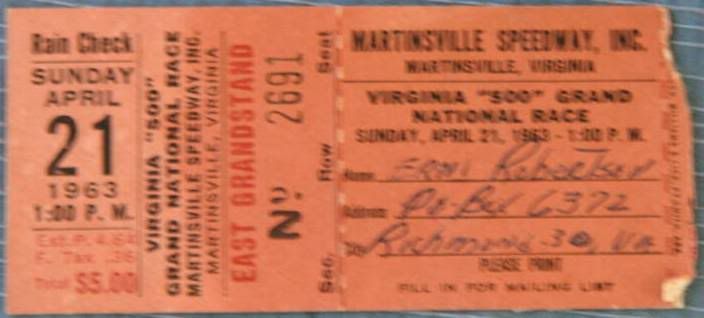
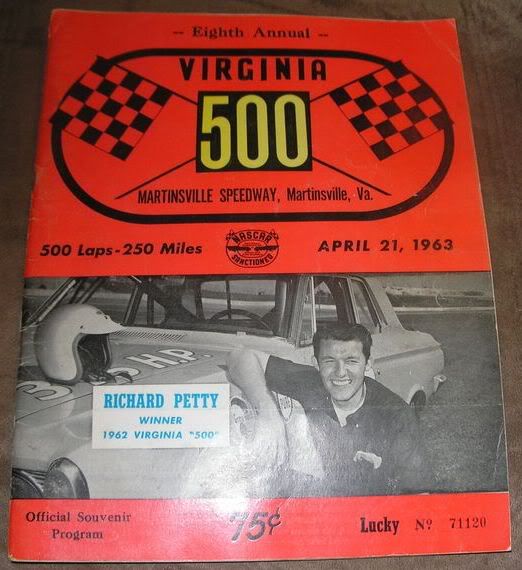
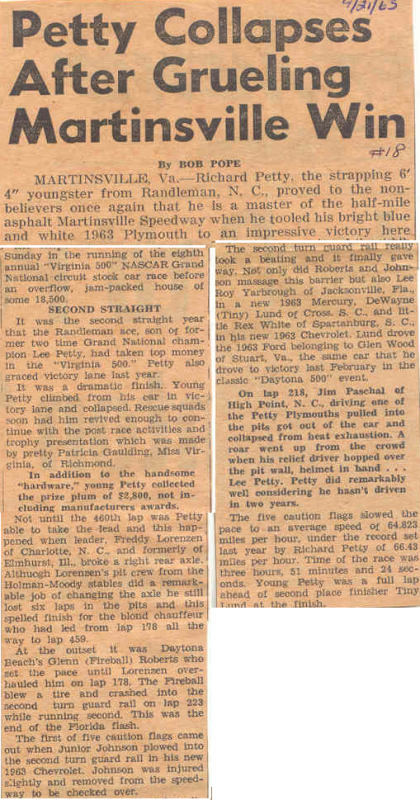
1963 - Starting 8th, Richard Petty leads the final 41 laps and notches his 18th career victory with a one-lap win over Tiny Lund in the Virginia 500 at Martinsville.

The pace lap before the start - with Rex White starting from the pole and Fireball Roberts alongside him on the front row. Petty started on the outside of the 4th row.

Source: Fantasy NASCAR Racin
Teammate Jim Paschal suffered heat exhaustion and needed help from a relief driver. The observant and appreciative crowd roared when the old man - Lee Petty - took over the #41 Petty Plymouth and soldiered it home to an 8th place finish. Lee had raced only once since a near-death accident at Daytona in February 1961 (video).

Article courtesy of Jerry Bushmire
TMC

Friday, April 20, 2012

April 20 - This day in Petty history

1980 - Starting seventh, Richard Petty leads 327 of 400 laps and wins the Northwestern Bank 400 at North Wilkesboro Speedway.

The King won his 191st race with a 1-lap victory over second place Harry Gant. Kyle Petty somehow managed to finish eighth despite three spins during the race. With all due respect to Kyle, however, he was making only his first start at North Wilkesboro, his third start of the season, and his eighth career Winston Cup career start.

Joe Millikan finished 10th. Before moving to Winston Cup as a rookie in 1979, he worked for Petty Enterprises and won a few late model sportsman and ARCA races for PE in the 1970s. He was hired by L.G. DeWitt to run for rookie of the year in 1979, and Millikan finished second to Dale Earnhardt - who from what I've read ended up having a decent career of his own. (YES! I had tongue-in-cheek as I typed that.)

After the Wilkesboro race, DeWitt announced it was over. He shut his team down, and the one-time Petty protege Millikan was out of a ride. Millikan had a handful of rides over the next couple of seasons, but he never returned to a consistent, competitive ride. DeWitt's departure was sad too as he once owned the Rockingham and Atlanta tracks and fielded cars for Benny Parsons that yielded the 1973 Winston Cup championship and a Daytona 500 victory in 1975.

The following photo from The TMC Archives includes Richard's daughter, Rebecca. Today, Rebecca runs the Petty Family Foundation and is married to Brian Moffitt - now CEO of Richard Petty Motorsports.

Interestingly, TMC was photographed for the high school annual wearing the same t-shirt as Rebecca wore at Wilkesboro.

Article courtesy of Jerry Bushmire
The King's 1980 Wilkesboro trophy was one I spotted during my visit to the Petty Museum in 2011.

TMC

Wednesday, April 18, 2012

April 18 - This day in Petty history - part 2

1971 - Starting from the inside of the second row, Richard Petty leads almost half the laps and comfortably wins his 126th career race in the Gwyn Staley 400 at North Wilkesboro Speedway. The King also goes back-to-back as he successfully defends his win in the 1970 spring Wilkesboro race.

The race was run without a single caution - a remarkable feat for the tough ol' .625 flat short-track. Petty led 186 laps - including the final 126 - and finished a full lap ahead of second-place finisher David Pearson and four laps ahead of third-place finisher Dick Brooks who was driving Mario Rossi's #22 Dodge.

Pole-sitter Bobby Isaac led the first half of the race. He may well have dominated until the end except for a piece of metal hitting and breaking his windshield. After losing 2 laps to repair it, he regained his form but then lost an engine about 50 laps from the finish.

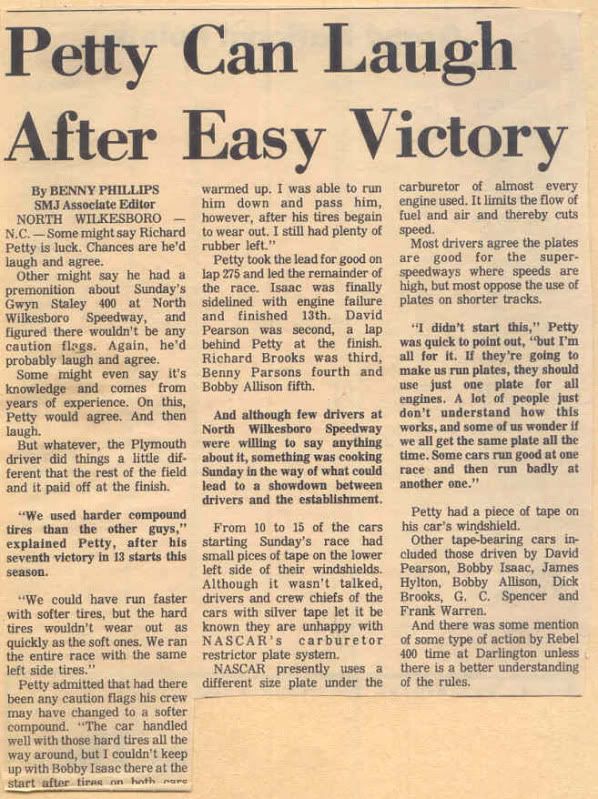
Today's fans are well familiar with NASCAR's use of restrictor plates at Daytona and Talladega. Others may even know the use of them began most recently after Bobby Allison's wreck at Talladega in 1987. Still others may know NASCAR used them on the superspeedways in the early 70s. But how many folks knew NASCAR used them in 1971 on short-tracks such as Wilkesboro. Read on...

Article courtesy of Jerry Bushmire

TMC