Showing posts with label usac. Show all posts

Saturday, April 2, 2016

April 2, 1961- USAC stockers make Southern debut

In January 2016, Curtis Turner and Bruton Smith were deservedly inducted into the NASCAR Hall of Fame. Their racing accomplishments earned them a spot in the Hall, but their selection for the same class was truly fitting. The two were allies and enemies - of each other and of Big Bill France.

Curtis and Bruton each announced plans for a superspeedway in the greater Charlotte area in the late 1950s. Bruton's plans withered, and he joined Turner's effort through somewhat of a forced marriage.

Charlotte Motor Speedway opened in 1960 with the inaugural World 600. NASCAR granted a second race to CMS - the National 400 - for that fall. Perhaps to open the eyes of fans to new types of racing - or perhaps to turn an extra buck for the financially strapped track - or perhaps simply to poke the bear, Bruton floated the idea of  a 100-mile, Indy-car, roadster race as a prelim event to the National 400. After some discussion and visits by the USAC brass, the race didn't happen.

For reasons only Bruton likely knows, he wasn't done courting USAC - or taking his jabs at Bill France Sr. In addition to his role with CMS, Bruton also promoted races at the nearby Concord Speedway.

Instead of an open wheel race at the 1.5 mile, paved Charlotte Motor Speedway in 1960, he chose to host USAC's stock car drivers for a 200-laps, 100-miles race on Concord's half-mile, dirt surface Easter Sunday, April 2, 1961.

Source: Daytona Beach Morning Journal via Google News Archive
Since its formation as a sanctioning body, NASCAR had dominated the south - and frankly still does. USAC, its preceding AAA sanctioning of open wheel races, and its successor organizations such as CART and the IRL had little exposure in southern states beyond general awareness of the annual Indianapolis 500.

The race seems to have been the first time USAC's stock car fellers were to be introduced to folks below the Mason-Dixon line. With the champ car race off the table, Bruton went right at NASCAR's wheelhouse with the scheduling of a USAC stock car race. Many wondered how fans would accept it. A more important question was how they would support it - with their greenbacks.

Source: Spartanburg Herald via Google News Archive
Bruton claims he scheduled his USAC race based on an open NASCAR date ignoring the obvious reality of it being Easter Sunday. NASCAR Grand National races were scheduled for Saturday April 1st at Greenville-Pickens Speedway and April 3rd, the traditional Easter Monday race at Bowman Gray Stadium Nothing was scheduled, however, for Easter Sunday. Until.

Rain postponed a Grand National race scheduled at Orange Speedway in Hillsboro, NC for March 19. Rather than reschedule it for Good Friday or another non-Easter weekend date, the promoter booked it on Easter Sunday. The promoter's name? Well, it happened to be the same guy who ran the sanctioning body: Bill France, Sr.

A degree in rocket science isn't needed to know France was willing to go head-to-head with Bruton's race - never mind most God-fearing, southern-by-the-grace-of-God race fans likely preferred to take the day off from anyone's race.

Source: Daytona Beach Morning Journal via Google News Archive
Source: Spartanburg Herald via Google News Archive
Bruton's race at Concord was held as scheduled (as was France's rescheduled one in Hillsboro). Bill Cheesbourg won the pole and led 12 laps. Don White dominated the race, however, and won after leading 165 of the race's 200 laps. Ramo Stott started fourth and finished seventh. Fifteen years later, Stott would find himself starting P1 for the now-legendary 1976 Daytona 500.

In the late 1960s, Richard Petty was coronated as The King of NASCAR. Don White was held in essentially the same high esteem in the ranks of USAC's stock car division.

Source: Spartanburg Herald via Google News Archive
The 1961 race wasn't USAC's last venture at Concord. The stockers returned two years later for another event. The pole winner for the 1961 race, Bill Cheesbourg, took home the trophy on race day in 1963. USAC's open wheel or stock cars never raced at Charlotte Motor Speedway; however, Buddy Lazier won the Indy Racing League race at CMS in 1997 - the first of three IRL events at the track.

TMC

Friday, March 6, 2015

March 6, 1977 - Jimmy Insolo wins Ontario

Through much of the 1970s, NASCAR's Winston Cup Series began its season in January at Riverside's road course in California. When Ontario Motor Speedway closed in the early 1980s, Riverside's season opener was moved to the end of the season. Then began the tradition begin of starting the season in February with the Daytona 500.

USAC had its own stock car division for about three decades from the mid-1950s through the mid-1980s. Though the division had several name drivers, many of them were 'double-dippers' - Indy car drivers who also raced in USAC's other divisions - including the stock car one.

USAC started its 1977 season with a twin-bill event at Ontario, another southern California track. Modeled after Indianapolis Motor Speedway, Ontario was a track ahead of its time, but it was woefully underfunded. From the early 70s through 1980, Ontario was the site of NASCAR's season-ending race.

On March 6, 1977, the track promoted the Datsun Twin 200, a pair of 80-lap, 200-mile races for USAC's stock cars and Indy/Champ cars.

A couple of drivers - Bobby Unser and A.J. Foyt - were looking to turn the double by entering both events. Foyt threw down the gauntlet early by winning the pole for the stock car event in his #51 Chevelle. Making his first USAC stock car start, west coast regular, Jimmy Insolo, qualified on the front row alongside Super Tex in his Chevelle. Unser lined up behind Foyt in the third spot in his Camaro.

The 30-car field was a hodgepodge of cars. Some were from the muscle-car class of Detroit such as Unser's Camaro. Others ran full-size sedan models such as Foyt and Insolo in their Chevelles and the 8th place starter, Ohio's Woody Fisher in his 1974 Schlitz Beer Dodge Charger.

Fisher's Charger was built by Petty Enterprises and was the same one he raced to victory in the 1977 ARCA 200 at Daytona about a month earlier.

Foyt set the early pace and let the field know who was boss.

Source: Bakersfield Californian
Unser's day nearly ended before it really got going. With a nudge from Insolo, he spun off turn 3 on lap 16. Bobby sent up a plume of white tire smoke, but his car was otherwise unharmed. After a stop to replace his flat-spotted tires, he went back on the track and was a contender as the race neared its conclusion.

Source: Corona Daily Independent
Foyt was in control of the race though Unser had rallied. With 5 laps to go, however, Super Tex cut a tire and began to fade. Foyt's misfortune quickly became a huge opportunity for others. Insolo's hulking Chevelle and Unser's small Camaro hooked up in the race to the finish. The duo swapped the lead eight times in the final four laps.

Unser took the white lap with Insolo in tow. With the checkers in sight, the two drivers came upon a slower car. Unser went to the inside, and Insolo jumped to the outside putting the lapped car in the middle of a 3-wide sandwich. Insolo carried the momentum off the corner and won by less than a car-length over Unser.

Photo courtesy of Jerry Bushmire
Though the race was Insolo's first USAC stock car race, it was not his first Ontario race nor his first close win. A year earlier, he narrowly defeated L.D. Ottinger in a 250-mile NASCAR late model sportsman race.

Foyt managed to keep his ride under him and came home a disappointing third. Chuck Bown - who later won NASCAR's Busch Series championship in 1990 - finished fourth, and Ron Hutcherson rounded out the top five. Full-time beer distributor and part-time racer Woody Fisher brought home the Petty-built Charger tenth.

Foyt's day wasn't a complete loss. After finishing third in the day's opener, he dusted the field to easily win the Indy car main event race.

The two winners

Photo courtesy of Jerry Bushmire
Source: Corona Daily Independent
Two years later, Insolo played a significant role in Richard Petty's seventh Winston Cup title. When The King needed relief help in the NAPA 400 at Riverside, Insolo was called upon to belt into the 43. He rallied the STP Monte Carlo to a third-place finish behind second-place finisher Darrell Waltrip. Considering Petty won the title over Waltrip by a razor-thin margin, Insolo was instrumental in Petty getting his seventh Cup.

TMC

Tuesday, July 1, 2014

Schaefer 500s revisited

Back in 2010 - a lifetime ago in my blogging practices - I posted about each of the Schaefer 500 USAC Indy car races at Pocono. At the time, I threw them together quickly.
  • the date
  • the winner
  • a link to the results
  • a photo or two
Over the last week, I've edited each of them with more details about the race, additional photos, plus an article or two as well. I left the entries with their original posting date though I did add an 'edited' date. Here are links to each of the posts.
Bench Racing's series of Schaefer 500 posts ... the one blog to read when you're reading more than one.


TMC

Sunday, April 27, 2014

April 27, 1975: USAC's Trenton Twin Bill

On April 27, 1975, the NASCAR Cup teams raced on the half-mile paperclip at Martinsville. King Richard won the Virginia 500 to claim his 14th victory at the track.

About 450 miles northeast of Martinsville in New Jersey, USAC ran a twin bill at the famed, kidney-shaped Trenton Speedway billed as the World Series of Auto Racing. (I'm curious as to how they may have secured the rights to use the name World Series. Or did they?)

From Motor Racing Programme Covers
The day featured two 100-lap, 150-mile races for the 'champ' cars and USAC stock cars. The races had short fields - 12 in the Indy car event and 10 in the stock car race. Apparently this was by design. Long before the days of NASCAR's The Winston but akin to the early years of IROC, participation in the WSoAR was by invitation only.

Johnny Rutherford won the open wheel race with a one-lap victory over second place Gordon Johncock.

In the stock car race, Super Tex A.J. Foyt continued to show his versatility in all forms of auto racing. The skills he'd honed on USAC's stock car circuit as well as his periodic starts (and wins) in NASCAR paid off again at Trenton. Driving a #28 Hoss Ellington prepared Chevy, he led all 100 laps and cruised to the victory.

What interests me about the race, however, is the SECOND place finisher. Bobby Unser - known more for his champ car results than his stock car career - drove a Norm Nelson 1972 Plymouth to a second place finish, the only car on the lead lap with Foyt. Unser's sponsor? You got it - a Bench Racing fave - Schaefer Beer.


Source: Reading Eagle via Google News Archive 
TMC

Monday, July 29, 2013

July 29, 1973 - Petty Poaches Pocono

Throughout 2013, I've focused on blogging about Petty Enterprises wins by drivers other than Richard Petty. I figured I'd already given The King his due with my blog series about his 200 wins. But Richard also competed in a few races not sanctioned by NASCAR, and he won one of them back in 1973. Because the win isn't part of his 200-win GN/Cup tally, I didn't blog about it back then. So now - bonus edition time! A Petty Enterprises win - with Richard as the driver - but in a series other than NASCAR.

July 29, 1973: After qualifying second, Richard Petty wins the Acme SuperSaver 500 USAC stock car series race at Pocono Raceway in Pennsylvania.

NASCAR's Winston Cup series had a couple of open weekends between its July 22nd race in Atlanta and August 12th at Talladega. So Petty took the opportunity to head north to race in the Poconos - perhaps even to enjoy a brief respite from the summer southern heat and humidity.

Other NASCAR regulars who made the trek with the Petty Enterprises included long-time Petty rival Bobby Allison and independent drivers Dick May, Bruce Jacobi, D.K.Ulrich, Frank Warren and H.B. Bailey. The race also featured several USAC drivers who occasionally dabbled in Cup racing including Super Tex himself - A.J. Foyt, Ramo Stott, Gordon Johncock, and Jim Hurtubise.

Bob Whitlow, former center for the NFL's Cleveland Browns, Detroit Lions and Atlanta Falcons, started the race as well. Following the end of his football career, Whitlow built a #51 Dodge Charger and raced in about 20 USAC and NASCAR stock car events from 1973 through 1976.

In his book Pocono: NASCAR's Northern Invasion, author Joe Miegoc writes:
Petty took control in the Acme 500 in 1973, beating [Butch] Hartman in a close finish that saw Petty lead 124 of the 200 laps, yet earn $10,730, or about two-thirds of what Hartman received for winning the Pennsylvania 500 in 1971.

Hartman led 39 laps and [Roger] McCluskey, who finished third, led 24. Foyt, back after skipping the 1972 race, led the other 13 laps and finished seventh after starting from the pole. Ron Keselowsi, who came out of nowhere to win in 1974 in USAC's last stock-car gasp at Pocono, was 17th, with Bobby Allison, who would be the only NASCAR driver to also run an Indy car race at Pocono, finishing 25th. Gordon Johncock who would beat Rick Mears in 1982 in the closest finish in Indianapolis 500 history, ran this stock car race for Hoss Ellington and finished 34th, losing his brakes after just 34 laps.

Petty was the big draw, but among USAC officials, the welcome mat was not exactly out for the King.

Under the organization's rules, a driver or team had to be a USAC member and run the entire series to get a garage spot at any race. Without points in the series, you were an outsider.

And that included even Richard Petty.

"We weren't exactly welcome, not really," Petty said with a laugh in 2009. "When we got there, they had some garage area, and there were some of them that were still empty, but we didn't get one. They made us park out in a tent in the gravel area, work on the car behind the garage area."

Then [track owner Joe] Mattioli, who insists he didn't pay Petty any appearance money to run at Pocono before NASCAR officially ran a race there, put his foot down.

"I told them (USAC officials) if Richard Petty didn't run that race, there would be no race," said Mattioli, who also once faced down an ABC Sports official by telling him there would be no Schaefer 500 on Wide World of Sports if the Schaefer name couldn't be used. The ABC guys, while trying to avoid giving sponsors free advertising, buckled then too.

"The gentleman that owned the track (Mattioli) decided us out in the gravel wasn't going to work,' Petty said. "He told them guys that if Richard Petty did not get in the garage area, he was going to run them all out. So that pretty much took care of all of it. Once we got there and started talking to all the guys and such, we realized that, 'hey, it wasn't the drivers, the guys we were competing against. It was the officials.' But I think everybody got on their fanny and by the time it was time to race, everybody had come around.

"We came back the second year and we were welcomed with open arms."

And true to his heritage, Petty ruled that Acme race.

Oddly, it was held as a prelude to the Pennsylvania State Fair, which among others, featured Bob Hope and the Jackson 5, with a youngster named Michael singing lead.

The King and the later King of Pop at Pocono in one weekend. Strange indeed. ~ pp. 109-110
The King and Super Tex go at it during the race.

USAC regulars Hartman and McCluskey were left to battle it out for second. Hartman tried to hang tough with Petty near the end of the race, but it wasn't to be.

Photo courtesy of Russ Thompson
The starting line-up ... and the finishing order.

So once again in his career, The King got the opportunity to snuggle up to Miss Hurst Shifter, Linda Vaughn, in victory lane.

As was so often the case, The King was the class of the field. His NASCAR rival Allison was a non-factor. Foyt - the larger-than-life personality of various open-wheel racing series over the decades - couldn't beat Ol' Blue. And the cast of USAC regulars and NASCAR independents were no match for the 43. So like the old Loony Tunes cartoons, the Coyotes couldn't catch the Road Runner (or the Dodge Charger) even with an assist from Acme.

Article courtesy of Jerry Bushmire
The race was also featured in the November 1973 issue of Stock Car Racing magazine. Writer Richard Benyo was complimentary of the NASCAR and USAC drivers and the show put on for the fans. But he was very biting in his criticism of the USAC sanctioning body and the Pocono track management for the underwhelming way the race was promoted.

A year later - plus a few days - Petty returned to Pocono for its inaugural Winston Cup race. The King picked up where he left off in 1973 by winning the 1974 Purolator 500.

Edited 2013-08-19: Petty raced the same Charger three years later at Pocono and won the 1976 Purolator 500 NASCAR Winston Cup race.
✮   ✮   ✮   ✮   ✮

July 29, 1973 is also memorable for another racing event - but for a painful, gut-wrenching memory. As Petty raced in the Pocono Mountains of Pennsylvania for a second time in his STP Dodge, fellow STP driver Roger Williamson of Great Britain suited up and belted in for his second career Formula 1 race. On the eighth lap of the Dutch Grand Prix in the Netherlands, Williamson's red March-Ford wrecked with David Purley, flipped, skidded a long distance, and caught fire - with Williamson trapped inside the car but not terribly injured.
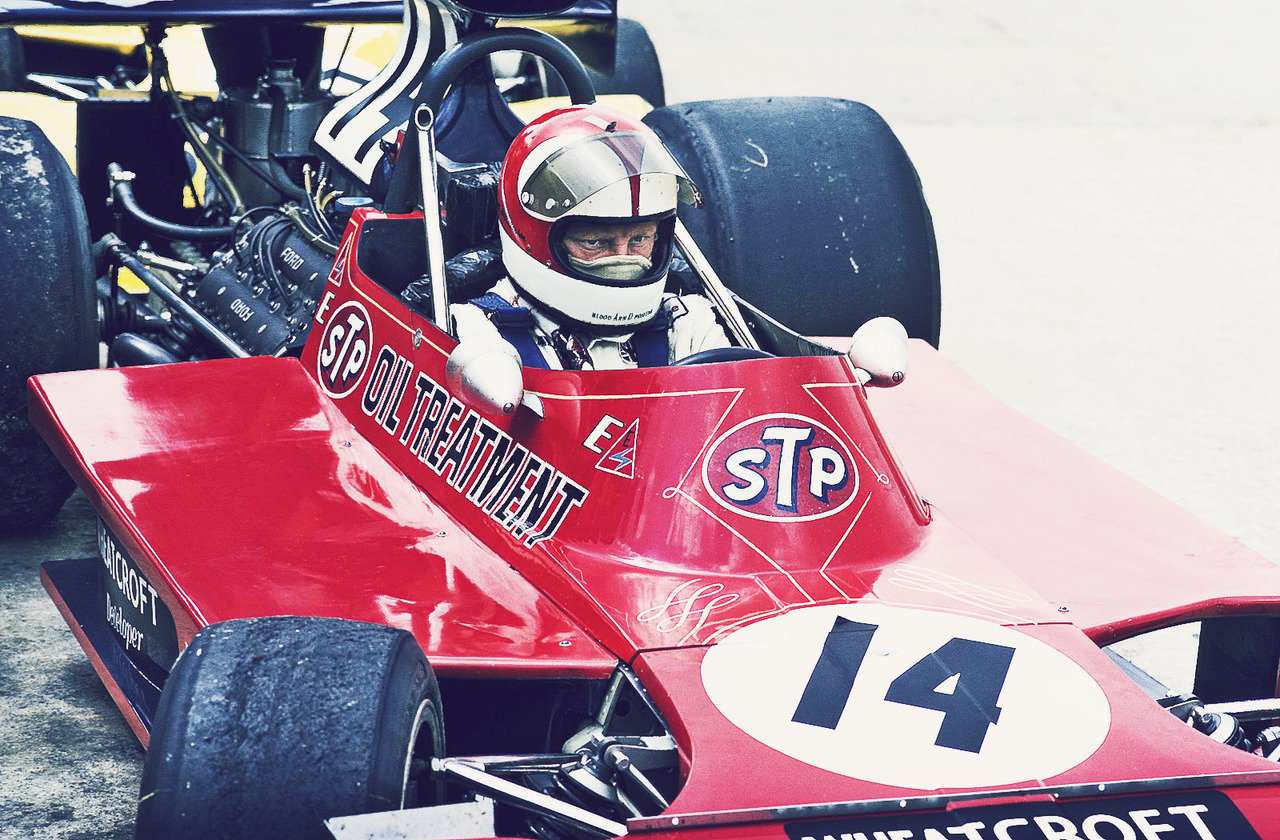
As the flames began to engulf Williamson's car, Purley ran to help his friend and fellow driver. Track officials were pathetically inept and ill-prepared. A couple of Keystone Kop type characters jogged over to the car but really had no idea what to do or have any equipment to use even if they had been able to figure out what to do. Minutes passed before any sort of rescue truck arrived. Purley tried in vain to flip the car right side up by himself but got no assistance from the course workers. Williamson died while still trapped in his car - though interestingly not from the fire. Instead, he suffocated and must have endured an agonizing death on the track.

TMC

Tuesday, December 20, 2011

1971 Schaefer 500

On July 3, 2010, I blogged about the inaugural 1971 Schaefer 500 Indy car race at Pocono. In combing the web for information about the race, I thought I uncovered some neat photos from the race, a scan of the race program, and some trivia nuggets.

Tonight, however, an extra bonus was made available - a YouTube clip from the race. With Bud Lindemann narrating, the episode does a great job of featuring vacationers in the Pocono Mountains of Pennsylvania and the yeoman's efforts of all involved in finishing construction on the new track so the race could run as scheduled.

A couple of things to be attuned to:
  • 3:36 mark - Soon-to-be NASCAR Hall of Famer Cale Yarborough in his limited time in USAC's Indy cars
  • 6:39 mark - Jim Hurtubise's Miller High Life Mallard
  • Legendary NASCAR announcer and Vermont short-track owner, Ken Squier, on the race call
  • And most of all, Schaefer sponsorship, signage, and consumption.

With Tuesday's announcement that Best Buy will leave the Richard Petty Motorsports #43 car, I'm convinced more than ever the King should pursue Schaefer as his sponsor.

Special thanks to Petty message board poster Stimlad for this requested fictional
I've already got the TV tagline for victory lane:

This is the one race to win when you're winning more than one!

TMC
Edited: 2013-05-28

Thursday, July 29, 2010

July 29 - This day in Schaefer racing history

1972 Schaefer 500
USAC Indy car race
Pocono International Raceway
Pocono, Pennsylvania
Winning driver: Joe Leonard
Full results: Racing-Reference.info

The race was originally scheduled for Sunday, July 2nd. Because of local flooding associated with Hurricane Agnes, Pocono agreed to postpone the race after consulting with state and local officials. USAC officials got their panties in a wad because they believed the sanctioning agreement gave THEM complete control over the go/no go decision. Their knee jerk reaction was to say the track forfeited the date as well as cash for guaranteed purse money. Fortunately cooler heads prevailed, and the race was rescheduled for the last weekend of July.

Source: Reading Eagle via Google News Archive
The front row of Bobby Unser, Gordon Johncock and Mario Andretti.

The winner of the race, Joe Leonard, was the reigning USAC Indy car champion. He would go on to win the championship again in 1972. One would think this win would register higher on the scale of photos being snapped and available.

Source: Bernie427 at Randy Ayers Modeling Forum
Source: Reading Eagle via Google News Archive
By reading as many articles as I can find, I think I've found two likely reasons why photos of Leonard's winning the race are scarce.
  • The race was rained out on its original date and rescheduled for Saturday, July 29. With the postponement, some writers and/or photographers may not have been able to return for the make-up date.
  • Leonard's win was awarded amidst controversy. He was a teammate of Mario Andretti and Al Unser Sr. Andretti faded late in the race due to fuel problems in the pits. Unser took the checkered flag, but Leonard's team believed Unser committed a pit infraction. Both cars headed to victory lane. It took over an hour for USAC officals to settle things and award Leonard the win. In those days with story submission deadlines looming, its probable writers and photographers submitted what they had - not knowing when things would be resolved.

Source: Eugene Register Guard via Google News Archive
Sports Illustrated ran a feature article in the August 7, 1972, issue.


In a notable Petty-related trivia moment from the weekend, Richard Petty was lured by track promoters to race in the 500-mile stock car portion of the twin bill on Sunday, July 30th. He wasn't much of a factor, and the 43 finished well back in the field.

The STP Plymouth did, however, make the cover of the November 1972 issue of Stock Car Racing magazine.


TMC
Edited June 28, 2014

Saturday, July 3, 2010

July 3 - This day in Schaefer racing history

The Inaugural 1971 Schaefer 500
USAC Indy car race
Pocono International Raceway
Pocono, Pennsylvania
Winning driver: the late Mark Donohue
Full results: Racing-Reference.info

Program and scoring tower photos source: Permission from Frank Hadl at Picassa
Thanks for the pics Frank and especially for your service in Vietnam!
Source: Wikipedia
Source: Toledo Blade via Google News Archive
Source: First Schaefer 500 recap at Motorcaster
Some notables from July 3, 1971:
  • Donohue's win was the first career Indy/Champ car win for car owner, Roger Penske. Gee, I wonder whatever happened to that guy.
  • NASCAR interloper, Cale Yarborough, finished 32nd in a 33 car field.
  • Another NASCAR regular, Donnie Allison, continued his dalliance with Indy cars and finished 18th.
  • Bill Simpson finished 18th. He ended his racer career in 1977 and then turned to a career of innovative racing products. He founded Simpson Performance Products. His most controversial moment came when Simpson products were used in Dale Earnhardt's car when he died at Daytona in February 2001.
  • For those who follow NASCAR's Silly Season on Jayski.com regularly like I do, Donohue was Jay's favorite driver back in the day.
TMC
Edited 2011-12-21: For video clips from the race, jump to this post.

Thursday, July 1, 2010

July 1 - This day in Schaefer racing history

1973 Schaefer 500
USAC Indy car race
Pocono International Raceway
Pocono, Pennsylvania
Winning driver: "Super Tex" A.J. Foyt
Full results: Racing-Reference.info

Road course legend Peter Revson surprised the oval racing bunch by laying down the quickest qualifying lap to nab the pole.

Source: Spartanburg Herald via Google News Archive
An interesting entry was Mel Kenyon. The long-time USAC midget racer also ran in several Indy car races so his driving a car wasn't that surprising. His sponsor, however, was a bit interesting for the times: the Atlanta Falcons NFL team. Kenyon's car owner, Lindsey Hopkins, was a minority investor in the franchise.

Though I'm uncertain if the Falcons sponsorship was the first in motorsports for the NFL, it certainly preceded the NFL's associate sponsorship of Joe Gibbs Racing's NASCAR team by two decades.

Credit: illeagle10
Credit: jkacing50 on Flickr
Source: Observer-Reporter via Google News Archive
The front row of pole winner Revson, second place starter Al Unser and third place starter Mario Andretti.

Credit: National Speed Sport News
A.J.'s car being pushed from the track to the paddock.

Credit: illegale10
The first half of the race saw many drivers at the point. In the second half, however, Roger McCluskey was the dominant car leading 62 of the final 100 laps. With a comfortable lead over Foyt on the final lap, McCluskey was headed for victory...until. McCluskey and his team attempted to stretch his fuel load to the end and almost made it...almost. He instead ran out on the final lap, and Foyt was able to pass him for the win. McCluskey's car was unable to even coast around to take the checkers yet still finished second to Foyt albeit one lap down.

Winner celebration FAIL. You win the SCHAEFER 500 - yet you drink champagne in victory lane? C'mon A.J., you shoulda known better than that.

Source: The Victoria Advocate via Google News Archive
But at least a Schaefer did make it to victory lane.

Source: Reading Eagle via Google News Archive
Some notables from July 1, 1973:
  • Jerry Carl finished 26th driving for legendary NASCAR innovator and trickster Smokey Yunick.
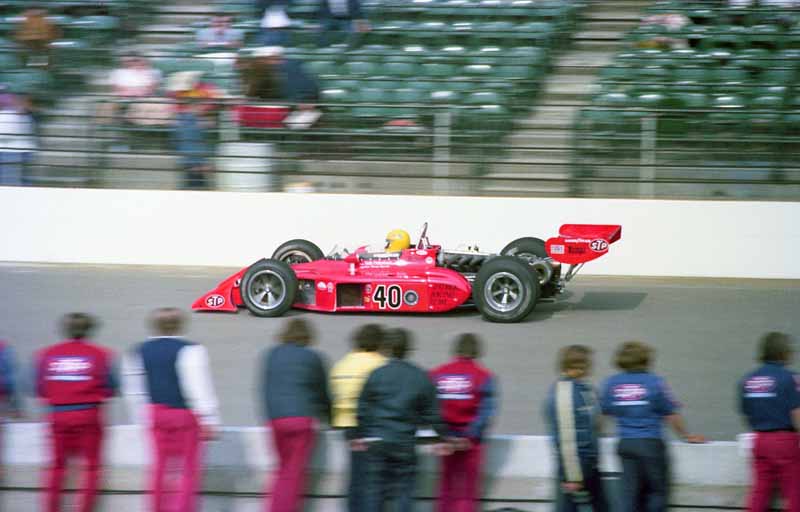
  • Wally Dallenbach finished 29th driving a #40 STP Eagle/Offenhauser (shown below in his 1974 colors at Indy):
Credit: Russ Thompson
  • Two decades later, his son and current TNT announcer, Wally Dallenbach, Jr., found himself driving the #43 Petty Enterprises Pontiac - also sponsored by STP.

Source: Reading Eagle via Google News Archive

TMC
Edited July 1, 2014