Monday, April 13, 2009

Kyle Petty: Shopping for Mikey

Kyle Petty's latest Unleashed on NASCAR.com is pretty funny. Its about his shopping for Michael Waltrip at a fully-stocked grocery store in the infield at Texas Motor Speedway.

Now while it is funny (especially quip at 1:22 mark), I'm not sure Kyle is coming all that 'unleashed'.

Gentlemen, start your buggies!


TMC

Friday, April 10, 2009

Langhorne Speedway Memories

Ryan McGee from ESPN wrote a neat article about memories from the old Langhorne Speedway in Pennsylvania.

The Track That Ate The Heroes

I only learned about Langhorne over the last few years. It was one of the oddest-shaped tracks ever built - an almost perfect circle vs. most other tracks built as ovals (until the Charlotte 'quad-oval' and Daytona 'tri-oval' phases began).

Langhorne's relevance for NASCAR has long been gone. I have learned, however, Lee Petty earned one of his 54 wins there.


TMC

Thursday, April 9, 2009

The Lonely End of The Rink

My Nashville Predators may not make the NHL playoffs. Because of a scoring drought in the middle part of the season resulting in several losses, their playoff fate is now in the hands of other teams. And that is not a comfortable feeling.

However, teams often have mini-playoffs within the regular season. The Preds won their season series with the Wings 4-2. The wins included:
  • 3 Pred wins in a row against the defending Stanley Cup champs
  • an 8-0 beat down of the Wings in Nashville
  • 2 consecutive wins at the Joe including tonight's shootout victory
So for my fellow crew chief banktruck and the goalies of the Detroit Red Wings - Chris Osgood and Ty Conklin, I give you The Tragically Hip's The Lonely End of the Rink...


Spare me the reminder that the Wings are the defending cup champs. I know it & I get it. But over the 10 year history of the Preds, its often hard to talk justifiable trash against the Wings. So I'll take it where I can get it.

TMC

Tuesday, April 7, 2009

Ab Jenkins

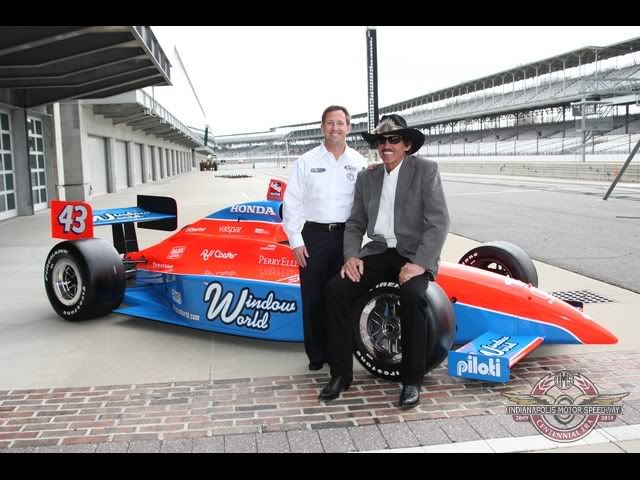
The Petty/Andretti Indy 500 announcement and my reading of Brock Yates' Umbrella Mike book made me recall a treasured memento I had stored away in our fireproof strong box.

In 1991, my Uncle Max sent me a photo card Ab Jenkins gave him in 1938 at Indianapolis along with a hand-written note about his memories of that month of May. Uncle Max passed away only a couple of years later, and I feel fortunate to be able to still have this memory of him.

In case you can't read the letter, here's the text of it.
April 10, 1991 - You may have forgotten that I promised to give you the card Ab gave me in Indianapolis in May 1938. Well, here it is. I worked in a Bar-B-Que stand and fed many of the racers and their associates in the weeks before the race. Three of them were the winner that year, Floyd Roberts, his car owner Lou [Moore] and his mechanic Lou Webb. Those three had to scratch for living money before that race but the owner had some top finishes, including at least one winner, in subsequent years. Floyd was not so lucky – he was killed in the 1939 race. Sorry it took so long to keep my promises. Love & best wishes to you both. Uncle Max
At the time he sent me the letter and picture, I was certainly surprised. Even at his old age, I think his memory was better than mine in my 20s at the time. His letter references a promise he made to get this card to me and apologizes for not having sent it earlier. Yet, I don't recall when he even promised to send it to me! It may have been at my cousin's wedding. Who knows.

Because I was grateful to have the picture and the note and because his memory was so sharp, I didn't bother to do any fact checking to see if he was right. Plus, the internet wasn't exactly up and running full speed back in 1991.

But in looking at the contents of his letter and doing some research, he was dead on with all his details. Ab Jenkins was indeed a world-speed setter in his day. I found a couple of articles about his Bonneville speed runs in his Mormon Meteor.
I also found a couple of on-line pictures - one of which seems to be the same car as in the 1938 photo card Uncle Max sent me.

And Jay Leno with a restored, later-version Mormon Meteor.

As for Floyd Roberts, he won the 1938 Indy 500 and was then killed in the subsequent year's race - just as my uncle noted. Brock Yates included an account of Roberts' tragic accident in his book Umbrella Mike. Roberts had swerved to miss another spinning car. In doing so, his car flipped over the fence, landed upside down, and his neck was broken killing him instantly.

The only discrepancy I found in Uncle Max's memory of the 1938 race was his reference to Lou Webb as the mechanic. From what I can tell, Lou Moore was the car owner as well as the chief mechanic.

Nonetheless, I'm glad I remembered I had this piece of history and actually knew where I had it stored!

TMC

Book Review: Umbrella Mike

It was kind of neat with the timing with Monday's Petty/Andretti announcement about their planned Indy 500 effort because I just completed a book about old school Indy.


The book is Umbrella Mike: The True Story of the Chicago Gangster Behind the Indy 500 by Brock Yates. Yates cred is well established - executive editor of Car & Driver magazine, TV commentator for several Cup races back in the late 70s and 80s, and screenplay writer for Cannonball Run and Smokey & The Bandit. So the book definitely caught my attention based on the subject and its author.

While I feel like I can hold my own in talking NASCAR racing, I admit I know little about the history of the Indy 500. As a kid, I knew the drivers of that era - A.J., Mario, Gordon Johncock, Johnny Rutherford, the Unser brothers, Rick Mears, and a handful of others. Later, I knew who drivers like Danny Sullivan and Bobby Rahal were. And of course today we have Scott Dixon, Danica, Franchitti, Dan Wheldon and Tony Kanan. But I know virtually nothing about drivers pre-1960 - buys like Billy Vuckovich, Louie Meyer, Roger Ward, Wilbur Shaw, and the like.

The story was really a neat one. Yates did a nice job introducing the drivers, owners, and mechanics of the mid 30s to early 40s. And its obvious he did his research to write the book.

Without giving away all of the key details of the book, a few nuggets of info I learned that made me shake my head were:
  • Unlike today's Indy or NASCAR race cars which are often built for a unique type of track, could be rendered obsolete in one season, or may be discarded after only one wreck, the Indy cars of the 30s were often run a decade or more and at different types of tracks.
  • With today's advances in safety technologies, fans, media, and competitors are all shocked at those infrequent events when a driver is killed. However, from the 20s through the 40s, about one-third of drivers competing regularly in the 500 could expect to be killed - a startling, morbid, statistical reality of the early days of auto racing.
  • The Indy 500 ran throughout the 1930s despite the Great Depression that strangled much of America. The costs of fielding an entry and the purse and promotional rewards for the winner were shockingly high relative to the struggles of many in the country. Only the U.S.'s involvement in World War II in late 1941 interrupted the 500 from 1942 through 1945.
However, the book suffers from a couple of notable flaws:
  • I think Yates must have self-edited his book. He repeats himself frequently. Also, each chapter starts with a theme but frequently jumps off on a tangent - sometimes dropping in details from an event decades ahead or behind because of one lead-in sentence.
  • The title of the book leads the reader to believe it will be about Michael "Umbrella Mike" Boyle - head of the International Brotherhood of Electrical Workers labor union in Chicago - and his quest to win the 500. Yates introduces Boyle, talks about his Irish heritage, and notes the power he established in Chicago as a union boss. But he never really addresses the reasons for Boyle's passion for winning the 500. Nor does he answer some key questions such as how he managed to funnel his ill-gotten gains through his position to his race teams (although Yates does note that the FBI routinely investigated Boyle). In all fairness to Yates though, I'm guessing minute details about the life and happenings of a fraudulent, criminal union boss in Chicago in the same era as Al Capone aren't exactly available by the wheelbarrow load.
Boyle accomplished his goal by winning the Indy 500 three times. Wilbur Shaw drove an Italian Maserati to two of the wins in 1939 and 1940. (The story of how Boyle got the Maserati to the U.S. during the rise of fascism in Italy is a fascinating part of the book.) Today, Shaw's winning Maserati sits in the Indy 500 museum.


Despite some of the editing flaws, I do recommend the book. Its still a far better book than most books about NASCAR I've read over the last three decades.

TMC

Thursday, April 2, 2009

Texas Traditions

In 1997, my bro-in-law hooked me up with freebs to the inaugural Busch and Cup races at the new Texas Motor Speedway. I was working in Terrell, Texas the week before the race. So my travel expenses to get there were covered. I stayed with my sister and bro-in-law, he got comps on the tickets, he bought my dinner, the brews were covered with the hospitality, he got me pit passes, AND he arranged for a Sunday morning pre-race ride in a motorcade of Monte Carlos on the track. I don't think I spent a nickel of my own all weekend - a rare, perfect race weekend.

The area was hit with a deluge of rain in the days leading up to race weekend, and the parking lots were like a Florida swamp. But on race days, the skies were fine and we were ready to go racing.

Ricky Craven crashed...hard...during practice for the race. He suffered a head injury that took him a long time to recover. A Bodine - Todd - was chosen to fill his seat for the weekend.

Jeff Burton won his first Cup race that weekend in Jack Roush's 99 Exide Ford. The Cat in the Hat has had more than his share of success at TMS ever since.

While we were glad to see a first time winner, most of his competition got wiped out after only a quarter lap of racing. Darrell Waltrip and Johnny Benson barreled down nose to tail into turn 1 of the 1 groove track - but they didn't make it out together. DW was turned & about half the field piled in behind him. It was as if TMS wanted its own Texas-sized version of a Talladega Big One.


Eddie Gossage and Bruton Smith worked on the track a couple of years later and fixed it for much better multi-groove racing. I think the drivers genuinely enjoy racing there now vs. their dislike of it when it first opened.

But while Gossage fixed the track, he created another beast in its place - the traditional cowboy hat and fake six-shooters in victory lane. There have been some real 'winners' over the years. Some of these drivers look about as much like a cowboy as Vanilla Ice resembled a rapper. Heck, Eddie even makes the Indy guys wear the hats! Here's a sampler.


There simply has to be a better, less humiliating way to celebrate a hard earned victory in the state of Texas.

Update 2009-04-06: Well, I guess there's not a a better, less humiliating way...


TMC

Wednesday, April 1, 2009

Alan Kulwicki

December 14, 1954 - April 1, 1993

The Underbird did it his way. I was fortunate enough to see him start from the pole at Atlanta in 1991 in his first race with Hooters as his sponsor. And I was fortunate enough to be at Atlanta again in November 1992 when he led the most laps, traded the lead with Bill Elliott, finished 2nd, and won the Winston Cup championship. Many have suggested the 1992 Hooters 500 was the greatest NASCAR race of all time - the Kulwicki/Elliott/Davey Allison championship battle, Richard Petty's final race, and Jeff Gordon's first Cup race.

It was so bizarre to hear on April 1, 1993, that Alan was gone. Killed in a plane crash returning to Bristol, TN from an autograph-signing session in Knoxville the night before. The reigning Winston Cup champ - gone - less than 6 months after his triumph. 

Alan in garage pre-race - Atlanta - Spring 1992

Alan and The King headed to starting positions - Charlotte - Fall 1992

TMC